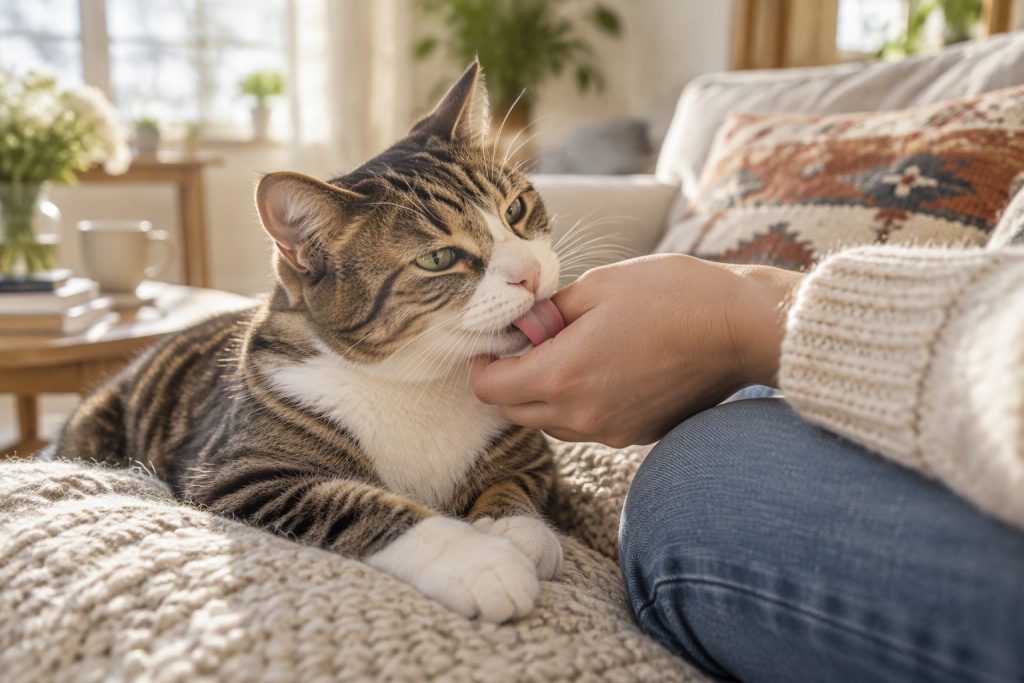
Cats lick their people for several overlapping reasons: affection, grooming, scent-marking, and sometimes comfort or stress relief. It is usually a warm, social behaviour rather than a problem, especially when it comes with relaxed body language and purring. The exception is when licking becomes compulsive, leaves your skin sore, or comes with signs of illness.
- Licking usually signals affection and bonding.
- It also grooms and marks you with her scent.
- Occasional licking is normal and harmless.
- Compulsive or sore-making licking needs a vet.
Why does my cat lick me?
Licking is one of the most basic social behaviours a cat has, and she uses it on you for the same reasons she would use it on a littermate. Cats groom each other as a form of bonding, and a cat who licks you is treating you as part of her social group rather than as a separate creature. Licking also transfers her scent onto you, which is a quiet way of claiming you as familiar and safe. For many cats, licking is soothing in itself, a repetitive action that calms her when she is content or slightly unsettled. Some cats lick to get attention, having learned that it reliably makes you react, and others lick after a meal or a grooming session as part of settling down. The context and her body language usually make the meaning clear. Some cats also lick a specific person more than others, often the one they are most bonded to.

Rainbow-striped plush cylinder. Keeps a bored indoor cat busy and burns off restless energy. Made from fleece and…
Is licking a sign of affection?
Often, yes. A cat who licks you while kneading, purring, or resting against you is showing the kind of relaxed, trusting behaviour she would reserve for someone she feels close to. Licking during cuddles, particularly on the hands or face, is a common way cats express attachment, and it tends to come with soft eyes, forward ears, and a loose body. Because cats cannot say thank you, these small grooming gestures are one of their main ways of communicating warmth. That said, affection is not the only possible meaning, and a cat can lick for comfort or habit as well. The best way to read it is to look at the whole picture: if she is relaxed and seeking contact, the licking is almost certainly affectionate rather than anything to worry about. If the licking feels like a ritual she repeats at the same times each day, that is usually a sign of comfort rather than concern.
Why does my cat lick me and then bite?
Licking that turns into a bite is usually overstimulation, not a sudden change of heart. Petting feels pleasant at first, but many cats reach a threshold where the same contact becomes irritating, and the licking continues out of habit while the body tenses. Watch for the warning signs: a twitching tail, flattened ears, dilated pupils, rippling skin along the back, or a sudden freeze. When you see those, stop the interaction and let her settle rather than pushing through. If the biting happens during play, she may simply have energy that needs a better outlet, and redirecting her to a toy helps. Learning to end contact a moment before she reaches her limit is the single best way to prevent the lick-then-bite pattern. A short pause is often enough to reset her, and you can then offer gentle head rubs, which most cats tolerate far better than body strokes.
Is licking a grooming or a comfort behaviour?
It is both, depending on the moment. Grooming is a huge part of a cat’s daily routine, and licking you can be an extension of that instinct, a way of tidying and connecting with a member of her group. At the same time, licking is repetitive and rhythmic, which makes it genuinely soothing, and cats often lick when they are content or when they are mildly anxious and trying to self-calm. That is why some cats lick more during stressful periods, such as a move or a change in routine. The two functions overlap, and a single session of licking can be both affectionate grooming and quiet self-soothing. You can often tell which by her overall mood: relaxed and sleepy suggests comfort, while tense or fixated suggests she is working through some stress. If she licks and then relaxes into sleep, you can be confident it is a settling behaviour rather than a symptom.

Cervical pillow, plush hammock, floor mat and paw cushion — four places to nap. Gives a cat a…
Can licking be a sign of a health problem?
Occasional licking is nothing to worry about, but licking becomes a concern when it is compulsive, constant, or causes hair loss and sore skin. Some cats over-groom themselves as well as their people, and that can be driven by stress, allergies, parasites, or pain, so a cat who licks to the point of baldness or skin damage needs a veterinary assessment. Licking you excessively can also be a comfort-seeking behaviour that ramps up when she is anxious or unwell. If the licking comes with other changes, such as hiding, appetite loss, restlessness, or irritability, treat it as a signal to have her checked. Purring does not always mean contentment either, and our article on why cats purr explains why the sound alone can mislead you. A cat can purr while anxious or in pain, so always read the whole cat rather than the sound alone.
How do I stop excessive licking?
If the licking is affectionate and harmless, you do not need to stop it, though you can gently redirect it to a toy or a blanket when it becomes too much. If it is attention-seeking, avoid rewarding it with a big reaction, and instead offer play or a puzzle feeder so she has another outlet. For cats who lick to self-soothe, reducing stress helps: keep routines predictable, provide vertical space and hiding spots, and give her daily play. If she licks herself to the point of sore skin, or if the behaviour feels compulsive, see your vet rather than relying on distraction alone. Understanding the drive behind the behaviour makes it far easier to respond well, and our guide to why cats knead covers another comforting behaviour that often appears alongside licking. Kneading, like licking, is a leftover from kittenhood that many cats keep for life as a sign of contentment.
Frequently asked questions
- Why does my cat lick my hand? It is usually affection or grooming, a way of bonding and marking you with her scent as someone familiar.
- Is it bad if my cat licks me a lot? Not usually, but compulsive licking or licking that leaves your skin sore can point to stress or a health issue.
- Why does my cat lick me at night? Night-time licking is often comfort-seeking or a wind-down behaviour, especially if she is settling near you to sleep.
- Does cat saliva cause problems for people? For most people it is harmless, but if you have allergies or broken skin, wash the area and take care.
- Should I let my cat lick my face? Many owners do, but if you are immunocompromised or your cat is unwell, it is safer to keep licks to your hands.