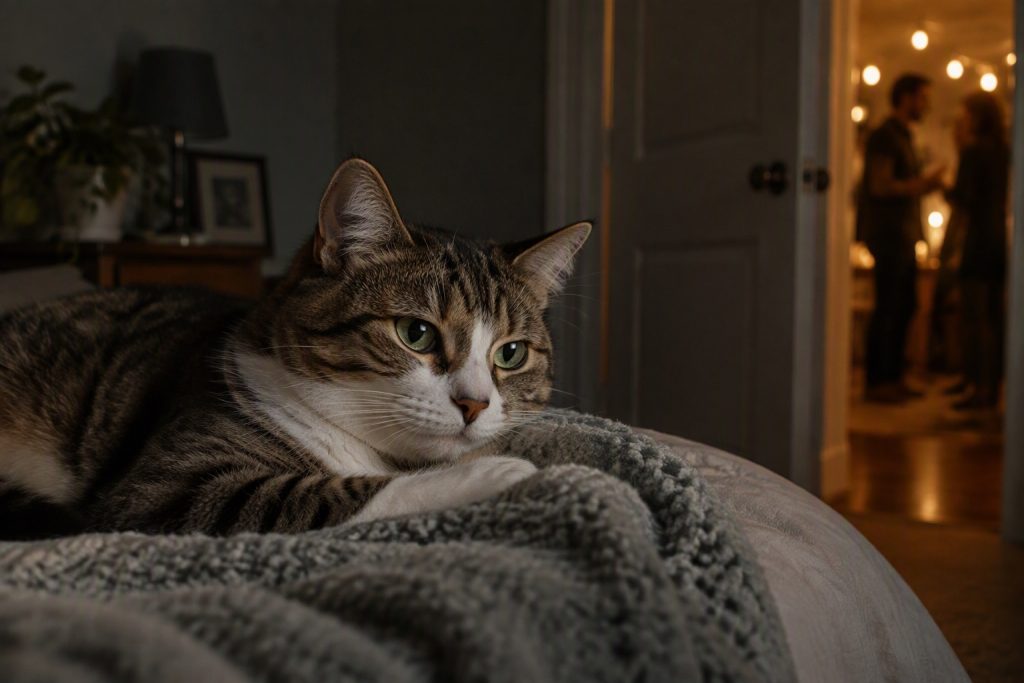
Halloween night is predictable, which is exactly what makes it manageable. The doorbell will ring repeatedly, strangers will appear in unusual clothes, the door will open and close, and the house will be noisier and brighter than usual. None of that is a problem for a confident cat, but for a nervous one it is a concentrated dose of everything it dislikes. A written plan made in advance turns the evening from a stressful scramble into a routine you can repeat each year, and it takes about twenty minutes to set up before the first knock arrives.
- Plan before the evening, not during it; set up a quiet room well in advance.
- Keep the cat away from the front door to prevent bolting and reduce noise exposure.
- Provide food, water, litter, a bed and a hiding place in the quiet room.
- Do not use sedatives without veterinary advice, and check on the cat during the evening.
What does a nervous cat need on Halloween night?
One room it already likes, as far from the front door as possible, with everything it needs inside. That means food and water in their usual bowls, a litter box, a comfortable bed, and a covered hiding place such as a box or cat hut. Familiar items matter more than new ones, so bring the cat’s own blanket rather than a fresh one. Draw the curtains if there are lights outside, and use a steady background sound such as a radio on low or a fan to mask the doorbell. Set the room up in the afternoon, and put the cat there before the first visitor arrives, because a settled cat copes far better than one moved once the noise has started. A second litter box in the room is worth having if the evening is long.

Round furry plush bed with cat ears on the rim. Made from velvet. Made for everyday resting. Gives…
How do I stop my cat getting out of the front door?
Use layers rather than relying on the cat’s restraint. The most effective setup is a closed inner door or a hallway between the cat’s room and the entrance, so there are two barriers between the cat and the street. If your layout does not allow that, a baby gate across the hallway is easier to manage with full hands. Ask visitors to knock and wait rather than holding the door open, and consider leaving sweets outside so the door is opened less. If the cat is already a known bolter, put it in its room before the first knock and leave it there until the last one. A microchip and a breakaway collar with an ID tag are sensible backup measures, but they are not a substitute for preventing the exit in the first place.
Should I stay with my cat during the evening?
It depends on the cat. A cat frightened by unfamiliar people usually does better alone in a quiet room, because every opening of the door is a disturbance. A cat that is distressed by being separated from its owner may do better with someone sitting quietly in the room for part of the evening. The useful approach is to check on the cat every half hour or so, keep those visits brief and calm, and avoid making a fuss. Do not bring the cat out to meet visitors, even well-meaning ones, because a stranger in a costume is alarming to most cats. If the cat is settled and asleep, leave it that way. If it is pacing, panting or drooling, that is a higher level of distress and worth staying with.
What if my cat is fine with noise and visitors?
Then you can be more relaxed, but not entirely. A confident cat that enjoys company can stay in the main part of the house, provided the front door is managed so it cannot slip out. The usual hazards still apply: sweets and chocolate within reach, dangling decorations, candles in pumpkins, and glow sticks. Even a bold cat can be startled by a sudden mask or a group of loud strangers, so give it a quiet room it can retreat to. Keep an eye on it through the evening rather than assuming it is fine because it usually is, and make sure it has access to food, water and its litter box without having to cross the busiest part of the house. Being sociable is not the same as being immune to a very strange evening.

Deep red plush donut bed. Made from cloth. Supplied in light gray. Made for everyday resting. Gives a…
How do I help a cat that is frightened anyway?
Let the cat hide, and do not try to coax it out. A cat under a bed has made a sensible decision, and pulling it out removes the only control it has. Keep the room dim and quiet, leave food and water within reach, and check without intruding. Do not punish the cat for any accident, and do not raise your voice, because both add to the fear. If the cat is shaking, panting or drooling heavily, or if it has injured itself trying to escape, contact a vet rather than waiting for the evening to end. In the longer term, a cat that reacts this strongly to noise would benefit from a plan put together with a vet before the next event, and the same approach applies to storms, as covered in storm and firework fear.
What should I have ready in case of an emergency?
Have the basics within reach before the evening starts. Know the number of your nearest emergency veterinary clinic, and keep it somewhere you can find quickly. Have the carrier accessible and already familiar to the cat, because a cat that has to be chased into a carrier is far harder to move in an emergency. Keep the cat’s microchip details and any medication in one place. If there are sweets in the house, know where they are and keep them out of reach, because chocolate and xylitol are genuine emergencies and treatment is time-sensitive. If you think the cat has eaten something it should not have, call a vet immediately rather than waiting for symptoms, and never induce vomiting unless a vet tells you to. The wider Halloween hazards are covered in Halloween cat safety.
Frequently asked questions
- Should I put my cat in a room all evening? For a nervous cat, yes. A quiet room with everything it needs is far kinder than the front hall on Halloween.
- Can I give my cat something to calm it down? Not without veterinary advice. Sedatives and supplements are a medical decision, and the wrong product or dose can be harmful.
- Will my cat be upset if I leave it alone? Most nervous cats do better with a quiet room than with the noise and strangers. Check on it regularly and keep visits calm.
- My cat does not seem bothered by Halloween. Should I still plan? Keep the door management and the food hazards in mind. Confidence does not remove the risks of an open door or dropped sweets.
- How do I know if my cat is too distressed? Panting, drooling, pacing, trembling or trying to escape are signs of serious distress. Contact a vet if they do not settle.