

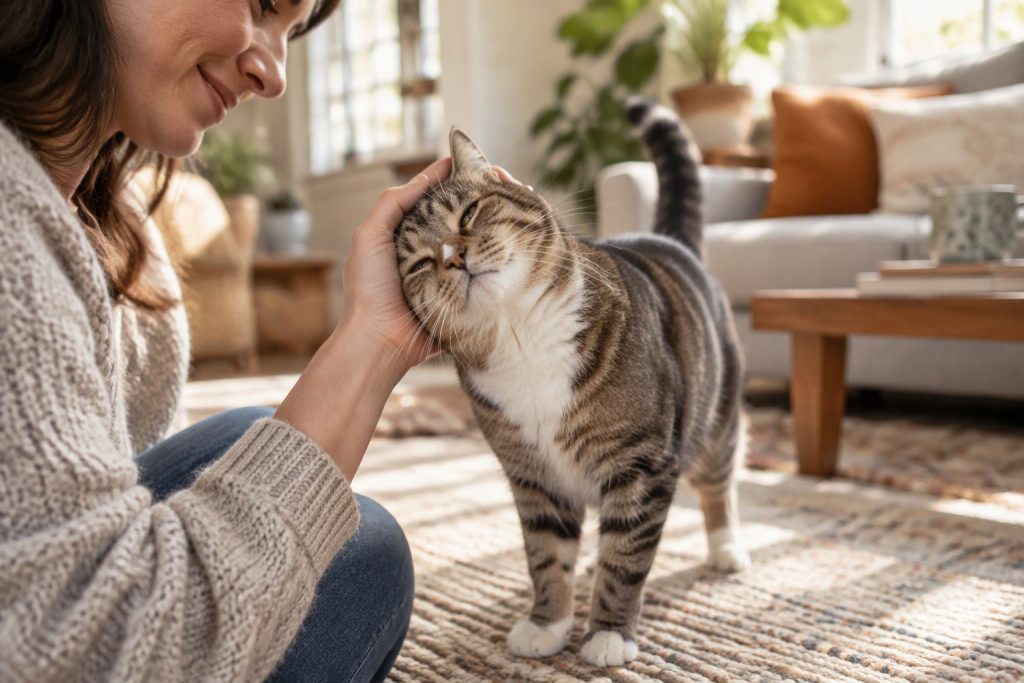
A cat headbutts to greet you, mark you with her scent, and show affection. The behaviour, also called bunting, is a friendly social signal rather than aggression, and it usually means your cat feels safe and bonded to you. When it comes with purring, kneading, or a relaxed body, it is one of the warmest things a cat does.
- Headbutting is a friendly greeting and bonding signal.
- It spreads your cat’s scent onto you.
- It usually comes with relaxed body language.
- Sudden head pressing is different and needs a vet.
Why does my cat headbutt me?
Headbutting is a social behaviour that cats use to greet and bond with familiar individuals. Cats have scent glands on their cheeks, chin, and forehead, and pressing her head against you deposits her scent, marking you as part of her group and as someone safe. It is also a greeting: many cats headbutt when you come home, when they want attention, or when they are happy to see you. The behaviour is reciprocal in cat society, since cats bunt each other as a sign of trust and affiliation, so when she does it to you she is treating you like a member of her social circle. Headbutting can also be a request for petting or food, since cats learn that it reliably gets a response. In almost all cases, it is a warm, friendly gesture rather than anything to worry about.
Rainbow-striped plush cylinder. Keeps a bored indoor cat busy and burns off restless energy. Made from fleece and…
Is headbutting a sign of affection?
Yes, headbutting is generally a clear sign of affection and trust. A cat who presses her head into your hand, your leg, or your face is comfortable enough to make contact and to mark you with her scent, which is an intimate behaviour reserved for those she considers safe. It often comes with other signs of contentment, such as purring, slow blinking, kneading, and a loose, relaxed body, all of which reinforce the friendly meaning. Cats do not waste social gestures on individuals they distrust, so headbutting you is a genuine compliment. That said, the intensity can vary, and a cat who is hungry or wants attention may bunt more insistently. If the headbutting is accompanied by a relaxed posture and soft eyes, you can safely read it as affection. Our article on why cats purr explains another behaviour that often appears alongside it.
Why does my cat headbutt hard?
A hard headbutt is usually just enthusiasm rather than a problem, especially in a cat who is excited to see you or eager for attention. Some cats bunt with real force, and if you are not expecting it, it can be startling or even slightly painful if her head catches your nose or glasses. The force does not change the meaning; it is still an affectionate greeting, just a vigorous one. If the behaviour is uncomfortable, you can gently redirect her by offering your hand for her to bunt at a lower intensity, or by giving her attention before she builds up to a hard press. Some cats bunt hard when they want food or play, so meeting the underlying need reduces the intensity. Only if headbutting is accompanied by other unusual behaviour, such as disorientation or a change in temperament, would it be worth investigating.
Is headbutting the same as bunting or rubbing?
Headbutting, bunting, and rubbing are closely related and often used interchangeably, though there are subtle differences. Bunting describes the behaviour of pressing the head or cheek against something, which is what most people mean by a headbutt. Rubbing is the broader action of a cat pressing her face, cheeks, or body against a person or object, often in a slow, deliberate motion, and it serves the same scent-marking purpose. All three rely on the scent glands around the head and spread a cat’s personal scent onto her territory and her people. Cats may bunt a doorframe, a new piece of furniture, or another cat for the same reason they bunt you: to claim it as familiar and safe. So whether you call it a headbutt or a rub, the function is the same friendly, scent-based communication.
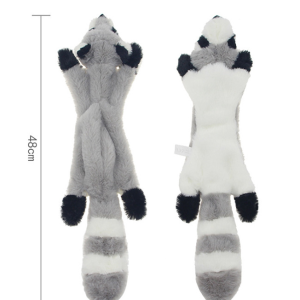
Made from cloth Key features 【Name】 : cat simulation animal sound shell toy[Fill]: No fill, 2 built-in BB…
Why does my cat headbutt objects and other cats?
Cats bunt objects and other cats for the same reason they bunt you: to mark their environment and their social partners with their scent. When she headbutts a doorframe, a chair leg, or a new box, she is adding her scent to it, which helps her feel that the space is hers and safe. When she bunts another cat, it is usually a friendly, affiliative gesture, often seen between cats who have a close bond, such as a mother and her kittens or a bonded pair. It can also be a way of reaffirming a relationship after a separation. If two cats bunt each other frequently, that is a good sign their relationship is relaxed. Bunting a new object is often a cat’s way of investigating and claiming it, which is why a new bed or carrier quickly gets a good rub from a curious cat. Our guide to why your cat follows you everywhere covers another common bonding behaviour.
When is headbutting a sign of a problem?
Friendly headbutting is normal, but head pressing is different and can be serious. If your cat stands and presses her head firmly against a wall, furniture, or the floor for long periods, seemingly unable to stop, that is not affection and can indicate a neurological problem, pain, or another medical condition. Head pressing of this kind warrants prompt veterinary attention. Also see your vet if headbutting is sudden and new in an older cat, if it comes with disorientation, circling, changes in behaviour, or if she seems to be in discomfort when her head is touched. A cat who avoids head contact when she used to seek it, or who flinches when you touch her head or ears, may have dental pain, an ear infection, or another issue. When head behaviour changes alongside any other symptom, treat it as a health question rather than a personality quirk.
Frequently asked questions
- Does headbutting mean my cat loves me? It is a strong sign of affection and trust, especially when it comes with purring, kneading, and a relaxed body.
- Why does my cat headbutt my face? Your face is a prime spot for scent-marking and greeting, so a face bunt is an intimate, friendly gesture from a bonded cat.
- Is headbutting a dominance thing? No. Headbutting is an affiliative, social behaviour, not a display of dominance over you.
- Why does my cat headbutt my hand for pets? She is asking for attention and marking you at the same time, and most cats take a bunt as an invitation to stroke the head and cheeks.
- Should I worry if my cat presses her head against the wall? Yes. Head pressing against hard surfaces is different from headbutting and can signal a medical problem, so see your vet.





