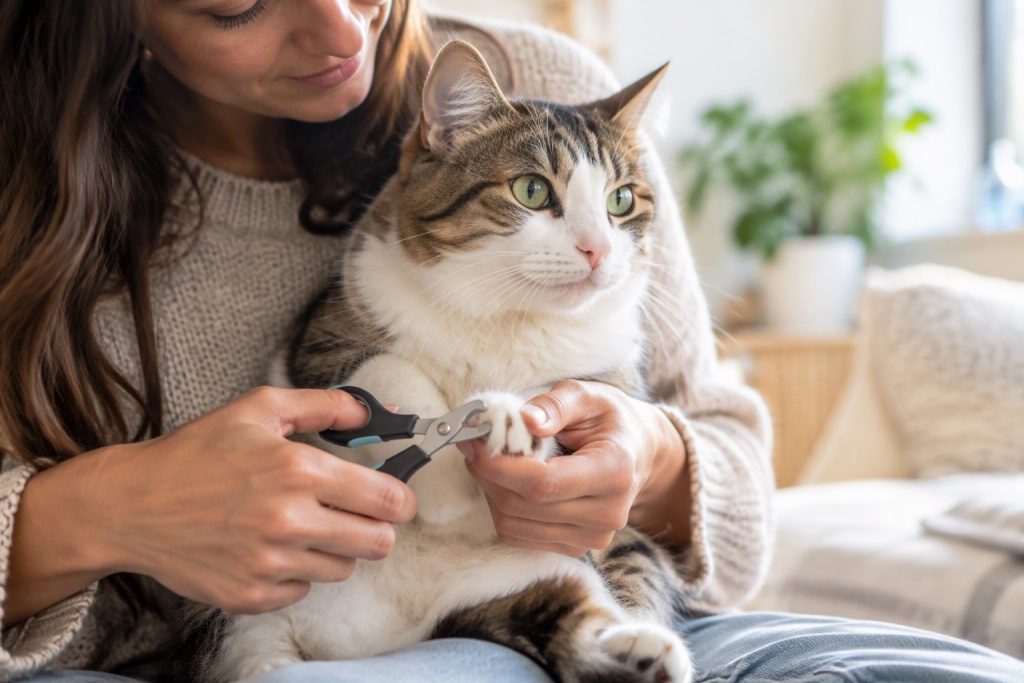
The best cat nail clippers are sharp, sized for a cat, and comfortable in your hand, because a clean cut with minimal fuss keeps the job quick and stress-free. Look for stainless-steel blades that meet precisely, a non-slip grip, and a size suited to small claws. Scissor-style clippers suit most owners, while guillotine styles can work for very small claws, and blunt or oversized tools risk crushing the nail rather than cutting it.
- Choose sharp, cat-sized stainless-steel blades.
- Scissor clippers suit most owners and cats.
- Blunt blades crush nails and cause pain.
- Replace clippers when they stop cutting cleanly.
What should I look for in cat nail clippers?
The most important qualities are sharpness, size, and control. Cat claws are small and curved, so a clipper designed for dogs will often be too large and awkward, leaving you unable to see the quick or position the blade accurately. Look for stainless-steel blades, which hold an edge and resist rust, and check that the two cutting edges meet flush when closed, since a gap crushes the nail instead of slicing it. A non-slip handle matters because claws are wriggly, and a lightweight tool is easier to manage one-handed while you hold a paw. Ergonomic grips reduce hand fatigue if you have several cats. Safety guards, which limit how much nail you can cut, are helpful for beginners. Finally, consider how easy the clipper is to clean, since nail dust and debris build up. A good tool should feel precise, not bulky, and should cut with light pressure rather than a squeeze. Our guide on how often to trim cat claws helps you plan the routine around your tool.
A plastic dematting comb clears the loose hair before it lands on the furniture. Use it before the…
Scissor or guillotine clippers, which is better?
Both styles have loyal users, and the right choice depends on your cat’s claws and your confidence. Scissor-style clippers, also called plier or bypass clippers, work like scissors with two blades that pass each other, giving a clean, controlled cut. They are the most popular choice for cats because the small size and the open blade let you see the quick clearly, and they suit both thick and thin nails. Guillotine clippers, where the nail passes through a ring and a single blade drops down, are compact and can be easier for very small claws, but they can crush thicker nails and the blade is harder to see around. For most owners, scissor clippers are the safer bet, especially with a safety guard. Our comparison of scissor versus guillotine clippers looks at the trade-offs in more detail. Whichever you choose, the blade must be sharp and fit the nail snugly.
How sharp should the blade be?
Sharp enough that a single, gentle squeeze cuts cleanly through the nail without cracking, splitting, or crushing it. A sharp blade is not just a convenience; it is a welfare issue. When blades dull, they compress the nail before cutting, which is uncomfortable and can splinter the claw, and a cat who has one painful trim will remember it and resist the next. You can tell a blade is dull when you need to squeeze hard, when the nail frays, or when you see a white, crushed edge on the cut surface. Most cat clippers are not designed to be resharpened easily, so replacement is usually the answer. Keep the blades clean and dry, and store the clipper somewhere it will not be knocked about, since a nick in the edge ruins the cut. If you trim many cats, a spare pair is worth having so you always have a sharp tool on hand.
Do I need a nail file or grinder too?
Not always, but both can help. After clipping, a nail file or a fine emery board can smooth the sharp edge that remains, which is useful if your cat kneads you or scratches furniture. Filing takes only a few seconds per nail and reduces the chance of snagging. Electric nail grinders, which sand the nail down gradually, are popular with some owners because they leave a rounded tip, but many cats dislike the noise and vibration, and they require careful use to avoid catching fur or skin. If you choose a grinder, introduce it slowly with the power off, reward calm behaviour, and keep sessions very short. For most cats, a sharp clipper plus a quick file is enough. If your cat has very thick nails or a medical condition affecting the claws, ask your vet whether a grinder is appropriate before trying one.
Nail scissors, bath brush, de-shedding glove and a drying towel — the full groom in one box. Cuts…
How do I keep a cat still while clipping?
Work with your cat’s temperament rather than against it. Choose a time when she is relaxed and a little sleepy, and clip one or two nails at a time rather than insisting on all of them in one go. Many owners find it easiest to sit on the floor with the cat on their lap or between their legs, holding one paw gently and pressing the pad to extend a claw. Speak softly, keep sessions short, and pair each trim with a treat so the clipper becomes a predictor of something good. If your cat struggles, wrap her loosely in a towel with one paw out, and stop the moment she becomes distressed. Never force it, as a bad experience sets you back. For a cat who truly will not tolerate clipping, ask your vet or a groomer for help, and space sessions sensibly rather than trying to do everything at once.
How often should I replace clippers?
Replace them when they stop cutting cleanly, which for a typical household is every year or two with regular use, and sooner if you trim several cats. There is no fixed expiry, so let the blade tell you: if you are squeezing harder, if the cut looks ragged, or if your cat flinches, it is time. Rust, a loose pivot, or blades that no longer meet are also signs to replace. Keeping the clipper clean and dry and storing it closed will extend its life, and occasional oiling at the pivot, if the manufacturer allows, keeps the action smooth. Because a dull blade is the most common cause of a stressful nail trim, a fresh pair is a cheap upgrade. If you are unsure whether yours is still sharp, test it on a piece of thick paper; a sharp blade slices cleanly, while a dull one tears. Replace rather than persevere.
Frequently asked questions
- Can I use human nail clippers on my cat? They can crush the nail; cat-specific clippers are far safer.
- What if I cut the quick? Apply styptic powder or pressure, stay calm, and call your vet if bleeding continues.
- Are electric clippers better? They suit some owners, but many cats dislike the noise; sharp manual clippers are fine.
- Do indoor cats need claw trims? Often yes, because they wear claws down less than outdoor cats.
- How much nail should I cut? Only the clear, curved tip, well in front of the pink quick.