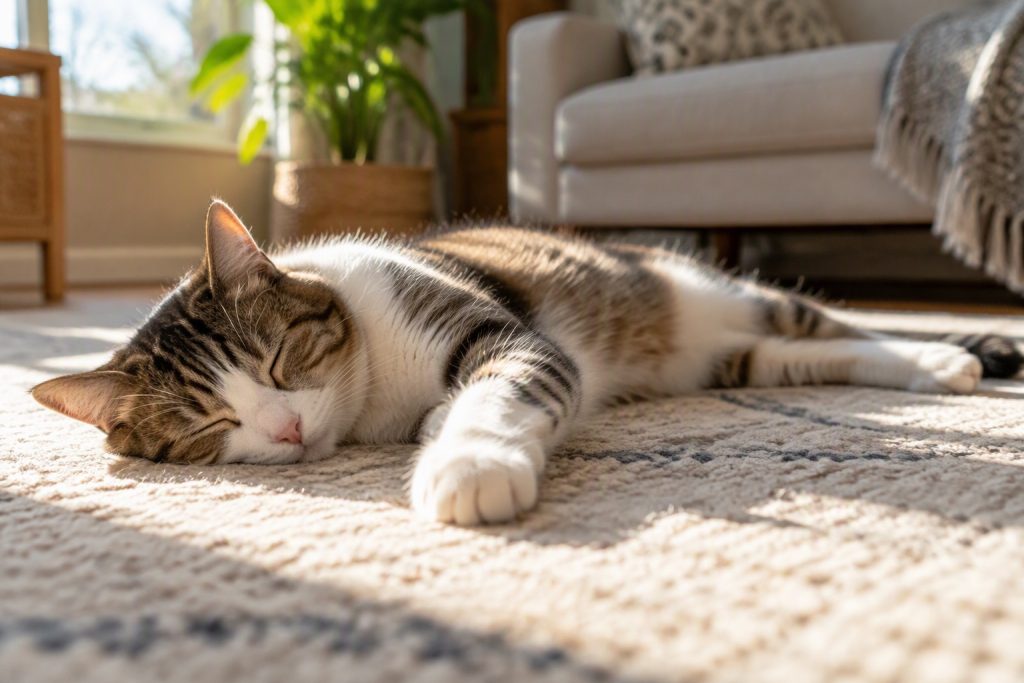
Cats sleep a great deal, often twelve to sixteen hours a day, and much of that happens during daylight, so a cat who seems to sleep all day is usually behaving normally. Cats are crepuscular, most active at dawn and dusk, and they nap in short cycles rather than one long sleep. It only becomes a concern if the sleeping is new, excessive, or comes with other signs of illness.
- Cats normally sleep twelve to sixteen hours a day.
- Much of it is daytime napping.
- Boredom can increase sleeping.
- A sudden increase with other signs needs a vet.
Is it normal for a cat to sleep all day?
Yes, in most cases. Cats are built to sleep in short bursts throughout the day and night, and a healthy adult cat may spend the majority of the daylight hours resting. Their natural activity peaks are at dawn and dusk, when their prey would be most active, so midday is prime napping time. A cat who sleeps a lot during the day but is alert, playful, eating well, and active in the evening is perfectly normal. Indoor cats often sleep more than outdoor cats, because their environment is safe and predictable and they expend less energy. Kittens and senior cats sleep more than adults, and a cat who is bored or under-stimulated may sleep simply because there is nothing else to do. What matters is the pattern and the overall picture. If she is bright and interactive when awake and her appetite and habits are unchanged, daytime sleeping is not a problem. Our article on why cats sleep so much explores the reasons in more detail.

Cervical pillow, plush hammock, floor mat and paw cushion — four places to nap. Gives a cat a…
How much do cats actually sleep?
The commonly quoted figure is twelve to sixteen hours a day for an adult cat, though this varies with age, health, and lifestyle. Kittens can sleep up to twenty hours, since growth and development demand it, and senior cats often sleep more as their activity levels decline. Cats sleep in cycles, moving between light sleep and deeper sleep, and they wake easily, which is why a napping cat may respond to the smallest sound. Much of their sleep is what is called polyphasic, meaning spread across many short periods rather than one long block. A cat may doze for fifteen minutes, wake, stretch, eat or use the litter box, then settle again. This pattern is normal and healthy. The exact number matters less than the quality of her waking hours. A cat who sleeps sixteen hours but is alert, curious, and playful when awake is fine, whereas a cat who sleeps constantly and seems dull or unresponsive when awake may have a problem.
Why do cats sleep so much during the day?
Several factors drive daytime sleeping. The first is instinct: cats are crepuscular hunters, wired to be most active at dawn and dusk, so the middle of the day is naturally a rest period. The second is energy conservation. Hunting is energetically expensive, and resting between bursts of activity is efficient. The third is environment: indoor cats have food delivered, no predators to avoid, and limited space, so they have less reason to be active and may simply sleep out of boredom. Warmth also encourages sleep, which is why cats seek sunny spots and radiators. Age plays a role, with kittens and seniors sleeping more. Finally, if a cat is left alone all day with little stimulation, sleeping becomes the default activity. Providing play, enrichment, and interesting spaces can shift some of that daytime sleep into activity, which is often better for her wellbeing. Our article on whether cats need beds covers how to make rest spots comfortable.
When does daytime sleeping become a problem?
It becomes a problem when it represents a change or comes with other signs. See your vet if your cat is suddenly sleeping much more than usual, if she seems lethargic or hard to rouse, or if the extra sleeping is accompanied by appetite loss, weight loss, vomiting, diarrhoea, or hiding. Increased sleeping can be an early sign of illness, pain, or, in older cats, a condition such as hyperthyroidism, kidney disease, or arthritis. A cat who sleeps all day and is restless all night may have a disrupted routine or a medical issue. Depression and stress can also reduce activity. Conversely, a cat who sleeps a lot but is bright, eating, and interactive when awake is usually fine. The key is comparing her current behaviour with her normal baseline. Because cats hide illness well, a persistent change in sleep patterns is worth mentioning at a vet visit rather than assuming it is just age.

A thickened cloth bed is stepped into rather than climbed over. Try it near the window first, then…
How do I keep my cat awake and active during the day?
If you want her to be more active in the day and sleep better at night, build a routine that matches her instincts. Offer interactive play sessions, especially in the morning and evening, using a wand toy that lets her stalk and pounce, and end with a catch so the hunt feels complete. Feed her after play, which mimics the natural hunt-eat-groom-sleep cycle and encourages settling afterwards. Provide food puzzles and treat-dispensing toys to keep her mind busy while you are out, and rotate toys to maintain novelty. Add vertical space, such as cat trees and window perches, and a bird feeder outside a window for passive entertainment. A little environmental enrichment goes a long way. If she is alone for long hours, consider a timed feeder or a camera that dispenses treats. Avoid waking her constantly, which causes stress; instead, create reasons for her to be active. A well-stimulated cat often self-regulates and sleeps more at night.
When should I see a vet about excessive sleeping?
Book a vet visit if the increase in sleeping is new, marked, or accompanied by any other change. Warning signs include lethargy, reluctance to move, hiding, appetite or weight changes, vomiting, diarrhoea, increased thirst or urination, and a cat who seems painful or irritable when touched. In older cats especially, more sleeping can be the first sign of an underlying condition such as arthritis, kidney disease, hyperthyroidism, or dental pain. Seek prompt care if she is difficult to rouse, unresponsive, or seems weak, since that can indicate something more urgent. If the cause turns out to be behavioural, such as boredom or a disrupted routine, your vet can still help rule out medical issues first. Never assume a big change in sleep is simply ageing. A quick check-up is a reasonable, low-risk step, and early treatment of any underlying problem usually makes a real difference to your cat’s comfort and quality of life.
Frequently asked questions
- How many hours a day do cats sleep? Typically twelve to sixteen, with kittens and seniors sleeping more.
- Is it normal for a cat to sleep all day and be awake at night? It can be, since cats are crepuscular, but a disrupted routine can be improved.
- Why is my cat suddenly sleeping more? It can be boredom, but also illness or pain, so a vet check is wise.
- Does a cat sleeping a lot mean she is depressed? Sometimes, but illness and boredom are more common; see your vet if it is new.
- Should I wake my cat during the day? No, avoid constantly disturbing her; provide enrichment so she chooses to be active.