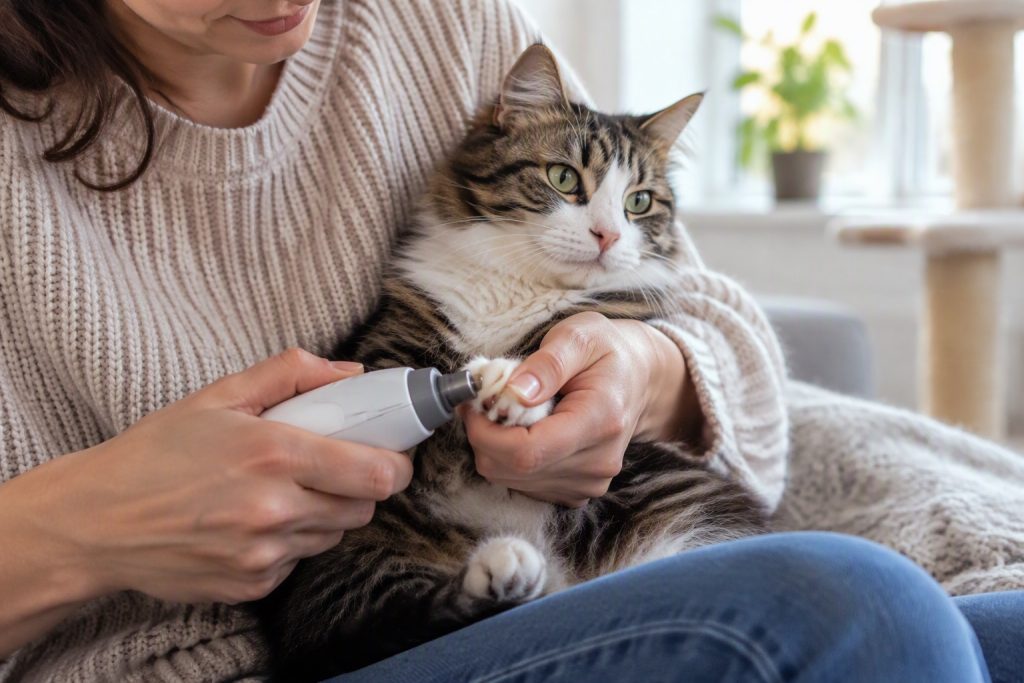
A nail grinder is a good choice for cats who panic at the sound or squeeze of clippers, because it removes the claw tip gradually instead of cutting it. The best grinder for a cat is quiet, low-vibration, cordless, and fitted with a fine sanding drum rather than a coarse one. It is slower than clipping, so it suits owners who can work in short, calm sessions rather than in one go.
- Choose a quiet, low-vibration, cordless grinder.
- A fine drum removes less claw per pass.
- Short sessions beat long ones for nervous cats.
- Never grind past the pink quick.
Are nail grinders better than clippers for cats?
Neither is universally better, but they suit different cats and different owners. Clippers remove the claw tip in a single, quick cut, which is faster and often easier for a cat who tolerates handling but dislikes noise. Grinders work by abrasion, so they take longer but leave a smooth, rounded tip with no sharp edge, and many cats find the sensation less alarming than the pressure of a blade. Grinders are especially useful for thick or brittle claws that tend to splinter when cut. The downside is noise and vibration, which some cats find far more frightening than clippers. If your cat is noise-sensitive, a good pair of clippers may genuinely be the better tool. Our guide on the best cat nail clippers compares scissor and guillotine styles, and many owners end up owning both tools for different situations.
A plastic dematting comb clears the loose hair before it lands on the furniture. Use it before the…
What should I look for in a cat nail grinder?
Noise is the first thing to check, because a loud motor defeats the purpose. Look for a grinder rated at a low decibel level, and read reviews from cat owners specifically, since dog-sized grinders are often too loud and too powerful. Vibration matters almost as much: a grinder that buzzes hard against the claw startles cats. Cordless operation is important, because a cord limits your movement and can tug unexpectedly. Choose a model with a fine-grit sanding drum, adjustable speed, and a safety guard that stops hair and skin from catching. Battery life should cover several sessions, and the drum should be replaceable. A small, lightweight body is easier to hold at the odd angles cats’ paws require. Finally, check that the drum can be swapped without tools, since a worn drum slows the job and heats up. If you have more than one cat, a second drum or a spare grinder saves you stopping mid-session to swap parts, and a grinder that overheats is one you will start avoiding.
How quiet does a grinder need to be?
Quieter is always better, and for cats the practical target is a motor you can barely hear from a metre away. Cats have sensitive hearing and often react to the pitch as much as the volume, so a high-pitched whine can be more alarming than a low hum. If you can run the grinder in one room and your cat does not startle in the next, that is a good sign. Some models offer two speeds, and the lower setting is usually quieter and sufficient for a cat’s thin claws. You can also reduce the impact by turning the grinder on briefly while your cat is relaxed and feeding, so the sound becomes background noise before it is ever associated with her paws. If she still flees, a silent tool such as clippers may simply be kinder.
How do I introduce a grinder without stress?
Desensitisation takes days, not minutes, and rushing it is the main reason cats learn to hate the tool. Begin with the grinder switched off, letting your cat sniff it while you offer treats, and repeat until it is unremarkable. Next, turn it on nearby for a second or two while she eats, then switch it off, building up the duration slowly. Then touch the handle to a paw without grinding, and reward. Only after that do you grind a single claw for a fraction of a second and stop. Keep sessions to one or two claws at first, and always finish on a success. A helper can hold a lickable treat while you work, which keeps the experience positive. If your cat is genuinely terrified, stop and consider clippers or a groomer instead. Our article on how often to trim cat claws helps you plan the schedule.
Nail scissors, bath brush, de-shedding glove and a drying towel — the full groom in one box. Cuts…
How do I grind nails safely?
Work in good light, hold the paw gently, and press lightly on the pad to extend one claw at a time. Grind in short passes of a second or two, pausing to let the claw cool, because friction generates heat that can be uncomfortable. Angle the drum so you are smoothing the tip and the underside curve rather than boring straight into the claw. Stop well before the pink quick, which is the living tissue inside the claw; you want to leave a small margin of opaque white. If you see a pink dot appear, you are close, so stop. Keep a styptic powder or cornflour nearby in case of a nick. Replace the drum when it slows or gets hot, and clean the grinder after each session. Never force a struggling cat, because a sudden movement with a spinning drum can cause injury. Work on a non-slip surface, and if your cat is wriggling, stop and try again later rather than pushing on, since a half-finished claw is far better than an injured paw. A second pair of hands makes the whole job easier.
When should I use clippers instead?
Use clippers if your cat is frightened by noise, if her claws are thin and easy to cut, or if you need the job done quickly. Clippers are also the better choice for a cat who will only tolerate a few seconds of handling, since each claw is done in one motion rather than a series of passes. A good scissor-style clipper gives a clean cut with minimal pressure, and it is quiet, which many cats prefer. Some owners use clippers for most claws and a grinder only to smooth a rough edge. There is no rule that you must pick one. What matters is that the tool you choose lets you trim regularly without a struggle, because claws that are never trimmed can curl into the pad and cause real pain. If you are unsure which suits your cat, ask your vet or groomer to demonstrate both.
Frequently asked questions
- Are nail grinders safe for cats? Yes, if used in short passes with a fine drum and you stop before the pink quick.
- Can I grind a kitten’s claws? Only very lightly and gently, and only once the claws are developed; ask your vet first.
- How often should I grind my cat’s claws? Most indoor cats need attention every two to four weeks.
- What if I hit the quick? Apply styptic powder or cornflour and press gently; it will stop, but the claw will be sore for a day.
- My cat hates the noise. What else can I try? Quiet scissor clippers, or ask a groomer or vet nurse to trim them for you.