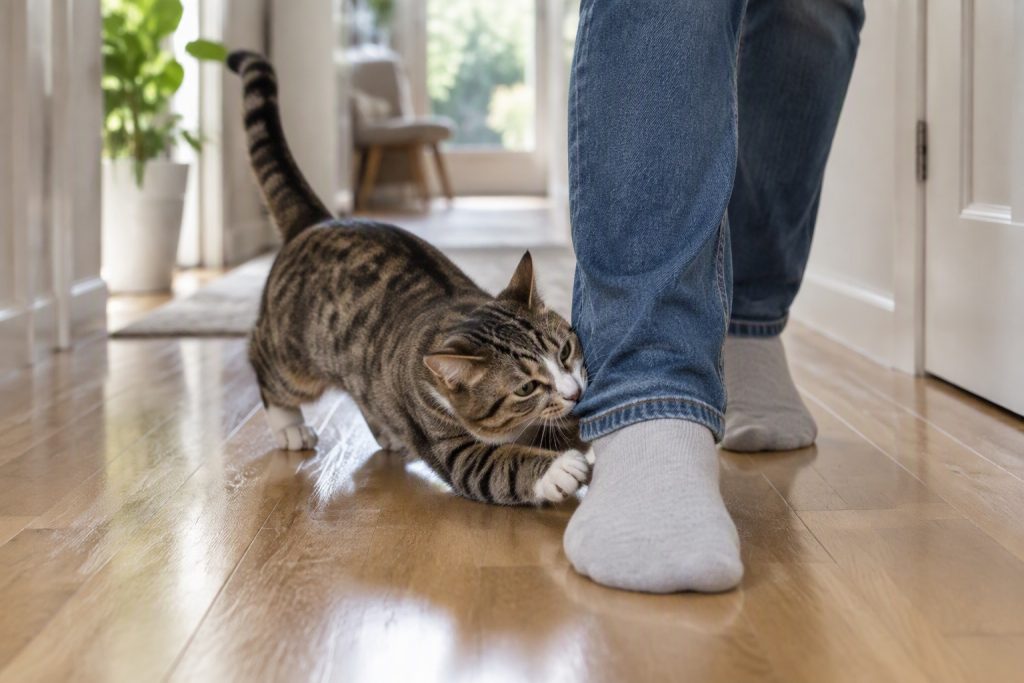
Cats bite ankles because ankles behave exactly like prey. They move quickly, they appear and disappear at the edge of vision, and they are at the right height for a cat to ambush. In most cases it is play behaviour driven by pent-up hunting energy, not aggression or dislike of you. The fix is not punishment but redirection: more appropriate outlets for the stalk-and-pounce sequence, and a consistent response that makes ankles boring.
- Ankles look and move like prey.
- Most ankle biting is play, not aggression.
- Punishment makes it worse, not better.
- Two short play sessions a day reduce it.
Why does my cat attack my ankles?
Ankle biting is the tail end of a hunting sequence. A cat’s natural pattern is to stalk, creep, pause, then pounce and grab, and that entire sequence is hardwired. In an indoor home with no mice to hunt, a moving ankle triggers the final stage directly. The behaviour clusters around predictable moments: when you walk past a doorway, come down the stairs, get up from a chair, or move at speed through the house. Cats also learn that ankle biting produces a reaction, and a reaction, even a yelp and a jump, is a form of attention and an exciting game outcome. Kittens and young cats do it most, because their play drive is highest, but adults who are under-stimulated do it too. The same instinct explains why cats attack feet under blankets, where a moving shape under fabric triggers the identical response. If your cat is biting at night specifically, our guide to cat biting ankles at night covers the timing pattern in more detail.
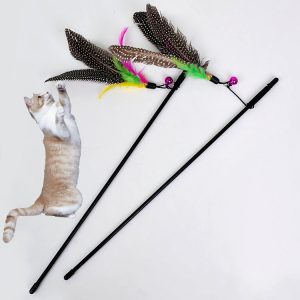
A teaser wand built to turn a few minutes into a full hunt — a cat needs to…
Is ankle biting a sign of aggression?
Usually not. True aggression in cats looks different: ears flat back, pupils narrowed, hissing or growling, a stiff body, and a bite that is hard and held rather than a quick grab. Play biting has a looser body, ears forward or neutral, and often a sideways hop or a pounce with the front paws wrapped around the ankle. It also tends to happen when the cat is otherwise relaxed and seeking engagement. There are exceptions. A cat who bites ankles when cornered, when you try to move her, or when she is in pain is communicating something else entirely, and that needs a different response. Redirected aggression is another pattern worth knowing: a cat who is wound up by an outdoor cat at the window may turn and bite the nearest moving thing, which happens to be your leg. If the bites are hard, drawn blood, or come with a defensive posture, get veterinary advice.
What triggers an ankle attack?
The most common trigger is unspent energy. A cat who has not had a real hunt-style play session will find her own outlet, and ankles are convenient. The second is timing: movement at speed, especially through a doorway or around a corner, mimics prey behaviour. The third is learned reward. If biting your ankle once made you stop, turn around, or shout, the behaviour paid off. The fourth is boredom combined with a predictable routine, which is why attacks often happen at the same time each evening. Stress can also raise the odds, since a cat who feels unsettled is more reactive. And finally, some cats target ankles as part of a demand for food or attention, particularly if they have learned that biting results in you walking toward the kitchen. Identifying your cat’s specific trigger is the first step.
How do I stop my cat biting my ankles?
Do four things consistently. First, ignore the bite: stop moving, say nothing, and do not make eye contact, then walk away calmly after a few seconds. Any reaction rewards the behaviour. Second, prevent the setup by keeping a toy in your pocket or near the doorway and tossing it ahead of you as you move, so the pounce lands on the toy. Third, add real play. Two sessions a day of ten to fifteen minutes with a wand toy, ending with a successful catch and a small treat, drains the drive that fuels the biting. Fourth, protect your ankles in the meantime by wearing longer trousers or socks, which removes the fun. Never use your hands as toys, never spray water or shout, and never physically punish her, because all three increase arousal and damage trust. If the behaviour is intense and persistent despite these steps, ask your vet about a referral to a behaviour specialist.

A rotating ABS plastic and feather wand fits a cat that needs a target more than another thing…
What play routine actually reduces ankle biting?
The most effective routine mimics a hunt. Use a wand toy with a feathered or fabric end and move it like prey: dart it, drag it behind furniture, let it pause, then whisk it away. Let your cat stalk, chase, and finally catch it, then give her a small treat or a piece of food so the sequence completes with a reward. Do this twice a day, ideally once in the late afternoon and once before bed, since evening is when most cats are naturally most active. Keep sessions short enough that she stays engaged but ends tired. After play, feed a meal, which mirrors the natural pattern of hunt, catch, eat, groom, sleep. Rotate toys weekly so the game stays interesting, and put the wand away in a cupboard between sessions so she does not play with it alone. A cat who has had a proper hunt twice a day has far less reason to stalk your ankles.
When should I worry about ankle biting?
Worry if the bites are hard enough to break skin, if they come with hissing, growling, flattened ears, or a defensive crouch, or if the behaviour is directed at a specific person or only when your cat is approached. Worry too if the behaviour is new in an older cat, because sudden irritability can signal pain, dental disease, arthritis, or hyperthyroidism. A cat who bites when touched on a particular part of the body is telling you that area hurts. If a bite breaks the skin, wash it thoroughly with soap and running water and seek medical advice, because cat bites can introduce infection deep into tissue. For persistent behaviour that does not respond to play and redirection, ask your vet to rule out a medical cause and to discuss whether a certified behaviour consultant would help.
Frequently asked questions
- Why does my cat only bite my ankles when I walk past? Movement triggers the pounce instinct, especially in doorways and corridors.
- Is ankle biting a sign my cat hates me? No. It is almost always play behaviour or a demand for attention, not dislike.
- Should I spray my cat with water when she bites? No. Punishment raises arousal and damages trust without teaching an alternative.
- Do cats grow out of ankle biting? Many do once their play needs are met, but under-stimulated adults can continue.
- What if my cat bites hard and draws blood? Clean the wound thoroughly and seek medical advice, then have your cat assessed for pain or stress.