

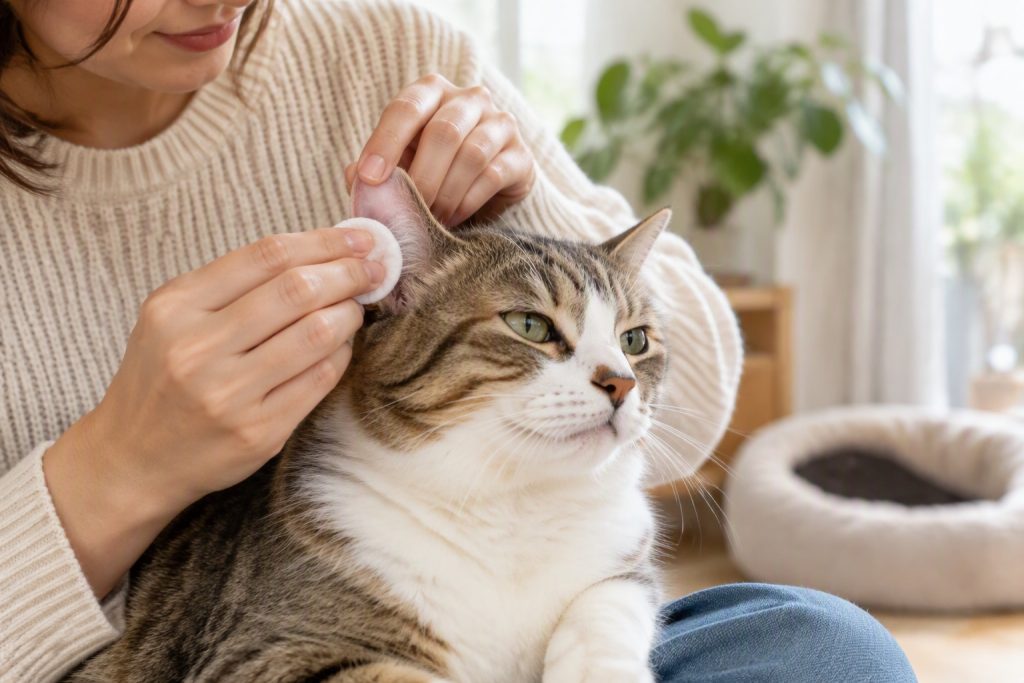
Most healthy cats do not need their ears cleaned on a schedule at all. A cat who is well and whose ears look clean should be checked weekly and cleaned only when there is visible wax or debris, which for most cats means rarely. If your cat has a history of ear infections or produces wax quickly, your vet may suggest cleaning every week or two. Cleaning a healthy ear too often can irritate the canal and do more harm than good.
- Healthy cats usually need no routine cleaning.
- Check ears weekly and clean only when needed.
- Never push anything into the ear canal.
- Stop and see a vet if there is pain or discharge.
Do cats need their ears cleaned regularly?
No, and this surprises many owners. A healthy cat’s ear canal is largely self-cleaning: wax migrates outward, and the shape of the canal discourages debris from settling. Unless there is a reason to intervene, the best thing you can do is leave it alone. Over-cleaning strips the natural protective film inside the canal, which can leave the skin dry and irritated and, paradoxically, create the conditions for infection. The one exception is a cat whose vet has advised a specific cleaning routine because of a chronic condition, ongoing treatment, or a breed with narrow canals. Even then, the frequency should come from your vet rather than a general rule. What every owner should do, regardless, is a weekly visual check: look at the ear flap and the visible canal in good light, and notice any smell, redness, or debris. Checking is free and takes seconds. Cleaning is an intervention with real downsides if done unnecessarily.

A stainless ABS plastic and metal comb clears the loose hair before it lands on the furniture. Keep…
How often should I clean my cat’s ears if she has problems?
It depends on the problem, and the answer should come from your vet. For a cat recovering from an ear infection, cleaning may be required daily or every other day for a short period, to remove debris so medication can reach the skin. For a cat with a chronic wax build-up, a weekly or fortnightly routine is often enough. For a cat being treated for ear mites, cleaning frequency is usually part of the treatment plan, because debris has to be cleared for the medication to work. Cats with allergies that affect the ears may need more frequent cleaning during flare-ups and almost none between them. The general principle is to clean only as often as necessary to keep the ear clear and the treatment effective. If you find yourself cleaning more than weekly on an ongoing basis without a vet’s plan, that is a sign the underlying problem has not been solved. Our guide to cat ear mites treatment explains why mites in particular need a complete plan.
What does a healthy cat ear look like?
A healthy ear flap is pale pink on the inside, smooth, and free of crusting or thickening. The visible part of the canal is a light pink colour with a small amount of pale, waxy material that is either barely visible or a soft, light yellow-brown. There should be no smell, or at most a faint, neutral scent. You should be able to see down the canal a short way without any dark mass. Your cat should not react when you gently touch the base of the ear. Compare the two ears to each other, because a difference between them is often the clearest sign that something is wrong. One ear that is redder, warmer, dirtier, or smellier than the other deserves attention. If you are not sure what normal looks like for your cat, take a photo of each ear when she is well, and use that as your baseline for comparison.
What are the signs an ear should not be cleaned at home?
Several signs mean stop and see a vet rather than reaching for a cleaner. If the ear is painful when touched, if your cat flinches, pulls away, or vocalises, do not clean it, because the canal may be inflamed or the eardrum may be damaged. If there is thick discharge, pus, a strong foul smell, or a dark, crumbly debris that resembles coffee grounds, that points to infection or mites and needs a diagnosis. If there is swelling, a lump, or a haematoma on the ear flap, cleaning will not help. If your cat is tilting her head, losing balance, or shaking her head violently, the problem is deeper than the surface. And if the ear is bleeding, do not intervene beyond keeping it clean. In any of these cases, cleaning can push debris deeper, irritate already inflamed tissue, or introduce fluid through a perforated eardrum. Our step-by-step guide to how to clean cat ears describes the safe technique for a healthy ear only.
A plastic dematting comb clears the loose hair before it lands on the furniture. Use it before the…
How do I clean a cat’s ears safely when it is needed?
Use a veterinary ear cleaner, never water, hydrogen peroxide, alcohol, or a homemade mixture. Warm the bottle in your hands first, then hold your cat securely but gently, with her body against you and her head steady. Lift the ear flap and squeeze a small amount of cleaner into the canal, then massage the base of the ear for a few seconds so the liquid works around. Let her shake her head, which brings debris up, and then wipe away what surfaces with a soft cotton pad or gauze. Never insert a cotton bud into the canal, because you can push debris deeper or injure the eardrum. Give her a treat and stop immediately if she becomes distressed. Work in a calm, quiet room, and if you need two people, use two people. If the ear looks worse after cleaning, or if your cat seems uncomfortable, stop and call your vet.
When should I see a vet about my cat’s ears?
Book an appointment if you see redness, swelling, discharge, crusting, a bad smell, or a difference between the two ears that persists. Also go if your cat is scratching at an ear persistently, shaking her head, holding an ear flat, or tilting her head, since these indicate discomfort rather than simple dirt. Act promptly if there is any loss of balance, circling, or flickering eye movements, because those point to the inner ear or the vestibular system. Go too if the ear problem keeps returning after you treat it, since recurrent infections often have an underlying cause such as allergies, mites, or a polyp. A vet will examine the canal with an otoscope, check the eardrum, and take a sample to identify bacteria, yeast, or mites, then prescribe the right treatment. Most ear problems in cats resolve quickly once the correct cause is identified, and persistent problems should always be assessed rather than managed indefinitely at home.
Frequently asked questions
- How often should I clean my cat’s ears? Only when they are dirty. Most healthy cats need cleaning rarely or never.
- Can I use cotton buds in my cat’s ears? No. They push debris deeper and can damage the eardrum.
- What can I use to clean cat ears? A veterinary ear cleaner only. Never water, alcohol, or hydrogen peroxide.
- My cat’s ears look dirty all the time. Why? Persistent debris usually means mites, infection, or allergies, which need a vet diagnosis.
- Should I clean my cat’s ears if she has mites? Follow your vet’s plan, since cleaning and medication work together for mites.





