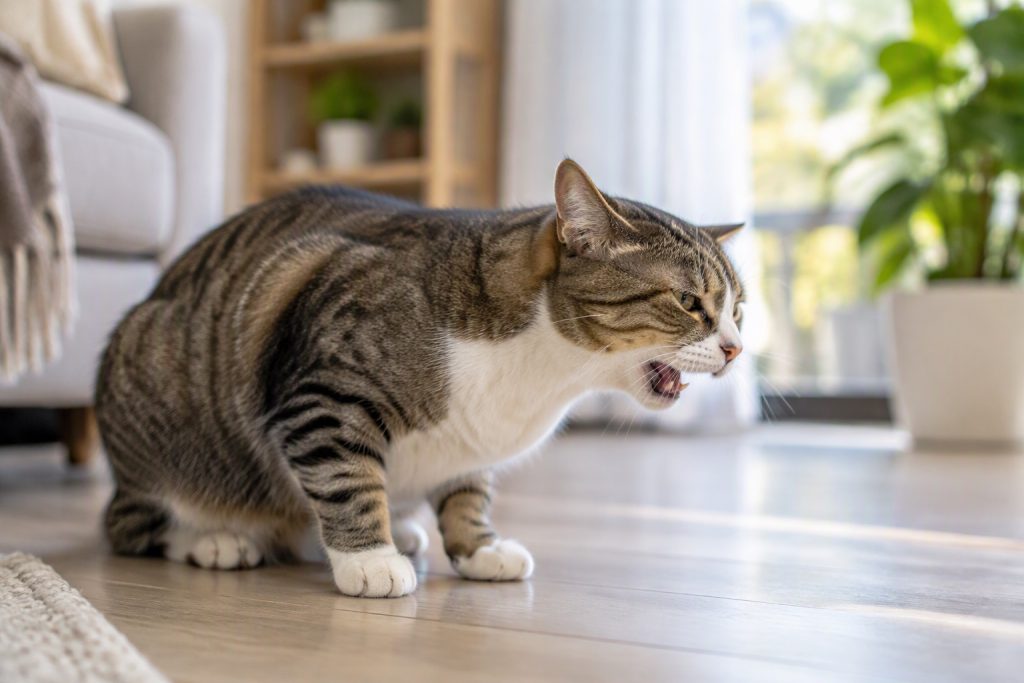
Coughing and hairballs look similar at a distance but sound and behave differently up close. A hairball is brought up from the stomach with a retching, heaving motion and produces a tubular clump of fur, often with food or fluid. A cough comes from the airway, is a sharp, repeated, dry expulsive sound, and produces nothing from the mouth. If your cat is coughing rather than bringing up hairballs, the cause is usually respiratory, and that needs a vet rather than a hairball remedy.
- Hairballs come from the stomach with retching.
- Coughing comes from the airway and brings up nothing.
- Frequent coughing is not normal in cats.
- Any repeated cough needs a vet visit.
What does a hairball actually look like and sound like?
A hairball episode starts with a deep, rhythmic heaving that comes from the abdomen, with the whole body contracting. The cat may extend her neck, open her mouth wide, and make a wet, gurgling sound, then produce a cylindrical mass of fur, usually coated in fluid, sometimes with a little undigested food. It often ends with a final swallow or a lick of the lips. The whole event looks like vomiting, and technically it is: a hairball is vomited up from the stomach rather than coughed up from the lungs. Cats also pass hair through the digestive tract normally, so most ingested fur never becomes a hairball at all. Occasional hairballs are common in long-haired cats and in cats who groom heavily. Our article on hairballs in cats covers how to reduce how often they occur, and how to tell when one is more than a nuisance.
Nail scissors, bath brush, de-shedding glove and a drying towel — the full groom in one box. Cuts…
What does a cat cough look like and sound like?
A cough is a short, sharp, forceful burst of air from the chest, often repeated in a series. The cat typically crouches or stands with her neck extended forward and low, and her body jerks with each expulsion. At the end, she may swallow or make a characteristic final gagging sound. Crucially, nothing comes up. Cats rarely cough, so a coughing cat is unusual by definition. The most common cause of chronic coughing in cats is feline asthma, which produces intermittent dry coughing, often at night or after exposure to dust, smoke, or strong scent. Other causes include respiratory infections, heart disease, lungworms, a foreign body in the airway, and, less commonly, tumours. Because the sound of a cough and a hairball can be genuinely similar, owners often assume asthma is a hairball problem and lose valuable time. Video the episode on your phone if you can, because it helps your vet enormously.
How can I tell the two apart reliably?
Watch the ending. If something comes out and it contains fur, it was a hairball. If nothing comes out, or only a small amount of clear fluid or foam, it was a cough. Then look at the posture and the sound. A hairball involves a whole-body abdominal heave with a wet, gurgling quality. A cough is a sharper, drier, more explosive series of bursts with a stiff, forward-leaning posture. Frequency is another clue: hairballs in a long-haired cat may happen every few weeks, while a cough tends to be episodic and can cluster around triggers such as dust, exercise, or night-time. Finally, consider the cat’s overall state. A cat with asthma may be slightly quieter or breathe faster than usual, while a cat with occasional hairballs is otherwise completely normal. If you cannot tell, treat it as a cough until a vet says otherwise, because a missed respiratory problem is far more serious than a missed hairball.
Is frequent coughing in cats normal?
No. Cats do not cough as a normal part of life, so any repeated coughing deserves investigation. Occasional, single, isolated coughs after drinking too fast or after a hairball episode are usually harmless. But a cough that recurs, that happens several times a week, that lasts more than a few days, or that comes with any change in breathing, appetite, or energy is a genuine concern. Asthma is common and treatable, and early treatment prevents the airway damage that comes from repeated inflammation. Left untreated, asthma can progress to a state where breathing is difficult even at rest, which is an emergency. Heart disease in cats is often silent until it is advanced, and a cough can be an early clue. Respiratory infections in a multi-cat household spread quickly. In every one of these cases, earlier is easier and cheaper than later. Our guide to hairball or vomit helps with the third possibility, which is ordinary vomiting.

Brush designed to lift loose hair out of a cat's coat — the hair has to go somewhere…
What should I do while I wait for the vet appointment?
Keep a diary. Note the date and time of each episode, what it sounded like, whether anything came up, what your cat was doing beforehand, and whether she seemed normal afterwards. Record a short video, which is the single most useful thing you can bring to a consultation, because most cats do not cough in the clinic. Reduce potential triggers in the meantime: switch to dust-free litter, stop using scented candles, air fresheners, and aerosol sprays, avoid smoking indoors, and keep the house well ventilated. Do not give any human medication, and do not give cough suppressants, which are not appropriate for cats. If your cat is breathing with effort, breathing with her mouth open, or has blue-tinged gums, that is an emergency and you should seek veterinary care immediately rather than waiting for an appointment.
How do I reduce hairballs if that is what it is?
If you have confirmed that the episodes produce fur and your vet is happy that the cause is ordinary grooming, then reducing hairballs is mostly about reducing swallowed fur and helping it pass. Brush your cat regularly, especially if she is long-haired, to remove loose fur before she ingests it. Increase water intake, since hydration helps the gut move fur through, and consider adding moisture to her food. A vet-approved hairball diet with added fibre can help some cats. Keep her busy with play, because a bored cat grooms more. Watch for signs that a hairball is not passing: repeated unproductive retching, refusing food, lethargy, or a change in bowel habits, all of which suggest a blockage and require urgent veterinary care. If hairballs are happening more than about once a month, that is worth raising with your vet rather than simply managing at home.
Frequently asked questions
- How do I know if my cat is coughing or coughing up a hairball? A hairball produces a clump of fur. A cough produces nothing.
- Do cats cough normally? No. Cats rarely cough, so repeated coughing should be investigated.
- Can a hairball look like a cough? Yes, the sound can be similar, which is why owners often mistake asthma for hairballs.
- Should I film my cat’s coughing fit? Yes. A short video is extremely useful for your vet.
- When is coughing an emergency? Open-mouth breathing, laboured breathing, or blue gums need immediate veterinary care.