

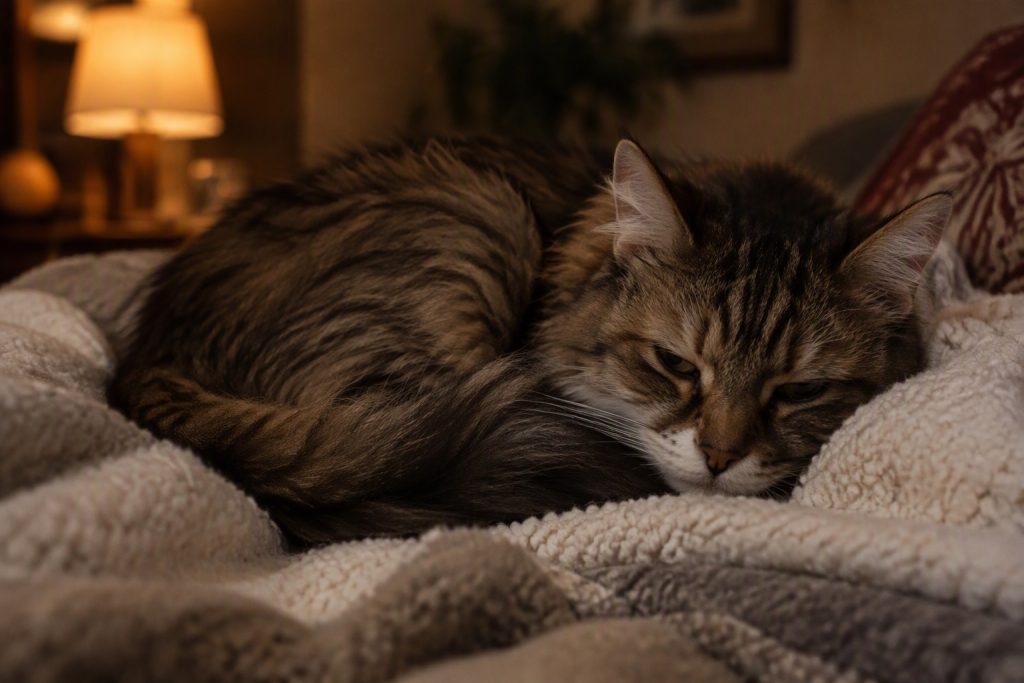
Cats purr when sick because purring is not only an expression of contentment. It is also a self-soothing behaviour, and some evidence suggests the vibration may have a healing or pain-modulating effect. A sick cat may purr to comfort herself, to seek reassurance from you, or as a reflex triggered by stress or discomfort. That means a purring cat is not automatically a healthy cat, and purring alongside other symptoms should never be read as a sign that nothing is wrong.
- Purring is not proof of contentment.
- Sick cats purr to self-soothe and to seek comfort.
- Judge health by appetite, activity, and behaviour.
- Purring with other symptoms needs a vet.
Why do cats purr at all?
Purring is produced by rapid vibration of the muscles in the larynx, combined with airflow, and it is unusual because a cat can purr continuously while both breathing in and out. Kittens start purring within days of birth, which is one clue that the behaviour is not simply about pleasure: newborn kittens purr while nursing, apparently as a signal to the mother. Adult cats purr in many contexts, including contentment, greeting, solicitation of food, and stress. That range is why purring is best understood as communication and self-regulation rather than a single emotional state. The frequency of a cat’s purr sits in a range that some researchers suggest may promote bone and tissue healing, which is a plausible explanation for why injured cats purr. Our article on why cats purr covers the full picture, including the different purr types and what they mean.

Rainbow-striped plush cylinder. Keeps a bored indoor cat busy and burns off restless energy. Made from fleece and…
Is it true that cats purr to heal themselves?
It is a widely repeated idea and it is partly supported. Purring occurs at frequencies between roughly 25 and 150 hertz, and vibrations in the lower part of that range have been studied in relation to bone density and tissue repair. The theory is that a cat purring while injured or unwell is applying a low-level mechanical stimulus that may ease pain and support healing. This remains a hypothesis rather than an established fact, and it is important not to overstate it. What is clear is that purring is associated with self-soothing: the rhythmic vibration and the act itself appear to calm a distressed cat, in much the same way that a repetitive behaviour can reduce anxiety. So the honest summary is that purring when sick is probably both a comfort mechanism and possibly a mild physical one, but it is not a treatment and it does not mean the underlying problem is minor.
What else can a purr mean when a cat is unwell?
It can be a request for help. Cats are social animals who have learned that humans respond to purring, and a cat in discomfort may purr while positioned near you, following you, or lying in an unusual spot. That is often a form of solicitation rather than contentment. It can also be a stress response: cats purr in the vet clinic, during car journeys, and in other situations that are clearly not pleasant. Some cats purr when they are in pain, and the purr may sound different, sometimes rougher or more forced. And some cats purr as a reflex during serious illness, including near the end of life, which is why purring is not a reliable indicator of wellbeing. The practical takeaway is that purring tells you a cat is vocalising, not that she is fine. Always weigh it against everything else she is doing.
How do I tell if my purring cat is actually sick?
Look past the purr and assess the whole cat. Appetite is the single most useful measure: a cat who is eating normally and drinking normally is usually coping, while a cat who refuses food for more than a day needs veterinary attention. Next, check activity: is she playing, jumping onto her usual spots, and greeting you, or is she quieter, hiding, and reluctant to move? Check grooming: a sudden drop in grooming, or obsessive grooming in one spot, is a signal. Check the litter box for changes in urine or stool, and check for vomiting, diarrhoea, coughing, sneezing, or discharge. Watch her posture and face for signs of pain, including squinting, a hunched back, flattened ears, or a tense abdomen. Our guide to how to tell if a cat is in pain sets out the subtle signs in detail, and it is worth reading before you need it.

Made from cloth Key features 【Name】 : cat simulation animal sound shell toy[Fill]: No fill, 2 built-in BB…
Which illnesses commonly cause a cat to purr while unwell?
Almost any condition can produce a purring cat, which is exactly why purring is not diagnostic. Cats with dental pain often purr while being handled near the head, apparently seeking comfort. Cats with urinary problems may purr while repeatedly visiting the litter box, which owners sometimes misread as contentment. Cats with arthritis may purr while being stroked on sore joints, and cats with gastrointestinal problems may purr while lying in a hunched position. Cats in respiratory distress can purr, though their breathing may look laboured. Cats recovering from surgery purr, and cats in the later stages of serious illness may purr continuously. Because the list is so broad, the useful approach is not to guess the condition from the purr but to notice everything else and describe it clearly to your vet. A short video showing your cat’s posture, breathing, and movement is genuinely one of the most helpful things you can bring to a consultation.
When should I take a purring cat to the vet?
Take her if the purring comes with any of the following: not eating for more than twenty-four hours, vomiting or diarrhoea that lasts more than a day, straining to urinate or passing no urine, laboured or open-mouthed breathing, a sudden change in behaviour such as hiding or aggression, limping or reluctance to jump, a swollen or painful abdomen, discharge from eyes or nose, or a noticeable change in weight. Take her urgently if she is collapsed, breathing with her mouth open, having seizures, or if you suspect she has eaten something toxic or a foreign body. Also go if the purring itself seems new and constant, or if she is purring while hunched, restless, or unable to settle. Anything persistent is worth a vet visit, and it is always reasonable to call the clinic for advice rather than waiting to see whether things improve.
Frequently asked questions
- Does purring mean my cat is happy? Not always. Cats also purr when stressed, in pain, or seeking comfort.
- Why does my sick cat purr when I stroke her? It is likely self-soothing and a request for reassurance from a familiar person.
- Can purring heal a cat? Some research links purr frequencies to tissue repair, but it is a hypothesis, not a treatment.
- My cat purrs at the vet. Does that mean she is fine? No. Cats commonly purr in stressful situations, including examinations.
- When should a purring cat see a vet? Any change in appetite, activity, breathing, or litter box habits alongside purring warrants a visit.





