

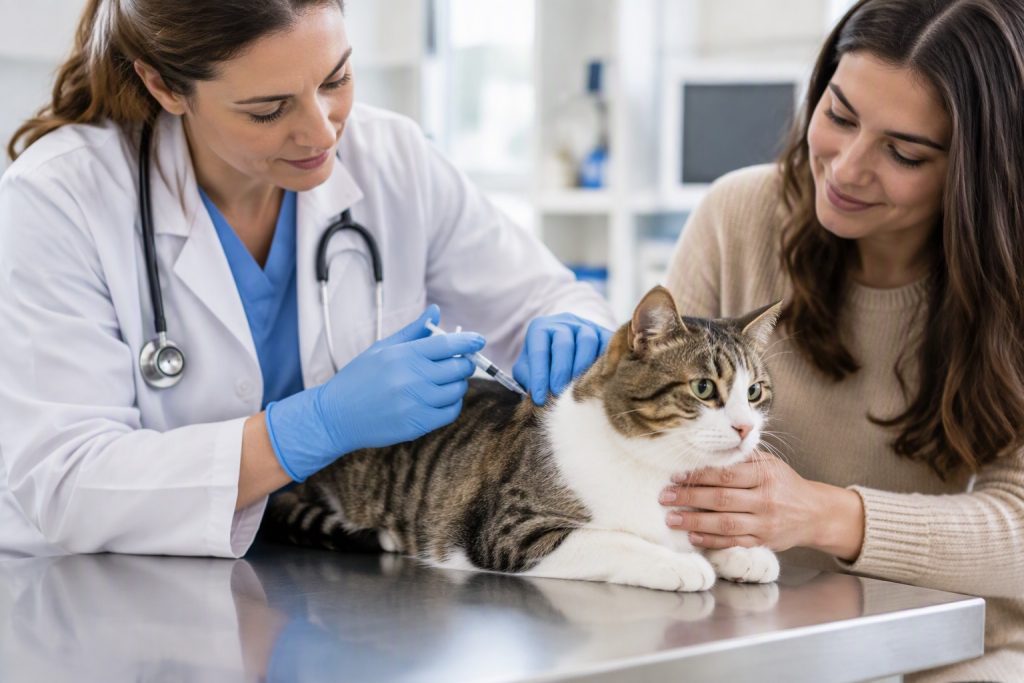
Kittens usually start their core vaccines at around six to eight weeks of age, then receive boosters every three to four weeks until about sixteen weeks, followed by a booster at one year and further boosters every one to three years. Adult cats with an unknown vaccination history generally need two doses two to four weeks apart. Your vet tailors the exact schedule to your cat’s age, lifestyle, and local disease risk, so treat any chart as a guide rather than a fixed rule.
- Kittens start core vaccines at 6–8 weeks.
- Boosters repeat every 3–4 weeks until about 16 weeks.
- A booster at one year, then every 1–3 years.
- Adult cats of unknown history need two doses.
What vaccines do cats actually need?
Vaccines are split into core and non-core. Core vaccines are recommended for essentially every cat because the diseases are serious and widespread: feline herpesvirus and calicivirus, which together cause cat flu, feline panleukopenia, which is often fatal in kittens, and rabies, which is required by law in many places and is always fatal. Non-core vaccines are chosen based on risk and include feline leukaemia, which matters for cats who go outdoors or live with an infected cat, and sometimes chlamydia or bordetella. Your vet decides which non-core vaccines suit your cat based on whether she goes outside, hunts, lives with other cats, or is boarded. Our guide to cat vaccinations explains each disease in more detail. Rabies vaccination is often required by law, so check your local rules before deciding what to skip. Your vet will also weigh her age, health, and any previous reactions before recommending a plan.

A fabric and Oxford cloth harness stays close enough that a cat cannot back out of it. Take…
What is the kitten vaccination schedule?
Kittens receive their first core vaccine at roughly six to eight weeks, then boosters every three to four weeks until they are about sixteen weeks old. The reason for the repeated doses is that antibodies from their mother’s milk can block the vaccine, and we cannot know exactly when those antibodies fade in each kitten. Giving several doses over that window ensures there is a point where the vaccine takes effect. Rabies is usually given later, often around twelve to sixteen weeks, depending on local rules. Kittens should be kept away from unknown cats until their course is complete, and they should be kept indoors or in a secure enclosure. Your vet will set the exact dates and record them for you. Keep her away from unvaccinated cats and unknown outdoor cats until the course is finished, because she is not yet protected. Your vet may also start rabies at a different age depending on local requirements.
What about adult cats and boosters?
After the one-year booster, most healthy adult cats need core vaccines every one to three years, depending on the vaccine and your vet’s assessment of her risk. Some vaccines are licensed for three-year intervals, while others are annual. An adult cat with no vaccination history, or an unknown one, usually needs two doses given two to four weeks apart to build solid immunity. Senior cats still need protection, though your vet may adjust the plan if she has a chronic illness. It is worth keeping a simple record of every vaccine and date, because boarding facilities and some travel rules ask for proof. If you are unsure when she was last vaccinated, it is safer to restart the course than to assume she is covered. If you are unsure of her history, a titre test can sometimes show whether she is already protected. Keep a written record of each vaccine, the date, and the product used, since clinics and boarding facilities often ask for it.
Are non-core vaccines worth it?
They are worth it for the right cat, and unnecessary for others. Feline leukaemia vaccine is strongly recommended for cats who go outdoors, hunt, or live with a cat who does, because the virus is spread by close contact and fighting and is often fatal. It is less important for a strictly indoor cat with no exposure. Other non-core vaccines, such as those for chlamydia or bordetella, are usually reserved for cats in shelters, breeding situations, or group housing. The decision is a genuine risk trade-off, not a money-making add-on, so discuss your cat’s real lifestyle honestly. A cat who never leaves a secure apartment genuinely needs fewer vaccines than one who roams. Our guide to the first vet visit covers how these choices get made. Cats who are boarded, shown, or live with an outdoor cat often need more protection than a cat who never leaves the house.

Bundle of multicoloured printed leashes. Made from fabric. Made for walks, travel and everyday wear. Keeps your cat…
What side effects should I expect?
Most cats have no reaction at all, or only mild, short-lived ones. You might see sleepiness, a slightly reduced appetite, or tenderness at the injection site for a day or so. Some cats get a small, firm lump under the skin that fades over a few weeks. Serious reactions are rare but possible, and signs include vomiting, diarrhoea, facial swelling, hives, difficulty breathing, or collapse. If you see any of those, contact your vet immediately. Tell the clinic about any reaction so it can be recorded, and mention it before future vaccines. A mild off-day is normal; a dramatic or worsening reaction is not. Never skip a vaccine because of a mild reaction without discussing alternatives with your vet first. If your cat had a reaction before, your vet may adjust the vaccine, split the doses, or give pre-treatment to reduce the risk. Mild sleepiness or a sore spot for a day is common and not a reason to avoid future vaccines.
Why do vaccines need boosters at all?
Immunity is not permanent for every disease, and it fades at different rates for different vaccines. The initial series teaches the immune system to recognise a threat, but the strength and duration of that memory vary. Boosters at one year and then at intervals top up protection before it drops too low. In kittens, the repeat doses exist mainly to overcome maternal antibodies, as explained above. Some vaccines, such as rabies and panleukopenia, tend to produce long-lasting immunity, while others need more frequent reminders. This is why schedules differ between products and why your vet may recommend a titre test instead of a routine booster in some cases. Titre testing measures existing antibodies and can show whether a cat is already protected, though it does not replace rabies vaccination where it is legally required. Titre testing is a useful tool for adult cats, but it does not remove the need for a booster if the result is low. Whatever the schedule, the aim is steady protection rather than the fewest possible visits.
Frequently asked questions
- At what age do kittens start vaccines? Usually at six to eight weeks, with boosters every three to four weeks until about sixteen weeks.
- How often do adult cats need boosters? Core vaccines are typically repeated every one to three years, based on the vaccine and your cat’s risk.
- Can indoor cats skip vaccines? They still need core vaccines, because viruses can be carried indoors on clothing, shoes, and hands.
- What if my cat misses a booster? A single late booster usually just needs to be given as soon as possible. A long gap may mean restarting the course.
- Are vaccine reactions common? Most reactions are mild and short-lived. Serious reactions are rare but need urgent veterinary attention.





