

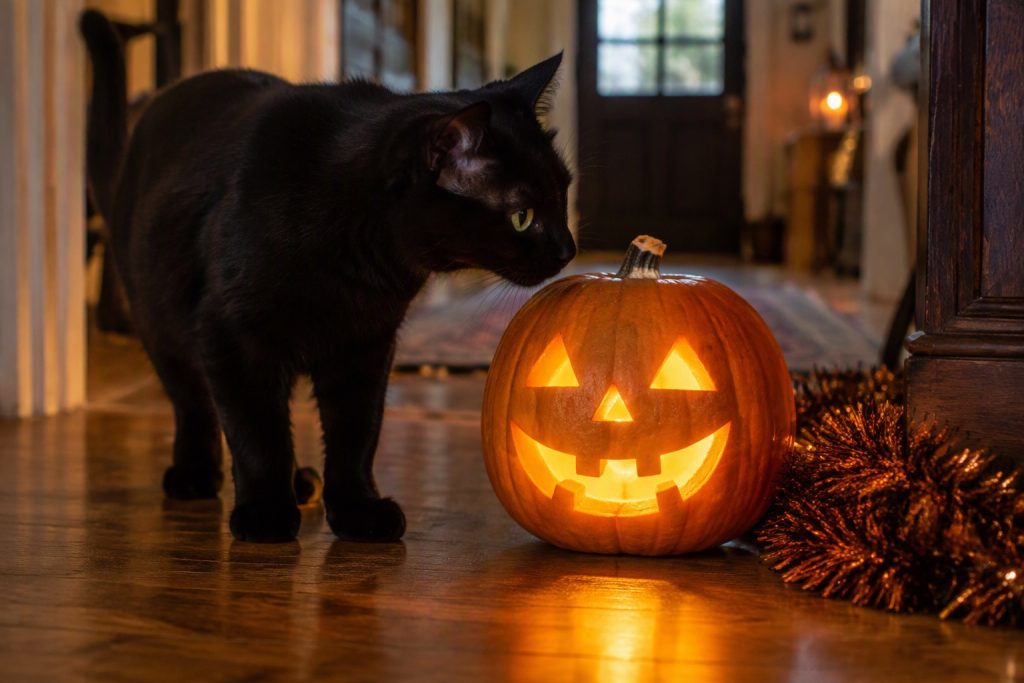
Halloween is one of the riskier nights of the year for an indoor cat, and the dangers are mostly ordinary things that only become dangerous in October quantities. Chocolate and raisins are genuinely toxic, tinsel and ribbon can cause a linear obstruction that needs surgery, and lit pumpkins plus a front door standing open for trick-or-treaters cover the rest. The single most effective precaution is unglamorous: keep the cat in one quiet room, away from the door, with its normal food, water, litter box and a familiar bed, for the whole evening.
- Chocolate, raisins and xylitol are the main food risks; contact a vet immediately if any is eaten.
- Tinsel, string and ribbon cause serious internal damage when swallowed, even in small amounts.
- A lit pumpkin or candle is a real burn and fire risk around a curious cat.
- One quiet room with normal food, water and litter prevents most of the night’s hazards.
Is chocolate actually poisonous to cats?
Yes, and cats are more sensitive to it than people often assume, though they are also less likely to eat it because they cannot taste sweetness. The risk is dose and type: dark chocolate and cocoa powder are far more dangerous than milk chocolate, and a small cat eating a modest amount of dark chocolate is a genuine emergency. Raisins and sultanas are also toxic to cats, and so is xylitol, the sweetener in many sugar-free sweets and chewing gums. If you think your cat has eaten any of these, do not wait for symptoms. Contact a vet or an emergency clinic straight away and tell them what was eaten and roughly how much. Symptoms can be delayed, and early treatment is far more effective than waiting to see what happens.

Round furry plush bed with cat ears on the rim. Made from velvet. Made for everyday resting. Gives…
What decorations are dangerous to cats?
The ones that dangle, sparkle or look like prey are the problem, which is most of them. Tinsel is the classic offender because it is light, shiny and string-like, and a swallowed strand can bunch up in the intestine and cause a blockage that requires surgery. The same applies to ribbon, string, fake cobwebs, and the elastic loops on some hanging decorations. Glow sticks are a separate hazard: the liquid inside is irritating rather than lethal, but it can cause drooling, pawing at the mouth and distress. Lit candles and tealights inside pumpkins are a burn and fire risk, particularly when a cat investigates from above. The practical approach is to keep anything dangling above the height a cat can reach, or to skip it entirely this year.
Are Halloween costumes safe for cats?
For most cats, no, and the honest answer is that the costume is for the owner. A cat in a costume often shows subtle signs of stress that people miss: freezing, flattening the ears, a tail tucked low, refusing to walk, or trying to back out of the garment. Some cats tolerate a simple bandana or a light harness for a short time, but many find even that unpleasant. If you do dress a cat, keep it brief, supervise constantly, and remove it the moment the cat shows any of those signs. Never leave a costumed cat alone, and never use anything that restricts the neck, covers the face, or has small parts that can be chewed off and swallowed. A photograph is not worth a stressed animal.
How do I stop my cat bolting out of the front door?
Reduce the opportunity rather than relying on the cat’s self-control. On Halloween night the door opens repeatedly, which is exactly the scenario a door-bolting cat has been waiting for. Set up a barrier: a second door, a hallway, or a baby gate between the cat’s room and the entrance, so there are two closed layers between the cat and the street. Ask visitors to knock and wait rather than holding the door open while they chat. If the cat is already a bolter, put it in its room before the first knock and keep it there until the last one. A microchip and a well-fitted breakaway collar with an ID tag are sensible backup, but they are not a substitute for preventing the exit in the first place.

A scratcher built to give a cat somewhere to scratch that is not the sofa — a cat…
What about trick-or-treaters and noise?
Repeated knocking, doorbells and unfamiliar voices are a lot for a cat used to a quiet house. The room you choose should be as far from the front door as possible, and ideally one the cat already likes, with a bed, litter box, water and something to do. Some cats do better with white noise to mask the doorbell; others find any new sound worse. Draw the curtains if decorative lights outside flicker. If the cat is genuinely frightened, a covered bed or a box to hide in helps more than company does. A cat that hides is coping; a cat that paces or drools is not, and that is a conversation to have with a vet. For a full evening plan, see Halloween night for nervous cats, and for costumes specifically, cat costumes: safe or stressful.
What do I do if my cat eats something it should not?
Act first, research second. Call a vet or an emergency clinic and describe what was eaten, roughly how much, and when. Do not induce vomiting unless a vet tells you to, because with some substances that causes more damage on the way back up. Do not give milk, oil or home remedies. If you have the packaging, keep it, because the ingredients list helps the vet decide on treatment. Signs to watch for include vomiting, drooling, wobbliness, tremors, restlessness, hiding, or a cat that simply seems not itself. With string, tinsel or thread, a particular warning applies: never pull on a strand you see hanging from the mouth or rear, because it may be anchored inside. That situation is always an immediate vet visit. It also helps to note the time, because how recently it happened shapes the treatment.
Frequently asked questions
- How much chocolate is dangerous for a cat? It depends on the cat’s weight and the type of chocolate, and dark chocolate is far more potent than milk. Any suspected ingestion is a call to a vet.
- Are pumpkin and pumpkin seeds safe? Plain cooked pumpkin is generally fine in small amounts. The danger is the candle inside a carved pumpkin, and any mould on a pumpkin left out for days.
- My cat ate a piece of tinsel. What now? Contact a vet immediately even if the cat seems fine. String-like objects can cause delayed, serious internal damage.
- Should I give my cat a sedative for the evening? Never without veterinary advice. Sedation is a medical decision, and the wrong drug or dose can be harmful.
- Will my cat be fine if I just shut it in a room? Usually yes, provided the room has food, water, litter and a comfortable hiding place, and the cat is checked on through the evening.


