

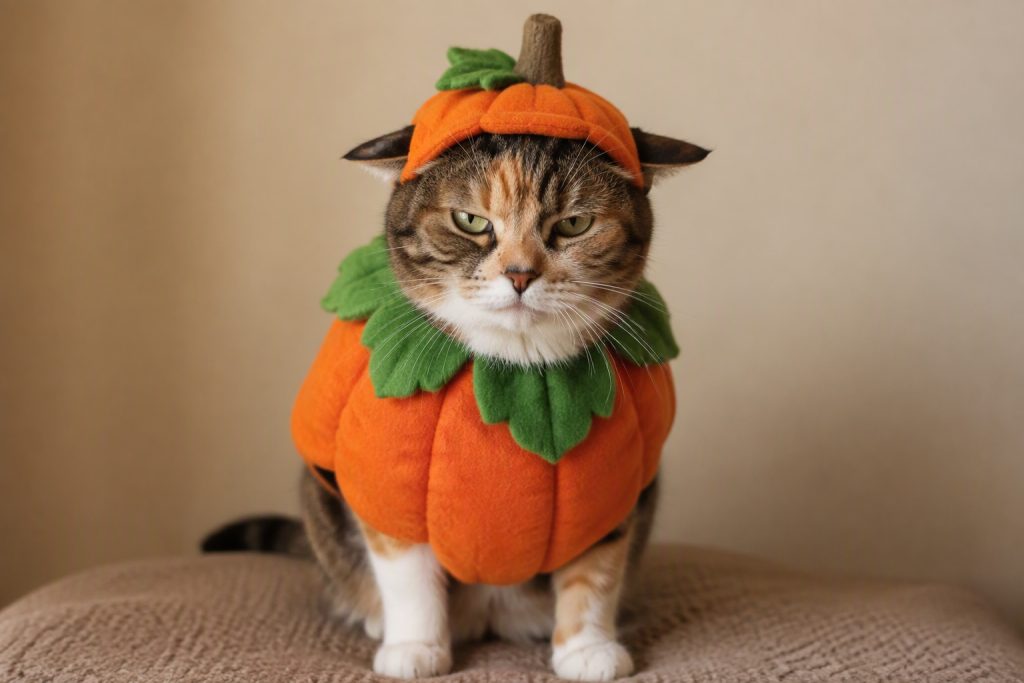
A costume on a cat is almost always for the person holding the camera, not for the cat. Most cats find clothing uncomfortable at best and frightening at worst, and the signs of distress are easy to miss because a stressed cat tends to freeze rather than struggle. That does not mean a costume is never acceptable, but it does mean the decision should be based on the individual cat’s response rather than on how the photograph will look. For a cat that genuinely tolerates clothing, a simple, safe, short-lived outfit is possible, but for most cats a themed collar or a seasonal bandana is the kinder compromise.
- Most cats dislike clothing, and a freezing cat is a stressed cat rather than a calm one.
- If you dress a cat, supervise constantly and remove the costume at the first sign of distress.
- Avoid anything tight around the neck, covering the face, or with small parts that can be chewed off.
- Never leave a costumed cat unattended, and never use a costume that restricts movement.
Do cats actually hate costumes?
Many do, though the strength of the reaction varies. A cat’s sense of safety depends partly on being able to move freely and to feel the world through its fur and whiskers, and clothing interferes with both. A costume also changes the cat’s silhouette, which other cats in the house may react to as though it were a stranger. Some cats are surprisingly tolerant and will wear a light item without obvious distress, particularly if they were introduced to clothing gradually as kittens. Others will freeze, walk stiffly, or try to back out of the garment, which are all signs of discomfort rather than cooperation. The honest position is that a costume is a human preference, and the cat’s comfort should decide whether it happens at all.
Teaser wand designed to turn a few minutes into a full hunt — a cat needs to finish…
How do I tell if my cat is unhappy in a costume?
Watch for the quiet signs, because a distressed cat is usually not the one making noise. Freezing in place and refusing to walk is the most common. Others include flattening the ears, tucking the tail low, crouching, trying to reverse out of the costume, licking or chewing at it, and a fixed stare. Some cats will walk with a stiff, low gait, as though the clothing is weighing them down. A cat that rolls repeatedly is often trying to remove the item. If you see any of these, take the costume off immediately. There is no value in persisting to see whether the cat adjusts; the distress is real and the cat cannot understand it. The one exception is a cat that is relaxed, moving normally and ignoring the costume entirely, which is the only response that justifies continuing.
What makes a costume unsafe for a cat?
Several things, and they are worth checking before anything goes near the cat. Anything tight around the neck is a strangulation risk, and anything covering the face interferes with vision, breathing and the cat’s ability to eat or drink. Small parts — buttons, bells, pompoms, glued-on eyes — can detach and be swallowed, which is a real hazard with string-like items in particular. Elastic can compress the chest or slip and tighten. Long trailing fabric can catch on furniture or be chewed. Anything that restricts the legs prevents the cat from jumping and landing safely, which is how injuries happen. And a costume that makes the cat unable to move freely should never be used at all, regardless of how it looks. If in doubt, leave it off.
How do I get my cat used to wearing something?
Slowly, and with food, and only if the cat is not distressed at the first step. Start with something minimal, such as a soft breakaway collar, worn for short periods while eating or playing. Then try a light bandana, tied loosely, for a minute or two, with a treat afterwards. Build up the duration only while the cat stays relaxed, and stop as soon as it does not. Never chase the cat to put something on, and never hold it down. If the cat tolerates the bandana, a simple costume without a face covering may be possible for a few minutes. If it does not, that is the answer, and the project ends there. Some cats accept a harness for walks, a different and more useful kind of training, and harness training is worth doing properly.
Plush toy designed to give a cat something to grab, kick and bite — a cat kills the…
What are the alternatives to a full costume?
Several, and most of them are better for the cat. A themed collar with a small, safe charm gives the seasonal look without any restriction, though a breakaway design is essential so the cat cannot be caught by it. A bandana tied loosely around the neck is light, easy to remove and tolerated by more cats than a full outfit. A seasonal cat bed, blanket or toy gives the photograph a Halloween feel without touching the cat at all. You can also photograph the cat next to a pumpkin, in a decorated box, or in front of a backdrop, which produces a better picture than a struggling cat in a costume. The cat does not need to wear anything for the photograph to work, and a relaxed cat makes a far better image than a stiff one.
Should I dress my cat for a photo?
Only if the cat is genuinely comfortable, and only briefly. A photograph takes seconds, so the standard is that the cat is relaxed throughout and the costume comes off immediately afterwards. If you need treats, holding, or a second person to keep the cat in place, the answer is no. It is also worth thinking about what happens after the photo, because a costume left on while the household is busy is a genuine hazard. For most cats, the honest answer is that a themed collar or a nice photo beside a pumpkin will look better and cost the cat nothing. If you do go ahead, keep it to a couple of minutes, stay in the room, and have the camera ready before the costume goes on. Halloween safety more generally is covered in chocolate, tinsel and costumes.
Frequently asked questions
- Is it cruel to put a costume on a cat? Not automatically, but it is unkind to keep one on a cat that is showing distress. Watch the cat, not the photograph.
- Do any cats enjoy wearing clothes? A small number tolerate it well, especially cats introduced to clothing gradually as kittens. Enjoyment is rare; tolerance is the realistic outcome.
- What if my cat freezes in a costume? Freezing is a stress response, not calm. Remove the costume immediately and do not repeat the attempt that day.
- Can I leave a costume on for a party? No. Never leave a costumed cat unattended, and keep the wearing time to a few supervised minutes at most.
- Are pet costumes regulated? Not to any meaningful safety standard, so the responsibility for checking for choking hazards and fit rests with the owner.


