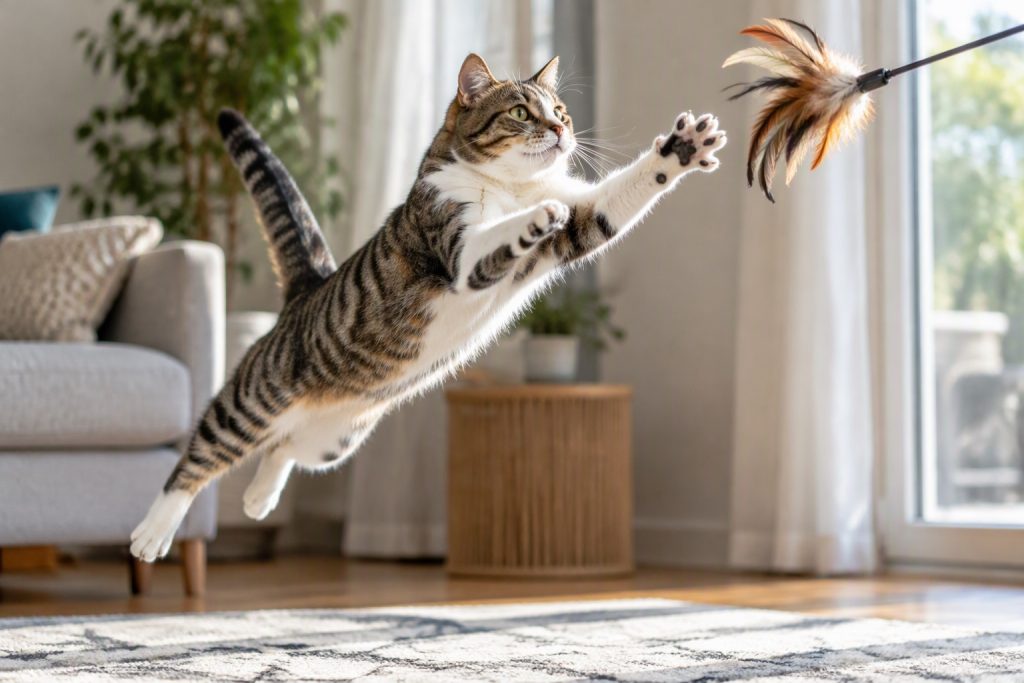
An indoor cat can get plenty of exercise, but it will not happen by itself. Without a garden to patrol, stairs to climb and prey to chase, most indoor cats move far less than outdoor cats, and the shortfall tends to show up as weight gain, boredom and behaviour problems. The good news is that a cat’s exercise needs are modest and mostly achievable in a living room: a few minutes of real hunting play, some vertical space, and a reason to move between meals. The aim is not a workout but a daily routine that keeps the cat active without the cat noticing it is exercising at all.
- Indoor cats need deliberate exercise because their environment provides very little.
- Two short play sessions a day, plus vertical space and food puzzles, cover most of the need.
- Weight gain is the clearest sign a cat is not moving enough.
- A sudden drop in activity in an older cat can indicate pain, so ask a vet.
How much exercise does an indoor cat need?
There is no fixed number, but two focused play sessions a day of around five to ten minutes each is a reasonable baseline for most adult cats, with more for young cats and less for seniors. What matters is the intensity rather than the clock: a cat that stalks, sprints and jumps for four minutes has done far more than one that bats lazily at a toy for fifteen. Beyond play, the rest of a cat’s activity comes from the environment, which is where indoor cats usually fall short. A cat that has to climb to reach its food, walk to a litter box in another room, and use a puzzle feeder will accumulate a surprising amount of movement across a day without any extra effort from the owner.
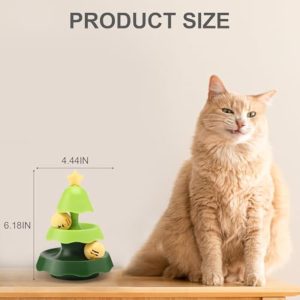
This rolling toy rolls and moves the way a cat's prey does — movement is the whole point.…
How do I get a lazy cat to move?
Start with what the cat already responds to, and build from there. Some cats want a wand toy moved low along the floor, some want it darting behind furniture, some prefer a ball they can chase alone. Try several styles rather than assuming the cat is not interested in play at all. Timing matters as much as the toy: most cats are most active around dawn and dusk, so a session in the evening is far more likely to succeed than one at midday. Keep sessions short and end them while the cat is still engaged. For a sedentary cat, build movement into the day: put food bowls upstairs, or move the water bowl away from the food. For a cat that is also overweight, portion control matters alongside activity, as covered in whether the cat is overweight.
Does vertical space count as exercise?
Yes, and it is one of the easiest forms of it. Jumping onto and off a cat tree, a shelf or a window perch uses the muscles of the hindquarters and back, and it is exactly the kind of movement an indoor cat would otherwise lack. A cat that has to climb to reach its favourite sleeping spot, or that has to jump between two platforms to reach its food, is getting real exercise without any prompting. Height also serves other purposes, since it gives the cat a vantage point and a way to avoid conflict in a multi-cat home. In a flat, a couple of shelves at different heights can achieve this. A cat tree near a window is particularly effective, because it combines climbing with something to watch, which keeps the cat returning to it.
Can a cat get too much exercise?
It is rare, but possible, particularly with very young cats or a cat pushed hard with intense play for long periods. The signs that a session has gone too far are panting, lying flat with the mouth open, refusing to continue, or becoming over-aroused and swiping at the owner. Cats are sprint athletes rather than distance runners, so short bursts suit them far better than long endurance sessions. Kittens often self-regulate and stop when they have had enough, but some will keep going until they are over-tired. A cat with a heart condition or another medical problem may need a restricted level of activity, and that should be discussed with a vet. If your cat pants during play, stop and let it recover, and mention it to a vet if it happens repeatedly.

A cat tree built to give a cat height to climb, perch and watch from — height is…
How do I know if my cat is getting enough?
Watch the body condition rather than the play log. A cat at a healthy weight with a visible waist and ribs you can feel but not see is generally getting the balance right, and weight creeping up over months is the clearest sign that activity is too low or portions are too large. Behaviour is the other measure: a cat that settles after play, is not destructive at predictable times, and does not pester you constantly in the evening is probably well exercised. If the cat is gaining weight despite reasonable portions, or if it is restless and vocal in the evenings, look at both the amount of play and the type of food delivery. Weighing the cat monthly gives you a trend rather than a snapshot, which is far more useful than judging by eye.
When is low activity a health problem?
A cat that has always been calm is one thing; one that has become inactive is another. A sudden or gradual drop in activity, especially over eight, is a common early sign of pain, and arthritis in cats is frequently missed because the cat just stops jumping as much. Other causes include dental disease, heart problems, thyroid disease and anaemia. Signs worth acting on include a cat that no longer jumps onto surfaces it used to reach, or hesitates before jumping down. Book a vet appointment and describe how the change developed, because the timeline is useful. Never give pain relief or a supplement for stiffness without veterinary advice, since several human painkillers are toxic to cats. If your cat is healthy and just needs more activity, harness training opens up supervised outdoor walking for the right cat.
Frequently asked questions
- Can an indoor cat get enough exercise without a garden? Yes. Structured play, vertical space and food puzzles can cover the need entirely indoors.
- Is chasing a laser pointer good exercise? It provides sprinting but no catch, which frustrates some cats. Finish by landing the dot on a real toy or treat the cat can capture.
- How long should a play session be? Five to ten minutes of genuine hunting play is usually plenty. Two sessions a day is a good target for most adult cats.
- Do cats need walks? No, though some enjoy harness walks. It is optional enrichment rather than a requirement, and it suits confident cats best.
- My cat sleeps all day. Is that normal? Cats sleep a great deal, so this is often normal. What matters is whether the cat is active and interactive during its waking hours.