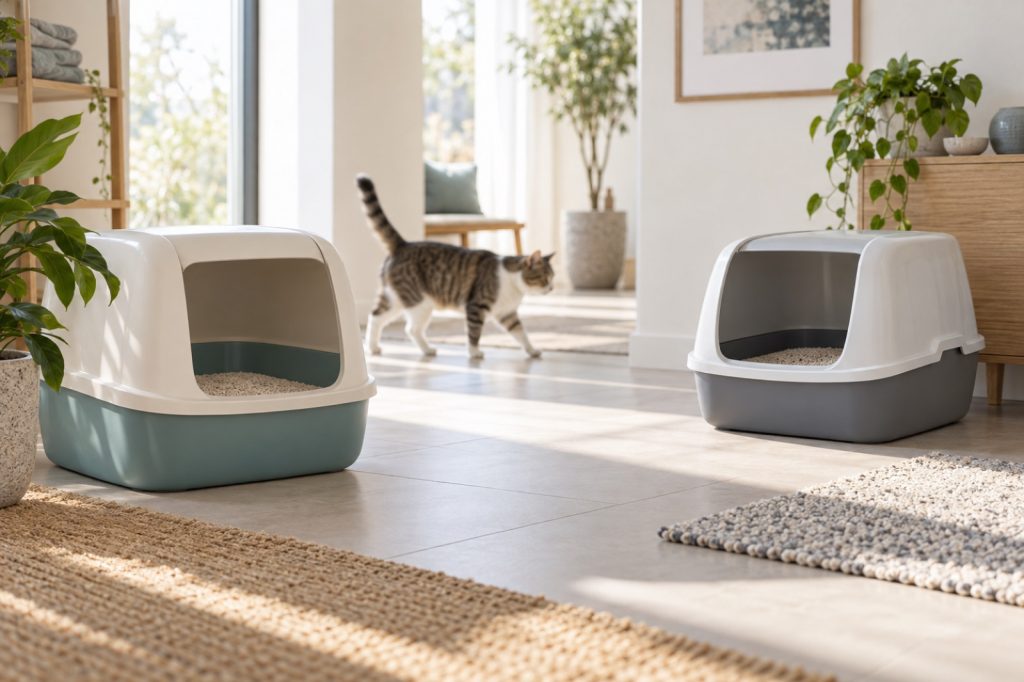
For two cats, the working rule is three litter boxes — one per cat, plus one extra. The spare box is not a luxury: it removes competition, gives each cat a clean and unclaimed option, and lets you spread toileting spots across the home so neither cat has to cross the other’s territory. Running fewer boxes is one of the most common reasons a two-cat household develops house-soiling.
- Two cats need three boxes: one each, plus one spare.
- Spread them across separate rooms, never side by side.
- Scoop at least once a day; cats avoid dirty boxes.
- If space is tight, make each box larger and spotless instead.
Why do two cats actually need three litter boxes?
Cats are solitary about toileting in a way dogs are not. In a multi-cat home, one cat often claims a box and quietly patrols it, so a second cat who needs to go may find her usual spot occupied, freshly used, or guarded. A third box breaks that bottleneck. It also solves a practical timing problem: cats prefer to urinate and defecate in separate places, so even a single cat will often use one box for pee and another for poop. Add a second cat and the maths becomes obvious. The spare box is your buffer against the moments when both cats need to go at once, which is exactly when accidents happen. Think of it as quiet insurance you never notice until you need it. The rule is not about pampering your cats; it is about removing the daily friction that turns a calm household into a tense one.

Tray, scoop, anti-splash mat and clumping litter. The whole litter corner, one box.
Can two cats share one litter box without problems?
Sometimes, yes — and if it works, you will know. But sharing is fragile. A single box means a single point of conflict, and cats communicate tension through litter-box behaviour long before anyone hisses. One cat may start hovering by the box, rushing her business, or waiting until the other is asleep. Others begin eliminating just outside the box, on a bath mat, or behind the sofa. Even bonded littermates who have shared everything since birth can fall out over a box once one develops a urinary issue that makes the litter smell different. If you genuinely cannot fit a second or third box, keep the one you have scrupulously clean, uncovered, and generously sized, and watch for the early warning signs covered in our guide to peeing over the box edge.
Where should the boxes go in a two-cat home?
Placement does as much work as the number of boxes. Put them in separate rooms, or at least in separate corners with sight lines broken, so a cat using one box is not staring down a rival using another. Avoid dead ends where a cat can be cornered on the way out. Keep every box away from food and water — cats instinctively separate dining and toileting — and out of noisy, high-traffic areas like a laundry room mid-cycle. If your home has two floors, aim for at least one box per floor so a senior or a cat mid-nap does not have to sprint downstairs. The fuller logic of safe placement is in our guide to litter box placement.
What size and style of box works best for two cats?
Bigger is almost always better. A box should be roughly one and a half times the length of your cat, nose to tail base, so she can turn around and dig without her paws hanging over the rim. For two cats, an uncovered, high-sided box suits most households: it contains scatter without trapping odour the way a hood does. If you have a senior or a cat with arthritis, add a low-entry box so she is not climbing a wall every time. Litter depth matters too — around five to seven centimetres gives digging room without turning the box into a beach. Whatever you choose, buy two or three of the same type, because cats are conservative and a mismatched set invites suspicion. If one cat is much larger than the other, size each box for the bigger cat so neither has to squeeze.

Pet Large Alloy Cat Litter Scoop Plastic Handle Cleaning. Part of the KiKi Meow Cat Litter and Hygiene…
How do I stop one cat from guarding or blocking the boxes?
Guarding is usually subtle: a cat who happens to be sitting near the box, or who follows the other cat and stares. The fix is redundancy and escape routes. With three boxes in different rooms, a blocked cat simply walks to another. Never trap a cat in a small room with the box; always leave two ways out where you can. Feed the cats in separate spots so mealtimes do not become a scuffle that spills into the litter area. If tension is real, separate them for short supervised periods and reintroduce them slowly. Persistent guarding that causes accidents is a behaviour problem worth raising with your vet, because stress-related urinary issues in cats can escalate quickly. Watch for the quieter signs too — a cat who suddenly avoids a room, eats less, or hides more is often reacting to tension you have not noticed yet.
How often should I clean and replace the boxes?
Scoop solids at least once daily, twice if you have three boxes and two cats, and stir the litter so damp patches are not left clumped in a corner. Every one to two weeks, dump the litter entirely, wash the box with a mild unscented soap, and let it dry fully before refilling. Avoid strong citrus or ammonia cleaners — cats find them repellent, and ammonia smells like urine. Replace plastic boxes when they are scratched and hold odour no matter how well you wash them, because scratches trap bacteria. A simple test: if the box still smells after a thorough wash, it is time for a new one. Fresh litter and a clean box are the cheapest behaviour fix you will ever buy. Set a reminder on your phone for the deep clean, because it is the task everyone means to do and most people forget until the smell tells them.
Frequently asked questions
- Is three boxes really necessary for two cats? It is the reliable minimum. Two boxes can work for calm, well-matched cats, but three removes almost all competition.
- Do the boxes need to be in different rooms? Ideally yes. Separate rooms prevent guarding and give each cat a private option. If that is impossible, break the sight line with furniture or a screen.
- Can I use one large box instead of three? A single huge box beats a single small one, but it still creates one contested spot.
- My cats share one box happily. Should I change anything? No — if it works, leave it. Just scoop daily and watch for early signs of stress.
- What if I only have room for two boxes? Keep both spotless, place them far apart, and add a third in another room if accidents start. A covered box can serve as the third in a tight space if it is large and clean.