

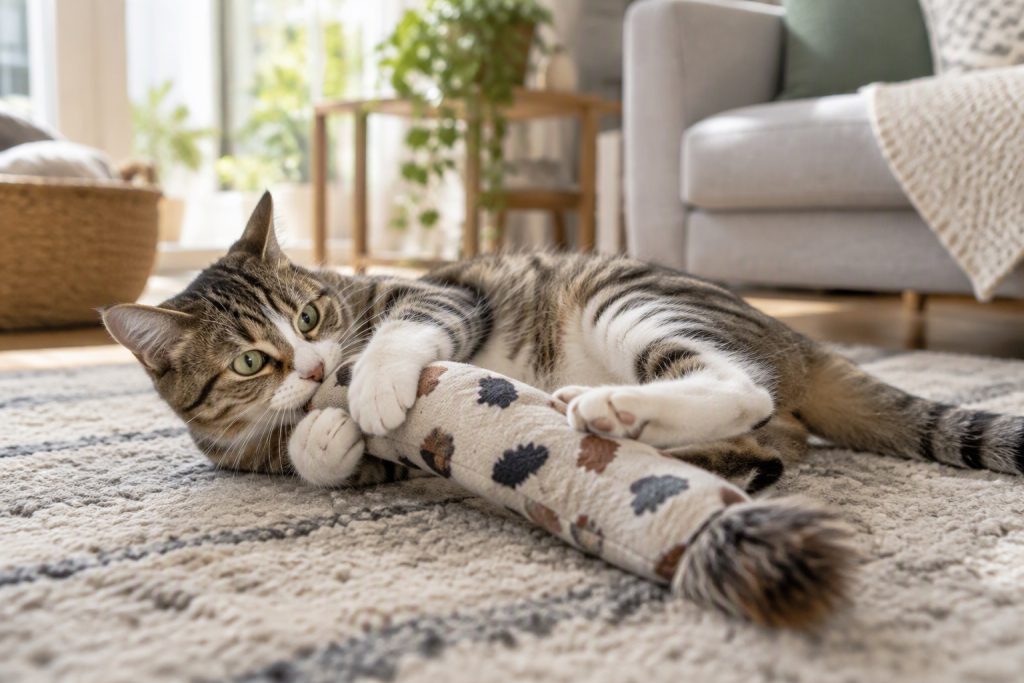
The best cat kicker toy is a long, soft, plush cylinder roughly the length of your cat’s body, firm enough to grip with both front paws but soft enough for bunny-kicking with the hind legs, and big enough that her claws cannot reach your hand through it. Length and stuffing density matter more than colour or novelty. A kicker that is too short puts your fingers in the danger zone, and one that is too floppy will not survive the grip.
- Length should roughly match your cat’s body.
- Firm stuffing supports a full hind-leg grip.
- No loose parts or crinkly plastic inside.
- Catnip filling raises its appeal for many cats.
What makes a good cat kicker toy?
Three things: size, density, and safety. Size first, because a kicker works by giving your cat something to wrap her front paws around while she rakes with her hind legs, and that only works if the toy is long enough. A good rule of thumb is a toy roughly as long as your cat from chest to tail base, which for most cats is 25 to 35 centimetres. Density next: the toy needs enough stuffing to hold its shape under a hard grip, but not so much that it feels like a brick. Soft but resilient is the target. Safety last, and most important: no loose ribbons, no bells that can be pulled off and swallowed, no plastic crinkle sheets that can be chewed through, and no long, thin appendages. If the toy has a loop, a string, or a tail, expect your cat to destroy it, so check it after every session.
A rotating ABS plastic and feather wand fits a cat that needs a target more than another thing…
Why do cats kick toys with their back legs?
The bunny kick is a genuine hunting behaviour. In the wild, a cat holds prey down with the front paws and rakes with the hind legs to disembowel or disable it, and the same motor pattern appears in play. It also serves a defensive purpose, letting a cat strike at a threat held at a distance. That is why a kicker toy is one of the few toys that lets a cat complete an entire natural sequence: stalk, grab, hold, and rake. For a cat who has been attacking ankles or hands, a kicker is often the most effective redirection, because it offers the exact same body contact without the injury. It is also a good toy for solo play, unlike a wand toy that needs you to move it. If your cat is a determined grabber, our article on why cats bring toys explains why she may also carry it around the house.
What size and filling should I choose?
Match the length to your cat, not to the photograph on the packet. A toy that is too short means your hand is close to the hind claws, and that is how owners get scratched. A toy that is too long is awkward for a smaller cat to hold. Around 25 to 35 centimetres suits most adults. For filling, look for a firm but compressible plush, usually a synthetic fibre, with the stuffing secured so it cannot be pulled out in clumps. Polyester fibre is the standard and is fine if the seams are strong. Avoid toys filled with beads, pellets, or anything small that could escape if the seam splits. A kicker with a slight curve or a shaped end suits some cats better than a plain cylinder, because it gives the front paws something to hook. If you have a very large cat, size up rather than settling for a standard toy.
Are kicker toys safe for cats?
They are safe when they are intact and unsupervised play is short. The main risks are ingestion and entanglement. Loose eyes, bells, ribbons, feathers, and elastic loops are all swallowable, and a swallowed foreign body can require surgery. Crinkle plastic inside a fabric sleeve is a particular risk once a cat chews through the outer layer. Check the toy after every session and throw it away as soon as it starts shedding filling, losing parts, or splitting at the seams. Avoid toys with long strings, which can wrap around a leg or a neck. Do not leave a kicker out for hours of unsupervised play if your cat is a chewer; instead, keep it in a cupboard and bring it out for sessions. If your cat has ever eaten part of a toy, or if she vomits after play, see your vet promptly rather than waiting for symptoms to pass.
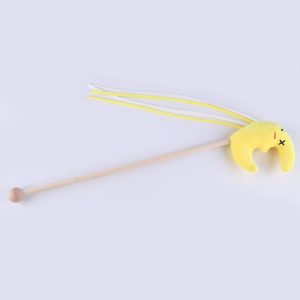
A plush toy that gives a cat a soft target to pounce on — a soft target takes…
Do catnip and silvervine make a kicker better?
For many cats, yes. Around half to two-thirds of cats respond to catnip, and a similar proportion respond to silvervine, with some cats responding to one and not the other. The response is a genetic trait, so a cat who ignores catnip is not broken; she simply does not have the sensitivity. For a cat who does respond, a kicker filled with catnip or silvervine becomes far more interesting, because she will grab, bite, and rake it more intensely. If your cat does not respond, try silvervine before giving up, and remember that the effect fades after ten to fifteen minutes, so rotating the toy in and out of a sealed bag refreshes it. Avoid spraying catnip oil directly on the fabric if your cat is prone to skin sensitivity. And never use catnip as a substitute for interactive play; it is an enhancer, not a replacement.
How do I use a kicker toy in play?
Offer it rather than throwing it. Hold the kicker near your cat’s chest and let her grab it with both front paws, then support it so she can rake with her hind legs. Keep your hands well behind the toy at all times. If she grabs your hand instead, stop the game immediately, go still, and withdraw, then re-offer the toy. Combine the kicker with a wand toy: use the wand for the chase, then present the kicker for the catch and the kick, which completes the sequence. End the session with a treat or a small meal. Store the kicker out of reach between sessions so it stays novel, and rotate it with two or three other toys. If the toy is losing appeal, put it away for a week, or refresh it with catnip. A cat who has a reliable outlet for grabbing and kicking is far less likely to use your arm or ankle instead. Our guide to toys for bored cats covers how to build a fuller rotation.
Frequently asked questions
- What size should a cat kicker toy be? Roughly the length of your cat’s body, about 25 to 35 centimetres for most adults.
- Why does my cat kick her toy with her back legs? It is a natural hunting and defence behaviour called bunny kicking.
- Are kicker toys safe to leave with my cat? Only if they are intact and your cat is not a chewer. Check seams and parts regularly.
- What if my cat ignores her kicker toy? Try silvervine, refresh the catnip, or use the toy as part of a wand-led chase.
- Can a kicker toy replace interactive play? No. It adds an outlet for grabbing, but wand play still matters for the chase.





