

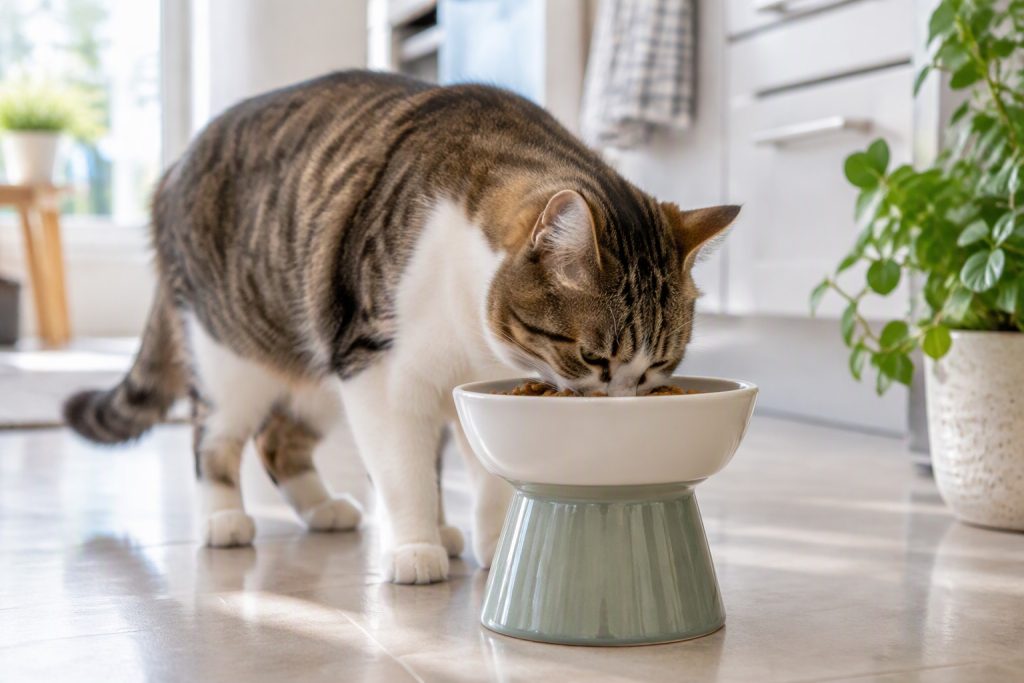
The best raised cat bowl is one that puts the food or water at roughly the level of your cat’s lower chest, so she can eat with her neck in a neutral, relaxed position. For most adult cats that means a bowl raised about 8 to 12 centimetres off the floor, with a wide, shallow dish that keeps her whiskers clear of the sides. Raised bowls help most with cats who gulp, regurgitate, or have joint stiffness, but they are not necessary for every cat.
- Raise to chest height, roughly 8-12 cm.
- Choose wide, shallow dishes, not deep cups.
- Most useful for seniors, gulpers, and flat-faced cats.
- Clean bowls daily to prevent chin acne.
Do cats actually need raised bowls?
Some do, and some do not. A raised bowl is genuinely helpful for three groups: older cats with arthritis in the neck or shoulders, who find it painful to lower their heads to the floor; cats who eat very fast and then regurgitate, because a raised bowl can slightly reduce the gulping of air; and flat-faced breeds with shortened airways, who often find it easier to swallow with the head higher. For a young, healthy, flexible cat, a bowl on the floor is perfectly fine, and there is no strong evidence that raising it prevents disease in otherwise healthy animals. The honest position is that raised bowls are a comfort and management tool rather than a medical necessity. If your cat is a senior, is stiff in the mornings, or leaves a trail of regurgitated food after meals, raising the bowl is a cheap change worth trying. Our article on slow feeders for cats covers the other main approach to fast eating.
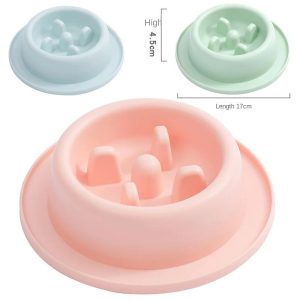
Round bowl with a removable flower insert. Made from PP. Made for daily feeding and fresh water. Keeps…
How high should a raised cat bowl be?
Set the rim so it sits roughly level with the point of your cat’s shoulder or lower chest when she stands normally. For an average adult cat that is around 8 to 12 centimetres from the floor, and for a larger cat it may be 15 centimetres or more. The test is simple: watch her eat. Her neck should be close to horizontal, her back should not be arched downward, and her shoulders should look relaxed rather than hunched. If she has to lower her head noticeably, the bowl is too low. If she has to reach up, or if food falls back out of her mouth, it is too high. Height needs change with age, so a stand you bought for a young cat may be too low for her at fifteen. Look for an adjustable stand, or one that comes with a shallow bowl you can raise with a simple riser. Always put both food and water at a comfortable height, since water intake matters just as much.
What bowl shape and material work best?
Wide and shallow beats tall and narrow. A deep, narrow bowl forces the whiskers to press against the sides, which many cats find unpleasant, and it makes it harder to see the food. Choose a dish that is wide enough for her whole face and shallow enough that she can reach the bottom without her nose touching the rim. Material matters too. Stainless steel and ceramic are easy to clean and do not hold odours, while plastic is lighter and cheaper but can scratch, harbour bacteria, and is often implicated in chin acne. Some cats are sensitive to plastic. Whisker-friendly designs, which are wide, flat, and often slightly tilted, suit cats who leave food around the edges. If you feed wet food, a shallow dish also helps you see how much she has eaten. Avoid bowls that move around while she eats, since sliding dishes are irritating and can put a cat off her meal.
Can a raised bowl help with regurgitation or vomiting?
It can help with one specific pattern and not others, and the distinction matters. Regurgitation is the passive return of undigested food shortly after eating, often because the cat ate too fast or swallowed too much air. Raising the bowl so the head is higher can reduce air swallowing, and slowing the meal down with a puzzle feeder or a wider, flatter dish often helps more. Vomiting is different: it involves active retching and often brings up digested food or bile, and it usually has a medical cause such as eating something unsuitable, a food intolerance, parasites, or an underlying illness. A raised bowl will not fix vomiting. If your cat vomits repeatedly, loses weight, or seems unwell, see your vet. Our guide to cat diet change guide explains how to transition food safely when diet is the suspected trigger.
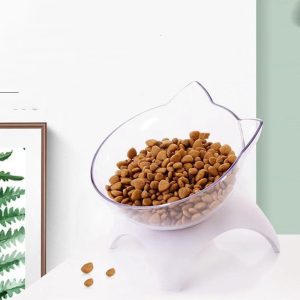
Clear glass bowl holding dry food. Made from plastic. Made for daily feeding and fresh water. Keeps food…
Do raised bowls help with whisker fatigue and chin acne?
Whisker fatigue is not a formally recognised medical diagnosis, but many owners report that their cats eat more comfortably from wide, shallow dishes, and the reasoning is sound: whiskers are highly sensitive and pressing them against a bowl wall is genuinely irritating for some cats. A wide bowl that clears the whiskers is a low-risk change worth making. Chin acne is a real and common skin condition, presenting as blackheads and small pimples on the chin and lower lip. It is associated with plastic bowls, poor bowl hygiene, and food residue sitting on the skin. The fix is to switch to stainless steel or ceramic, wash the bowls daily in hot soapy water, and dry them fully. A raised bowl helps indirectly by reducing the amount of food that ends up smeared on the chin, but the material and cleaning matter more than the height. If acne persists despite good hygiene, see your vet.
How do I get my cat to accept a raised bowl?
Change one thing at a time. Put the new raised stand in exactly the same spot as the old bowl, at the same time of day, with the same food, so the only difference is the height. If your cat is cautious, start with the bowl on the floor of the stand, or use a stand at the lowest setting, and raise it gradually over a week. Keep the old bowl nearby for the first few days so she always has a familiar option. Cats are sensitive to smell, so wash the new bowl thoroughly before first use to remove any manufacturing or packaging odour. If she refuses to eat from it after two days, try a different bowl shape on the same stand, because the dish is more often the objection than the height. Never remove her old bowl entirely until she is eating confidently from the new one, and never let a food refusal run on for more than a day in a cat, since cats can become unwell quickly without food.
Frequently asked questions
- What height should a raised cat bowl be? Roughly level with the lower chest, about 8 to 12 centimetres for an average adult cat.
- Are raised bowls better for cats? They help seniors, fast eaters, and flat-faced cats, but healthy young cats do fine with bowls on the floor.
- Do raised bowls stop vomiting? No. They may help regurgitation from fast eating, but vomiting usually has a medical cause.
- Is plastic bad for cat bowls? Plastic scratches and can harbour bacteria, and it is linked to chin acne. Steel or ceramic is better.
- Should food and water be raised together? Yes, if you raise one, raise both, since water intake matters just as much as food.





