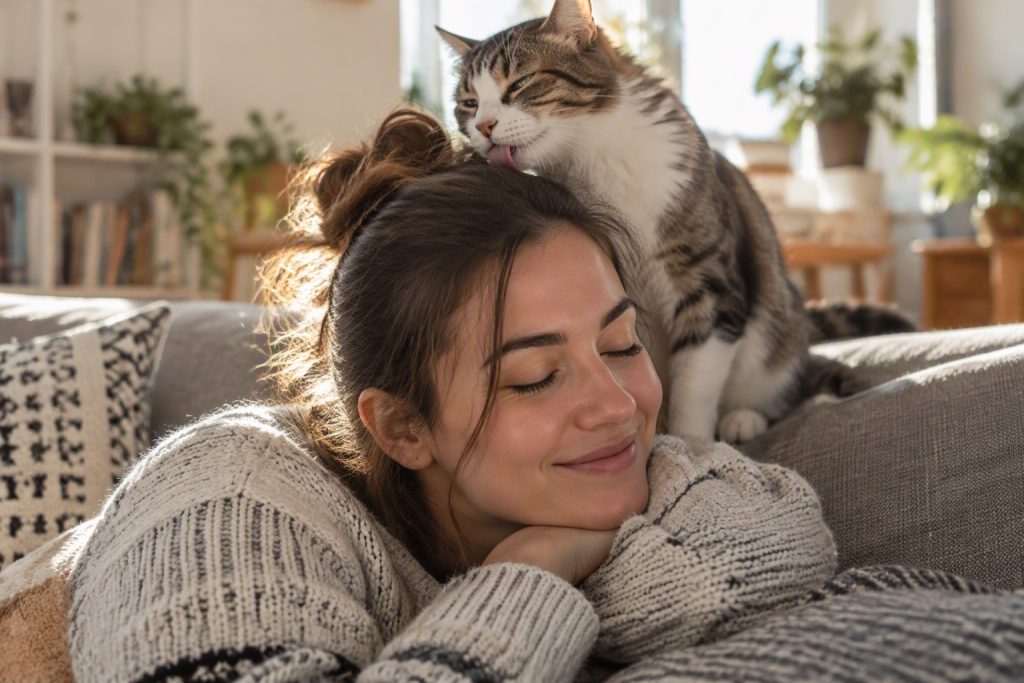
Cats lick hair as a social grooming behaviour, and for many cats it is a genuine sign of affection and belonging. Your hair also moves, smells of you, and hangs at a convenient height, which makes it an easy target. In most cases it is harmless bonding. It becomes worth thinking about if the licking is obsessive, if your cat is pulling out hair, or if the behaviour is new and comes with other changes in her routine or health.
- Allogrooming is normal social bonding behaviour.
- Your hair moves and smells like you.
- Occasional licking is nothing to worry about.
- Obsessive licking or hair pulling needs a vet.
Why does my cat lick my hair?
Licking another individual is called allogrooming, and cats do it to bonded companions, including their humans. In a cat colony, cats groom each other to reinforce social bonds and to share scent, and your cat treats you as part of her group. Your hair is an ideal target for this behaviour: it is close to your head, which is a socially significant area, it moves and responds to her, and it carries your scent plus the residue of whatever shampoo or product you use. Some cats are also drawn to the texture and to the sensation of grooming something soft. If you have recently washed your hair, or if you have used a new product, expect more interest, since the smell is different and therefore interesting. This is very often the same impulse behind a cat licking your hand or arm, which our article on why cats lick me explains in more detail.
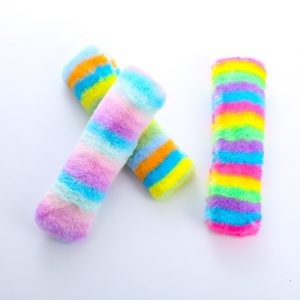
Rainbow-striped plush cylinder. Keeps a bored indoor cat busy and burns off restless energy. Made from fleece and…
Is it affectionate or a sign of anxiety?
It can be either, and the context tells you which. Affectionate licking is usually relaxed: your cat is purring, her ears are forward, her body is loose, and she settles against you while she does it. She may also knead or headbutt. Anxiety-driven licking tends to look different: it is repetitive and hard to interrupt, it may focus on one spot, and it often comes with other displacement behaviours such as over-grooming her own body, pacing, or excessive vocalising. A cat who licks your hair obsessively at the same time each day, or who cannot be distracted from it, is more likely working off tension than expressing affection. Changes in the household, such as a new pet, a move, or a change in your working hours, are common triggers. If you cannot tell which it is, look at the rest of her behaviour rather than the licking alone.
Why does my cat lick my hair and not my partner’s?
Several factors decide who gets groomed. The strongest is bond: a cat grooms the individual she is most attached to, which is usually the person who feeds her, plays with her, and spends the most time nearby. The second is hair itself. Longer, thicker, or differently textured hair is more satisfying to groom than short hair, and fine hair that moves easily is more interesting. The third is product. Shampoo, conditioner, hair oil, and styling products all leave a scent and a residue that a cat may find appealing or simply novel, and a cat who likes one person’s shampoo will return to it. The fourth is behaviour: a person who stays still and does not react becomes a better grooming subject. If your partner flinches or moves away, the cat learns to skip them. None of this is a judgement on your relationship; it is simply reward and opportunity.
Is my hair safe for my cat to lick?
Mostly, but a few products are worth checking. Cats groom themselves after licking you, so anything on your hair ends up being swallowed in small amounts. Hair dyes, chemical straightening or perming treatments, and medicated scalp treatments are the main concerns, particularly in the days right after application. Some essential oils used in hair products, including tea tree, eucalyptus, peppermint, and citrus oils, are toxic to cats, and while the amount transferred from hair is small, it is sensible to avoid close contact immediately after use. Minoxidil, used for hair loss, is highly toxic to cats and even small exposures can be dangerous, so keep it well away from your cat and never let her lick your scalp or pillow. If you are unsure about a product, check with your vet, and discourage licking for a day or two after applying anything new.
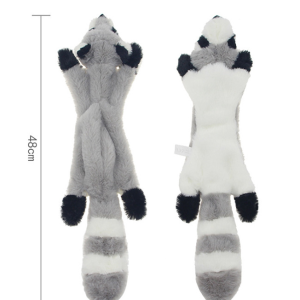
Made from cloth Key features 【Name】 : cat simulation animal sound shell toy[Fill]: No fill, 2 built-in BB…
How do I discourage hair licking gently?
Redirect rather than punish. The simplest method is to offer something else to lick: hold a soft toy or a grooming brush, or guide her to a licking mat, which satisfies the same oral behaviour in a safer way. You can also move your hair out of reach by tying it up, wearing a soft hat, or simply shifting position, so the habit does not get rehearsed. If she licks while you are relaxing, redirect with a wand toy to convert the energy into play, which meets the same need for engagement. Never shout at her or push her away sharply, since that damages trust and can make her more anxious, which may increase the behaviour. If she is licking because she is bored, adding a proper daily play session and a puzzle feeder often reduces it within a week or two.
When does hair licking become a problem?
It becomes a concern when it is compulsive, when it damages your scalp, or when it is part of a wider pattern. Signs to take seriously include licking that is impossible to interrupt, licking that continues until your scalp is sore or your cat is panting, and licking that is accompanied by pulling out her own fur or yours. Cats who over-groom their own bodies often have an underlying cause: parasites, allergies, skin infection, pain, or stress. Our article on why cats groom excessively explains how to tell normal grooming from a problem. A sudden new interest in licking, especially in an older cat, is also worth a vet check, because discomfort and cognitive changes can both alter behaviour. Anything compulsive, persistent, or accompanied by skin or coat changes deserves veterinary advice rather than a behavioural fix alone.
Frequently asked questions
- Why does my cat lick my hair so much? It is social grooming, and your hair is close, soft, and smells of you.
- Is hair licking a sign my cat loves me? Often yes. Allogrooming is a bonding behaviour between cats who are close.
- Can my cat get sick from licking my hair products? Some products, especially minoxidil and certain essential oils, are toxic, so avoid close contact after use.
- How do I stop my cat licking my hair? Redirect to a toy or licking mat, and tie your hair back rather than punishing her.
- My cat pulls out my hair while grooming. Is that normal? Occasional tugging is normal, but persistent pulling or obsessive licking needs a vet check.