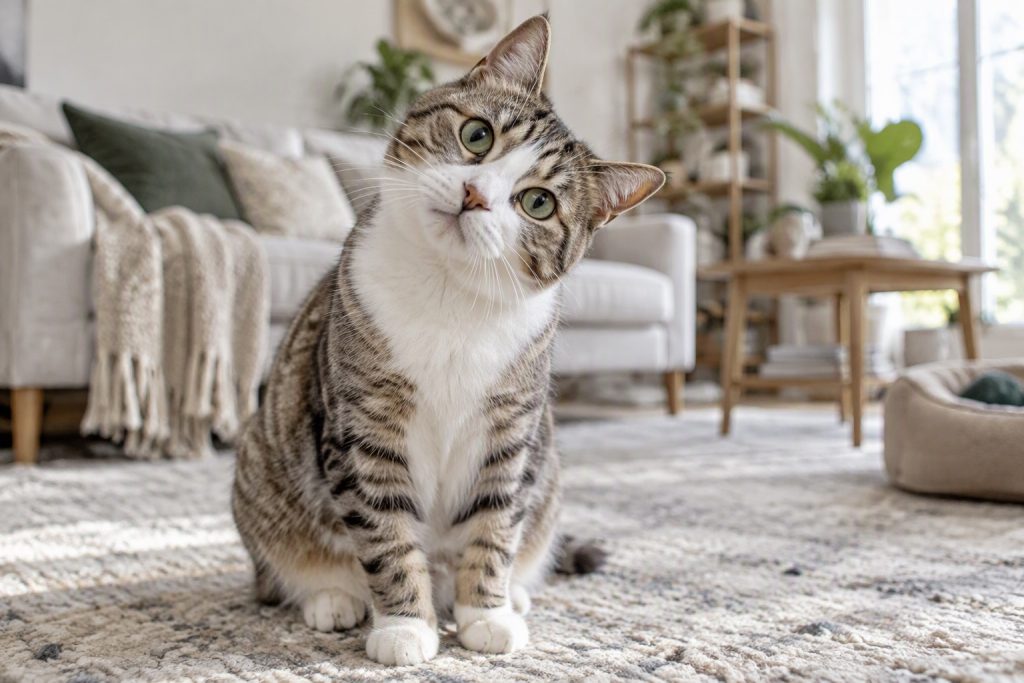
A cat tilts its head for two very different reasons: a quick, transient tilt is usually communication or curiosity, while a persistent tilt that lasts minutes or hours is usually a sign of something wrong in the ear, the balance system, or the mouth. The useful question is not “why did she tilt?” but “how long did it last, and what else came with it?” A tilt paired with head shaking, scratching, discharge, or a loss of balance needs a vet promptly.
- Brief tilts during play or listening are normal.
- A tilt that lasts needs a vet check.
- Ear mites and infections are the usual causes.
- Balance loss, nystagmus, or circling is urgent.
When is a head tilt completely normal?
Cats tilt their heads constantly as part of ordinary life. She may tilt to bring one ear closer to a sound she is trying to locate, especially a high-pitched noise like a squeak or a bird outside the window. She may tilt while tracking an insect, while watching a wand toy arc overhead, or while listening to you speak in a particular tone. A tilt often accompanies a slow blink or a relaxed, half-closed eye, which tells you it is social rather than medical. Cats also tilt briefly when something touches an ear, or when they are about to bat at an object. The key features of a normal tilt are that it is short, it resolves on its own within seconds, and your cat otherwise behaves exactly as usual: eating, playing, jumping, and using the litter box. If those conditions are met, there is nothing to worry about and no reason to intervene.
Made from cloth Key features 【Name】 : cat simulation animal sound shell toy[Fill]: No fill, 2 built-in BB…
What ear problems cause a persistent head tilt?
The most common causes sit in the ear canal. Ear mites are a classic trigger in cats, producing intense itching that leads to head shaking, scratching, and a tilt toward the affected side, often with dark, crumbly debris that looks like coffee grounds. Our guide to cat ear mites treatment explains what to look for and why treatment must cover every pet in the house. Bacterial and yeast infections also cause tilting, usually with redness, swelling, discharge, and a sour smell. A foreign body such as a grass seed can lodge in the canal and cause sudden, violent head shaking. Polyps, tumours, and a ruptured eardrum are less common but more serious. In each of these cases the tilt is the cat’s attempt to relieve pressure or pain, which is why it persists rather than flickering in and out. Anything lasting more than a few hours warrants an examination.
Can a head tilt mean something neurological?
Yes, and this is the distinction that matters most. When the tilt comes from the inner ear or the vestibular system rather than the outer canal, it is usually accompanied by other signs: a loss of balance, a drunken, weaving walk, rapid flickering eye movements called nystagmus, circling in one direction, falling, or a reluctance to move at all. Some cats develop a drooping eyelid or facial asymmetry on the same side. These signs point to vestibular disease, which can be caused by an inner ear infection, a head injury, a toxin, or in older cats an idiopathic condition that often improves over days to weeks. Vestibular disease is not something to manage at home. It is also genuinely frightening for a cat, who may feel like the room is spinning. If you see any of these signs alongside a tilt, contact your vet the same day.
Are there non-ear reasons a cat tilts its head?
Plenty. Dental pain is a frequent hidden cause: a sore tooth or inflamed gum on one side makes a cat hold her head at an angle to eat, and you may also see her drop food or chew on one side only. Neck pain, arthritis in the cervical spine, or a soft tissue injury from a jump can all produce a tilt, because the cat is holding her head in the least painful position. Vision problems sometimes cause a tilt too, as the cat tries to align a clearer part of her visual field. Some cats tilt habitually after an old injury, and the tilt is a permanent leftover rather than an active problem. If the tilt is new, is accompanied by any change in eating, and your cat is older, then dental disease and neck pain are both worth raising with your vet.

Rainbow-striped plush cylinder. Keeps a bored indoor cat busy and burns off restless energy. Made from fleece and…
How do I check my cat’s ears at home?
Look before you touch. In good light, gently fold the ear flap back and inspect the visible part of the canal. A healthy ear is pale pink, mostly clean, and smells faintly of nothing much. You are looking for redness, swelling, discharge, crusting, dark debris, a strong smell, or any lump. Then watch her behaviour for a minute: head shaking, scratching at one ear, rubbing the ear along furniture, or holding one ear flat are all meaningful. Never push a cotton bud into the canal, because you can pack debris deeper or damage the eardrum. Never pour anything into an ear that has discharge or a suspected rupture without veterinary advice. Our step-by-step guide to how to clean cat ears covers the safe method for routine cleaning of a healthy ear, which is a very different job from treating an infection.
When should I take my cat to the vet for a head tilt?
Book an appointment if the tilt lasts more than a few hours, if it comes and goes repeatedly, or if it is paired with head shaking, scratching, discharge, or a smell. Treat it as urgent, meaning the same day, if your cat is off balance, walking in circles, falling over, unable to stand, vomiting repeatedly, or showing flickering eyes. Also act promptly if the tilt appeared suddenly after a fall, a collision, or possible exposure to a toxin. A vet will examine the ear canal with an otoscope, check the eardrum, assess balance and cranial nerves, and may take a swab or recommend imaging. Most causes are treatable, and the ones that are not are usually easier to manage the earlier they are found. Do not try home remedies in the ear before the examination, because they can obscure what the vet needs to see.
Frequently asked questions
- Why does my cat tilt its head when I talk to her? She is locating the sound and reading your tone, which is normal social behaviour.
- Can a head tilt in cats go away on its own? Brief tilts resolve in seconds. A persistent tilt may improve with treatment but should always be assessed.
- Is a head tilt always ear mites? No. Mites are common, but infections, dental pain, and vestibular disease also cause tilting.
- Should I clean my cat’s ears if she is tilting her head? Not if there is discharge, swelling, or pain. Have a vet examine the ear first.
- Is head tilting in older cats more serious? It can be, since vestibular disease, dental disease, and neck arthritis are all more common with age.