

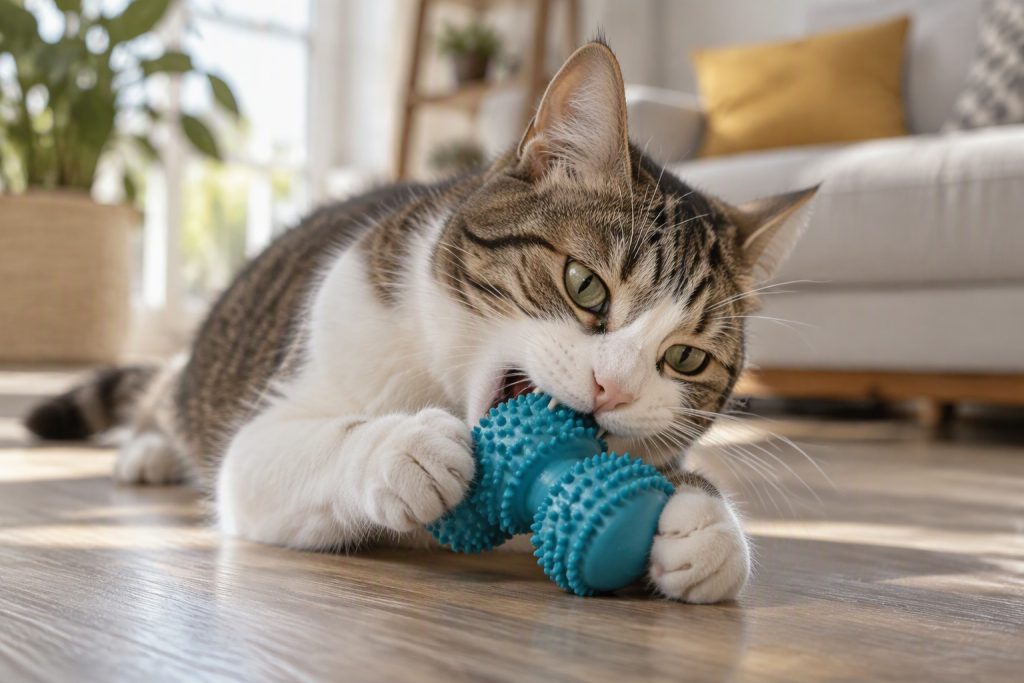
Dental toys for cats can help a little, mainly by encouraging chewing that produces saliva and by gently rubbing the tooth surface, but they are not a substitute for brushing. The most useful dental toys are soft, textured, and safe to chew, and they work best alongside brushing and regular vet checks. Anything hard enough to crack a tooth is a risk rather than a benefit.
- Dental toys support, but do not replace, brushing.
- Soft, textured chew toys are the safest choice.
- Hard toys can fracture teeth, so avoid them.
- Pair toys with brushing and vet checks.
Do dental toys actually clean a cat’s teeth?
They help modestly, and it is worth being realistic. When a cat chews a textured toy, the surface rubs against the teeth and can dislodge some soft plaque before it hardens into tartar. Chewing also increases saliva flow, which buffers acids and helps rinse the mouth. What toys cannot do is clean the gum line, which is where gingivitis and periodontal disease begin, and they cannot remove established tartar. Coverage is also limited, since a cat chews with her back teeth, so the front teeth and the gum line get little benefit. That said, a toy is far better than nothing for a cat who will not tolerate a brush, and it gives her something appropriate to chew. Think of dental toys as one layer in a routine, alongside brushing, dental chews, and professional care. Our guide on cat teeth cleaning covers the full picture.

A rotating ABS plastic and feather wand fits a cat that needs a target more than another thing…
What makes a good dental toy for cats?
Texture, softness, and size matter most. Look for a toy with a slightly rough or nubbed surface that provides gentle friction against the teeth, made from a soft, flexible material that gives under pressure rather than cracking. Size should suit your cat’s mouth: small enough to bite comfortably, but not so small that it can be swallowed. Avoid anything with loose parts, ribbons, or bells that could come off and be ingested. The toy should also be appealing enough that your cat actually plays with it, because a dental toy that sits in a basket does nothing. Some designs combine a chewable texture with a catnip filling or a treat pocket, which encourages engagement. Durability matters too, since a toy that shreds into pieces becomes a choking and blockage risk. Wash it regularly and check for damage after each play session. Our article on the best toys for bored cats helps you pick toys your cat will actually use.
Which dental toys work best?
The best option is usually a soft, textured chew toy that your cat will mouth and gnaw. Rubber or silicone toys with gentle nubs or ridges are the most common and the safest, since they flex rather than splinter. Some cats enjoy a dental toy with a treat compartment, which keeps them chewing for longer. Textured balls and soft rings work for cats who bat and mouth toys. Catnip-stuffed chew toys can also encourage the mouthing that provides the friction. What tends not to work well is anything rigid: hard plastic, dense rubber, antlers, bones, or hooves are all too hard for a cat’s teeth and are a known cause of fractures. Also avoid toys that are too soft to provide any friction, since they provide no cleaning benefit. The ideal toy sits in the middle: firm enough to rub, soft enough to give, and interesting enough to hold her attention for several minutes at a time.
Are dental toys safe?
They are safe when chosen carefully, but the risks are real. The main danger is hardness: a toy that does not flex can fracture a tooth, which is painful and often requires extraction. The second is breakage: a toy that shreds into small pieces can be swallowed, causing a choking hazard or an intestinal blockage. The third is size, since a toy small enough to be swallowed whole is unsafe. Check toys regularly for cracks, tears, and loose parts, and throw them away at the first sign of damage. Supervise your cat while she plays, especially with a new toy, and remove it if she starts tearing pieces off. Avoid toys with strings, ribbons, or small bells. Also be careful with toys that hold treats, since a cat can work a piece loose and swallow it. If your cat is a determined chewer, choose the toughest safe material available and check it after every session, replacing it at the first sign of splitting or missing pieces.
A plush toy that gives a cat a soft target to pounce on — a soft target takes…
How do I get my cat to use a dental toy?
Make it a game rather than a chore. Introduce the toy during play, rolling it or dangling it so she bats and mouths it naturally. Rubbing it with catnip or silver vine increases interest for many cats, and a toy with a treat pocket can be filled with a few small treats or a smear of cat-safe paste. Play with her using the toy for a minute or two at a time, and reward her when she mouths it. Some cats take to a chew toy immediately, while others need several introductions before they engage. If she ignores it entirely, try a different texture or shape, since cats have clear preferences. Keep the toy in rotation rather than leaving it out permanently, so novelty stays high. And remember that even a cat who loves her dental toy still benefits from brushing, so use the toy as an extra rather than the main event.
When are dental toys not enough?
Dental toys are not enough when there is actual disease. If your cat has bad breath that persists, red or bleeding gums, drooling, difficulty eating, pawing at her mouth, or visibly brown tartar, she needs a veterinary dental assessment, not more toys. Gum disease and tooth resorption are common in cats, they are painful, and they need professional cleaning or extraction under anaesthesia. A dental toy cannot remove hardened tartar or treat infection, and relying on one while disease progresses only delays treatment. Signs of pain can be subtle: a cat may drop food, chew on one side, eat more slowly, or become reluctant to eat hard food. If you notice any of these, book a vet visit. After a professional clean, dental toys, chews, and brushing can help maintain the result. Oral health that persists as a problem is always best handled professionally, and early treatment is far kinder than waiting.
Frequently asked questions
- Do dental toys really clean cat teeth? They help reduce surface plaque and increase saliva, but they do not clean the gum line.
- Are hard chew toys safe for cats? No. Very hard toys can fracture teeth and should be avoided.
- What is the best dental toy for cats? A soft, textured, chewable toy your cat will actually mouth, ideally with catnip or a treat pocket.
- Can dental toys replace brushing? No. Brushing removes plaque from all surfaces, including the gum line, which toys cannot reach.
- When should I see a vet about my cat’s teeth? With bad breath, red gums, drooling, or difficulty eating, book a dental check.





