

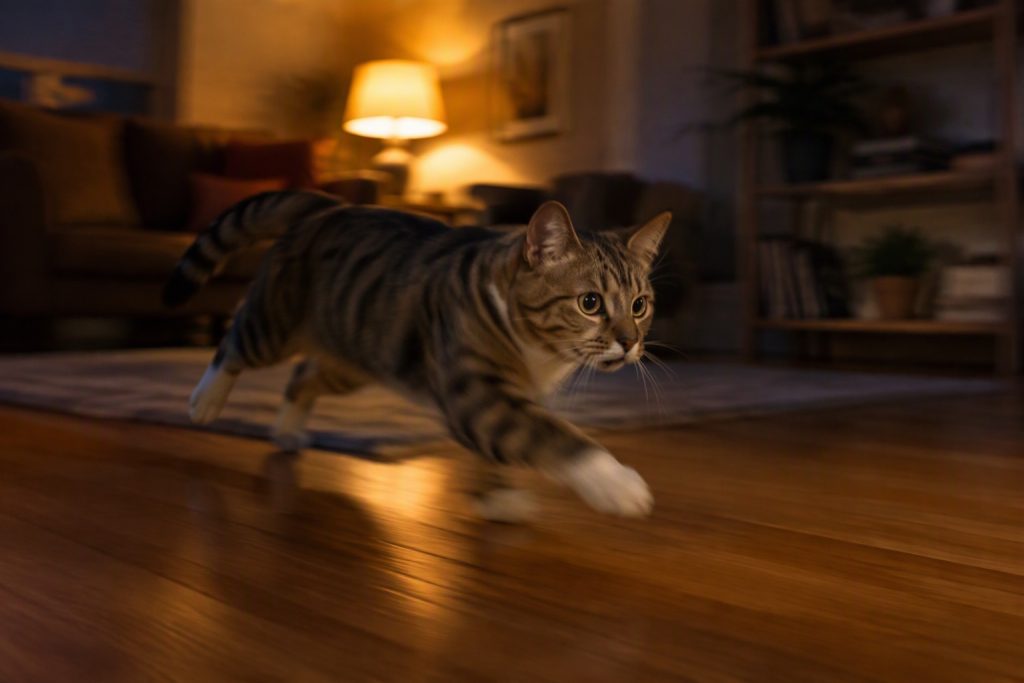
Cats run around at night because they are crepuscular by nature, most active at dawn and dusk, and because a day spent resting leaves energy to burn when the house goes quiet. Boredom, hunger, and a habit of getting a reaction from you all make it worse. The practical fix is to tire her out with a proper play session and a meal before bed, then make the night unrewarding so the behaviour stops paying off.
- Cats are naturally active at dawn and dusk.
- Unspent daytime energy fuels night activity.
- Play hard, then feed, before you sleep.
- Do not reward night noise with attention.
Why does my cat run around at night?
The core reason is biology. Cats are crepuscular, meaning they are wired to be most active around dawn and dusk, when their natural prey is on the move. An indoor cat has no hunting to do, so that energy has to go somewhere, and a long, quiet day gives it plenty of time to build. Night zoomies, the sudden bursts of running, jumping, and pouncing, are the release. Boredom is the biggest amplifier: a cat with little stimulation during the day will be restless at night. Hunger plays a role too, especially if her last meal was early in the evening. And there is a learned component: if running around has ever produced attention, whether you got up, called out, or fed her, she has learned that the night is when the household responds. Our article on why a cat meows at night covers the vocal version of the same pattern.

A teaser wand built to turn a few minutes into a full hunt — a cat needs to…
Is night zooming normal?
Yes, it is completely normal feline behaviour. Sudden bursts of running, racing up and down stairs, pouncing on invisible prey, and tearing around at speed are common, especially in younger cats, and they are usually a healthy sign of energy and playfulness. Kittens and young adults do it most, and even older cats have occasional bursts. The behaviour is not a sign of illness or unhappiness in itself. It becomes a problem only when it disrupts your sleep, damages things, or is accompanied by other signs such as vocalising for hours, destructive scratching, or aggression. If your cat is zooming for a few minutes and then settling, that is simply a cat being a cat. The goal is not to eliminate the behaviour but to shift it earlier in the evening, so that the burst of activity happens before you go to bed rather than at three in the morning.
How do I tire my cat out before bed?
The most effective approach is to run a proper hunting-style play session in the evening. Use a wand toy and move it like prey: dart it, hide it, drag it along the floor, let it escape, then let your cat catch it. Aim for ten to fifteen minutes of genuine exertion, with your cat running, jumping, and stalking, not just watching. Let her win at the end by catching the toy, because a hunt that never concludes leaves a cat frustrated and more likely to resume later. If she is not tired, the session was too short or too passive. Repeat play earlier in the day too, since a cat who has had two good sessions is far calmer at night. Rotate toys to keep novelty high, and add a food puzzle in the evening for cats who are home alone. Our article on a cat biting ankles at night shows the same solution applied to a related problem.
Does feeding time help?
Yes, and it is one of the most useful levers you have. Cats naturally follow a hunt-eat-groom-sleep cycle, so finishing play with a meal taps directly into that pattern. Feed the largest meal of the day, or at least a substantial one, right after the evening play session and close to your bedtime. A full stomach and a completed hunt signal that it is time to groom and sleep, which is exactly what you want. An automatic feeder set for the early hours can also help a cat who wakes you for food, by removing you from the equation entirely. If your cat is on a restricted diet, split her daily allowance so a portion lands at night rather than adding extra food. Do not free-feed all day, since a cat who grazes is never hungry and has no reason to settle after a meal. If your cat wakes you for food, moving her meals later or using an automatic feeder takes you out of the equation, which is what breaks the habit.

Rainbow-striped plush cylinder. Keeps a bored indoor cat busy and burns off restless energy. Made from fleece and…
Should I close my cat out of the bedroom?
It can help, but it works best as part of a plan rather than on its own. If your cat wakes you by walking on you, meowing, or batting your face, closing the door removes the payoff. The catch is that she may then scratch, meow, or rattle the door, which is worse for your sleep in the short term. If you choose this route, commit to it completely for at least two weeks, because opening the door even once teaches her that persistence works. Give her a comfortable alternative: a warm bed, a food puzzle, water, and a litter box she can reach. Some cats settle better with a second cat for company. Others do better with the door open but with you ignoring all night approaches. Either way, consistency is what makes the difference, and the first few nights are usually the hardest.
When is night activity a concern?
See your vet if the night activity is new, sudden, or comes with other changes. A cat who becomes restless and vocal at night may be in pain, anxious, or unwell, and older cats in particular can develop night waking linked to cognitive changes, thyroid problems, high blood pressure, or pain from arthritis. Sudden onset in a previously settled cat is a reason to book a check-up rather than assume it is behavioural. Also watch for weight loss, increased appetite or thirst, disorientation, or accidents outside the litter box, since these point towards a medical cause. If your cat is young, healthy, and simply energetic, the answer is more play and a better routine. If something has changed in an older cat, get it checked. Health topics that persist are always best discussed with your vet.
Frequently asked questions
- Why does my cat run around at 3am? It is the crepuscular activity peak plus unspent energy, often made worse by boredom and a habit of waking you.
- Is night zooming bad? No, it is normal and often a sign of a healthy, playful cat. The issue is only if it disturbs your sleep.
- How long should I play with my cat before bed? Around ten to fifteen minutes of active, hunting-style play, ending with a catch and a meal.
- Should I get up when my cat wakes me? No. Getting up rewards the behaviour, so ignore it consistently and it usually fades.
- Can a vet help with night waking? Yes. Older cats with sudden night restlessness should be checked for pain or medical causes.





