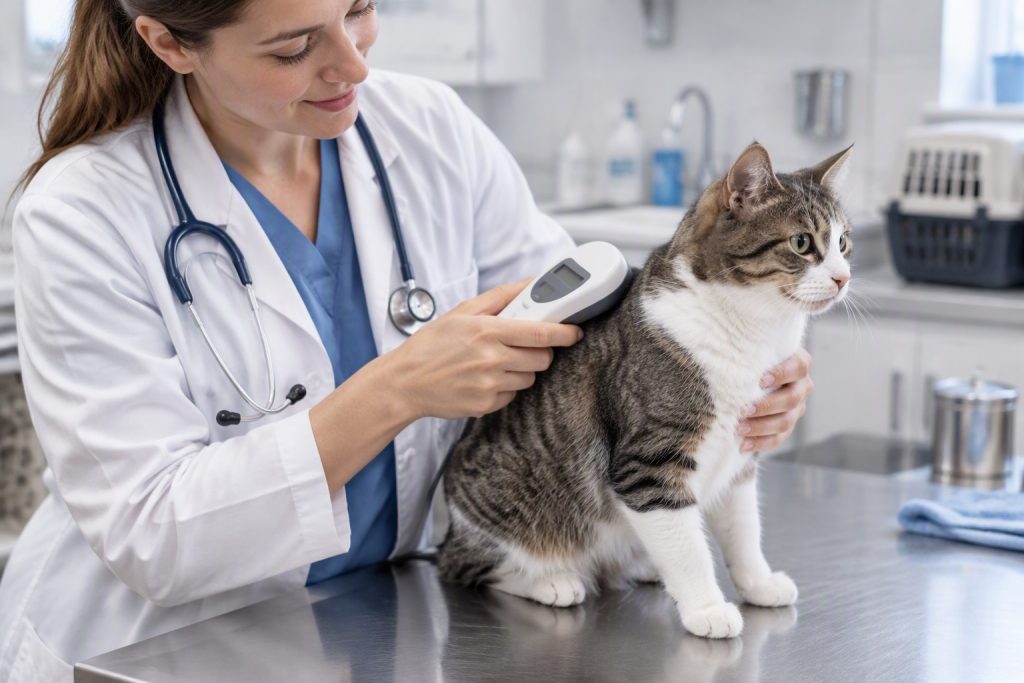
A cat microchip is a tiny, inert device, about the size of a grain of rice, implanted under the skin between the shoulder blades. It carries a unique identification number that a scanner reads, linking your cat to your contact details on a database. It is not a tracker and does not use power or GPS, but it is the most reliable way to prove ownership and get a lost cat home.
- A microchip is a permanent ID, not a GPS tracker.
- It is implanted under the skin, usually painlessly.
- Keep your contact details up to date.
- Use a microchip and a breakaway collar together.
What is a cat microchip and how does it work?
A microchip is a small, passive radio-frequency transponder encased in biocompatible glass. It contains no battery and no moving parts, and it holds only a single piece of information: a unique fifteen-digit number. When a vet, shelter, or council officer passes a scanner over your cat’s back, the scanner energises the chip with a low-power radio signal, and the chip returns its number. That number is then looked up on a pet database, which holds the owner’s contact details. The chip itself does not store your name, address, or phone number; it only links to a record you keep updated. Because it is passive, it lasts for the cat’s lifetime and cannot run out of power. Microchipping is a simple, one-off procedure, and in many places it is a legal requirement for cats, or strongly recommended. It is the standard permanent form of identification, and it works even if a collar is lost.
A reflective fabric and polyester collar is for the trips a cat actually takes, not a full day…
Does a microchip track my cat’s location?
No, and this is one of the most common misunderstandings. A standard cat microchip is not a GPS device and cannot tell you where your cat is. It has no power source and no transmitter that works at a distance; it only responds when a scanner is held close to it. That means it is only useful once your cat has been found and taken to a vet, shelter, or rescue that can scan her. GPS trackers, by contrast, are separate devices, usually attached to a collar, that use satellite or mobile signals and need charging. They can show you where your cat is in real time, but they rely on a battery and a collar, and they can be lost or removed. The two work together: a microchip proves who she is once she is found, while a GPS collar can help you find her in the first place. Neither replaces the other. If your cat is missing, you need both a registered chip and active searching, since the chip alone cannot locate her.
How is a microchip implanted?
The chip is implanted with a sterile, single-use syringe, usually by a vet or a trained professional. It is inserted under the skin between the shoulder blades, a spot with plenty of loose skin and little sensitivity. The procedure takes only a few seconds, and most cats tolerate it with no more fuss than a vaccination, sometimes with a brief flinch. Anaesthetic is not normally needed, though the chip can be implanted while a cat is already sedated for another procedure. After implantation, your vet will scan the chip to confirm it reads correctly, and you should receive paperwork with the chip number so you can register your contact details on a database. Some cats feel a small lump under the skin for a few days afterwards, which usually settles. Serious complications are rare, but as with any injection there is a small risk of infection or a reaction at the site, so contact your vet if you notice swelling, pain, or discharge.
How do I keep my cat’s microchip details up to date?
The chip is only as good as the details linked to it, so keeping them current is essential. When your cat is chipped, you or your vet register the chip number with a pet database, along with your name, address, phone number, and any alternative contacts. If you move house, change your phone number, or change your email, you must update the record, otherwise a scanner will return outdated information and the chip will not help. Keep the registration paperwork somewhere safe, note the chip number, and check the database every so often to confirm your details are correct. If you rehome a cat or adopt one, make sure the chip is transferred into your name, since a chip still registered to a previous owner can cause confusion. When you move or change contact details, update the record promptly rather than waiting. A registered chip with current details is one of the simplest, most effective things you can do to protect your cat.

A fabric and Oxford cloth harness stays close enough that a cat cannot back out of it. Take…
Is a microchip enough, or do I need a collar too?
The two work best together. A microchip is permanent and cannot fall off, which makes it the most reliable form of identification, but it can only be read by someone with a scanner, so a member of the public who finds your cat may not know to check for one. A collar with an ID tag is immediately visible, so anyone who finds your cat can call you straight away without needing a vet or a shelter. The catch is that collars can be lost or removed, which is why the microchip matters as a backup. For safety, choose a breakaway collar that releases if it catches on something, so your cat cannot be strangled or trapped. Our article on why breakaway collars matter explains how to choose one. Together, a visible tag and a registered microchip give your cat the best chance of getting home. Our guide to the first 30 days with a rescue cat covers other early safety steps.
What should I do if my cat goes missing?
Act quickly and methodically. First, search your home thoroughly, including cupboards, wardrobes, sheds, and under beds, since cats often hide nearby when frightened. Then search the immediate area, calling softly and checking hiding spots such as under cars and in bushes, ideally at quiet times like dawn or dusk. Contact your local vet clinics, shelters, and rescues with a description and the microchip number, and report your cat as missing on the database your chip is registered with, so any scan flags her as lost. Put up posters and post on local community groups and lost-pet websites, including a clear photo. Ask neighbours to check garages and outbuildings. Keep food and a familiar-smelling item, such as a used blanket, outside to attract her. Do not give up quickly, since cats are often found weeks later. Because a microchip with current details is what reunites most cats with their owners, make sure yours is registered and up to date before you ever need it.
Frequently asked questions
- Can a microchip track my cat? No. It is not a GPS device; it only works when scanned at close range.
- Does microchipping hurt a cat? It is a quick injection, usually tolerated as easily as a vaccination.
- How long does a microchip last? It is designed to last the cat’s lifetime and needs no power.
- Do I need to update my cat’s microchip details? Yes, whenever you move or change phone or email details.
- Is a collar enough without a microchip? No. Collars can be lost, so a registered microchip is the reliable backup.