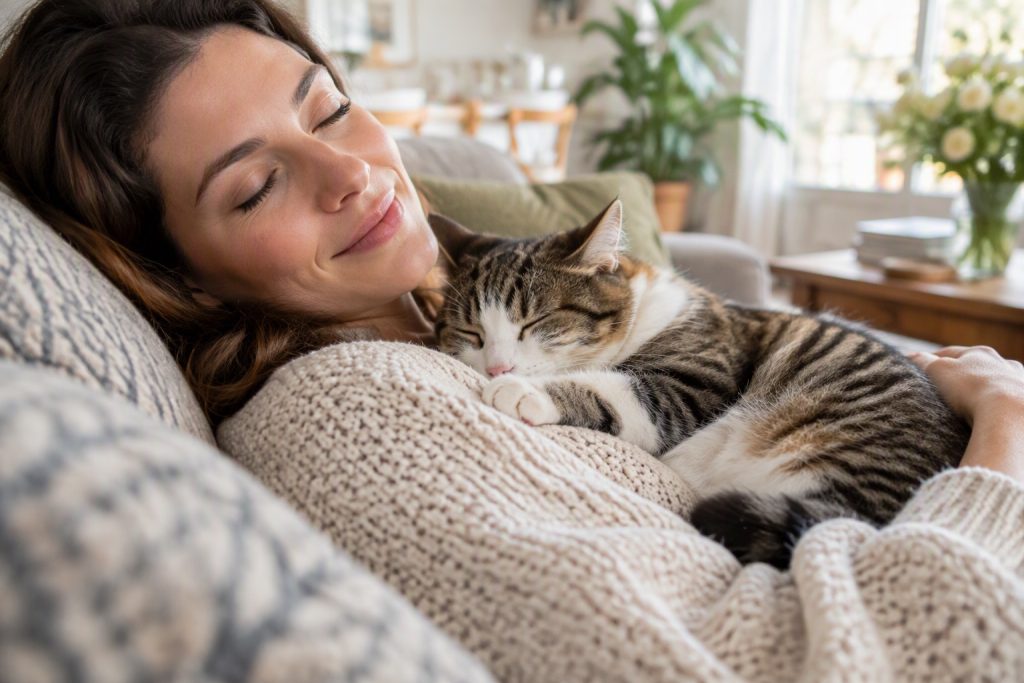
Cats sleep on your chest because it is warm, safe, and close to your heartbeat and breathing, which many cats find deeply soothing. Your chest also rises and falls gently, mimicking the comfort of a littermate or mother, and it is a high, secure spot. It usually signals trust and affection, not a problem, though it can be uncomfortable for you.
- Your chest is warm, safe, and rhythmic.
- It usually signals trust and bonding.
- Kneading often accompanies it.
- It is safe unless it disturbs your sleep.
Why does my cat sleep on my chest?
Several things make your chest irresistible to a cat. Warmth is the first: your chest is one of the warmest parts of your body, and cats seek heat to conserve energy. Security is the second, since resting on you puts her at the centre of a trusted, familiar presence, where she can relax completely. The rhythm of your heartbeat and breathing is soothing, and it echoes the comfort of being close to a mother or littermates as a kitten, which is why many cats settle there as if returning to that early safety. Height matters too, as your chest is elevated and gives her a vantage point. The scent of you is reassuring, and being physically close reinforces the bond. Some cats choose the chest simply because it is a comfortable, still surface when you are lying down. None of this is unusual, and for most cats it is a sign of feeling safe and attached to you. Our article on why a cat sleeps on your head covers a similar preference.

Cervical pillow, plush hammock, floor mat and paw cushion — four places to nap. Gives a cat a…
Is it safe for a cat to sleep on your chest?
For a healthy adult, it is generally safe, if sometimes uncomfortable. A cat’s weight is usually light enough that breathing is not affected while you are awake and moving, though it can feel heavy if she settles for a long nap. The main practical issues are sleep disturbance and the risk of rolling onto her, so if you are a restless sleeper, it is wise to encourage her to settle beside you rather than on you. For people with respiratory conditions, allergies, or a medical need for uninterrupted breathing, a cat on the chest can be a genuine problem, and it is reasonable to redirect her. There are also rare situations where a cat’s presence on the chest is worth noting, such as a cat who suddenly insists on lying on a specific area of your chest and will not be moved, though this is more often coincidence than anything else. If you have any health concerns, speak to your doctor rather than reading meaning into the cat’s behaviour.
Why does my cat sleep on my chest and knead?
Kneading, the rhythmic pushing of paws against a soft surface, is a kitten behaviour that carries into adulthood, and it is closely linked to comfort. Kittens knead their mother’s belly to stimulate milk flow, so the motion is associated with warmth, safety, and food. When an adult cat kneads your chest while settling, she is often recreating that feeling of early security, and the soft surface and your presence encourage it. Kneading also spreads scent from glands in the paws, marking you as familiar and safe, and it can be a way of settling herself before sleep. It is usually a sign of contentment, not agitation. Some cats knead more when they are happy or slightly wound up with affection, and the behaviour may come with purring or drooling. If her claws are sharp, trimming them and keeping a soft blanket over your chest makes it more comfortable for you. Our article on why cats knead explores the behaviour in more detail.
Does it mean my cat is bonded to me?
Choosing to sleep on your chest is a good sign of trust and attachment, though it is not the only measure of a bond. A cat who settles on you is choosing to be vulnerable and relaxed in your presence, which indicates she feels safe. Cats do not do this with everyone, so it is reasonable to read it as affection. That said, some cats are naturally more physically affectionate than others, and a cat who prefers to sleep nearby rather than on you can be just as bonded. Temperature and opportunity also play a role: a cat may choose your chest on a cold night and a chair in summer. The strongest signs of a bond are the everyday ones, such as greeting you, seeking your company, playing with you, and relaxing around you. Chest-sleeping is one expression of that, but the relationship is broader than any single habit.

A thickened cloth bed is stepped into rather than climbed over. Try it near the window first, then…
How do I sleep comfortably with a cat on my chest?
If you enjoy the closeness but not the disruption, a few adjustments help. Keep her claws trimmed so kneading does not hurt, and place a soft, washable blanket over your chest so she has a defined spot and your skin is protected. Encourage her to settle beside you rather than on you by making a cosy spot next to your pillow or along your side, and reward her when she chooses it. A warm, covered bed or a small blanket near you can be just as appealing as your chest, especially if it is soft and smells like you. If she wakes you repeatedly, set a bedtime routine with a play session and a meal before sleep, which helps many cats settle. Closing the bedroom door is a reasonable option if you need uninterrupted rest. Be consistent, since a cat who is sometimes allowed and sometimes not will be confused.
When should I worry about a cat sleeping on my chest?
For most cats, this is a normal and endearing habit with nothing to worry about. It becomes worth attention if the behaviour is new and comes with other changes, such as a cat who suddenly becomes clingy, restless, or unsettled. A cat who is unwell sometimes seeks more physical contact, so increased clinginess alongside appetite loss, hiding, or lethargy should prompt a vet visit. If your cat seems to be in pain, has difficulty settling, or has changed her sleeping habits markedly, it is worth checking. On your side, consider your own health: if a cat on your chest affects your breathing or sleep, it is fine to gently redirect her to a spot beside you. There is no medical significance in the position itself for a healthy owner and cat. Trust your instincts: if something feels off in her behaviour, ask your vet, and if it affects your health, speak to your doctor.
Frequently asked questions
- Why does my cat always sleep on my chest? It is warm, secure, rhythmic, and smells like you, which feels safe to her.
- Does a cat sleeping on your chest mean she loves you? It suggests trust and attachment, though bonds show in many ways.
- Is it safe to sleep with a cat on your chest? Usually yes, but redirect her if it disturbs your sleep or breathing.
- Why does my cat knead my chest? It is a comforting kitten behaviour linked to safety and warmth.
- How do I stop my cat sleeping on my chest? Offer a warm, familiar bed beside you and reward her for using it.