For most cats, sisal is the better scratching post material, because it shreds satisfyingly, lasts a long time, and does not teach the cat that carpet is fair game. Carpet posts feel good too, but they can reward the same digging that ruins your floors. The best choice depends on how your cat already scratches and what surface she is naturally drawn to.
- Sisal is durable and does not mimic your carpet.
- Carpet feels good but can encourage floor scratching.
- Height and stability matter as much as material.
- Cardboard is a cheap, useful second option.
Sisal or carpet: which is better for a scratching post?
Sisal wins for most households, and the reasoning is practical rather than fussy. Sisal rope gives a cat the resistance and texture she is looking for, and it wears well under heavy daily use, so a good post can last for years. Just as importantly, sisal does not resemble your carpet, so scratching it does not teach her that soft floor coverings are acceptable targets. Carpet posts have a genuine advantage: their texture feels wonderful to many cats, which makes them appealing right away, and they are often cheaper to buy. The catch is that a cat who learns to scratch carpet on a post may not distinguish the post from the stairs or the living room rug. If you do choose carpet, pick a texture that does not match anything in your home, and expect to replace it sooner. Whichever you choose, check the post for loose threads or exposed staples that could catch a claw, and replace frayed surfaces before they become a hazard.
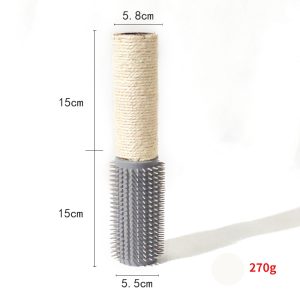
Sisal-wrapped post with a grooming brush base. Made from mixed materials. Made for scratching and stretching. Gives claws…
Why does material matter so much to a cat?
Scratching is not just sharpening claws; it is scent-marking, stretching, and a way to shed the outer sheath of each claw. Cats have clear preferences for the resistance and give of a surface, and once they find one they like, they return to it again and again. A material that is too soft gives no satisfying resistance, while one that is too hard does not let claws sink in properly. Sisal hits a middle ground that suits most cats, and cardboard offers a different, crumbly resistance that many cats love just as much. Because the behaviour is partly about marking territory, the post also has to feel secure, and a wobbling surface defeats the purpose no matter how good the texture is. Match the material to what your cat already scratches, and you are most of the way to a post she will actually use.
What height and stability should a scratching post have?
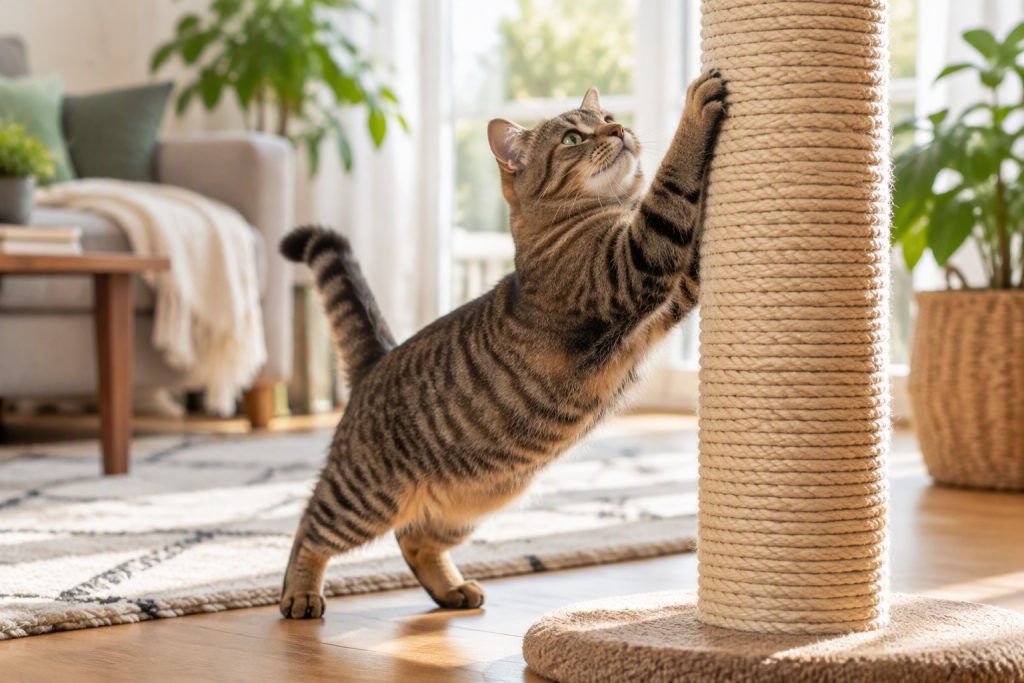
A good post lets your cat stretch to her full length with her front paws extended overhead, which usually means at least as tall as she is from nose to tail tip. Short posts force her to scratch at an awkward angle and often get ignored entirely. Stability matters just as much: if the post tips or slides, she will not trust it, and she will go back to the sofa. Look for a wide, weighted base, or bolt the post to a wall or a sturdy piece of furniture if needed. The scratching surface should be tall enough that a standing, stretching cat uses the whole length rather than a small patch near the top. When a post is tall and rock-solid, redirecting scratching there becomes far easier and your furniture stops being the default target.
Are cardboard scratchers a good alternative?
Cardboard scratchers are inexpensive, widely available, and genuinely appealing to many cats, which makes them a great addition even if they are not your only option. The corrugated texture offers a satisfying crumble that some cats prefer to sisal, and the flat or angled designs suit cats who like to scratch horizontally on the floor. The trade-off is durability: cardboard sheds and wears out faster, so you will replace it more often, and it can leave bits scattered around the house. They also tend to be smaller, so a big cat may outgrow one quickly or tip it over. The smart approach is often both, a tall sisal post for vertical stretching and a cardboard pad for horizontal scratching. Our comparison of sisal versus cardboard scratchers breaks down the trade-offs in more detail.
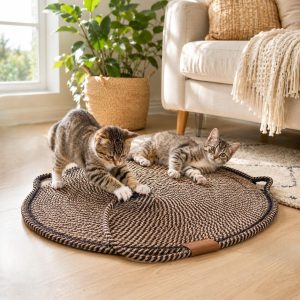
Woven cotton rope pad in an oval shape. Made from mixed materials. Made for scratching and stretching. Gives…
How many scratching posts does one cat need?
One post is rarely enough, even for a single cat, because cats scratch in different places and for different reasons. A common guideline is at least one scratching surface per cat, plus one extra, spread around the home rather than clustered in a single room. Place them where she already scratches, near where she sleeps, and close to the social areas she uses most. Variety helps too: a tall vertical post, a horizontal pad, and an angled scratcher cover the main scratching styles, so she always has an appealing option nearby. If you have more than one cat, add surfaces so no cat has to compete for the good one and conflict stays low. A generous supply of posts sounds like a lot until you compare it with replacing a sofa or a set of curtains. Rotating a worn post out and a fresh one in also keeps her interested, because novelty alone draws many cats back to scratching where you want them to.
How do I move my cat from the sofa to the post?
Redirect rather than punish, because scolding a scratching cat only teaches her to do it when you are not looking. Place the new post right next to her favourite scratching spot so it is the obvious alternative, and reward her with praise or a treat the moment she uses it. Make the post more attractive by rubbing it with catnip or dangling a toy along it, and make the sofa less appealing with a temporary cover or a deterrent strip while she learns. Never declaw, which is painful and can cause lasting problems with behaviour and mobility. Our guide to where to put a scratching post explains how placement drives success, and patience plus the right location usually wins within a couple of weeks.
Frequently asked questions
- Is sisal or carpet better for a scratching post? Sisal is generally better because it is durable and does not teach your cat that household carpet is fair game.
- How tall should a scratching post be? Tall enough for your cat to stretch fully with front paws overhead, usually at least her full body length.
- Do cats prefer vertical or horizontal scratchers? It varies by cat. Many like a tall vertical post, but some prefer a flat pad on the floor, so offering both is safest.
- Why does my cat ignore her scratching post? It may be too short, unstable, or in the wrong place. Move it beside her favourite target and steady it.
- Can I use catnip to attract my cat to a post? Yes. Rubbing catnip or a favourite toy on the post often draws her in so she discovers it herself.