

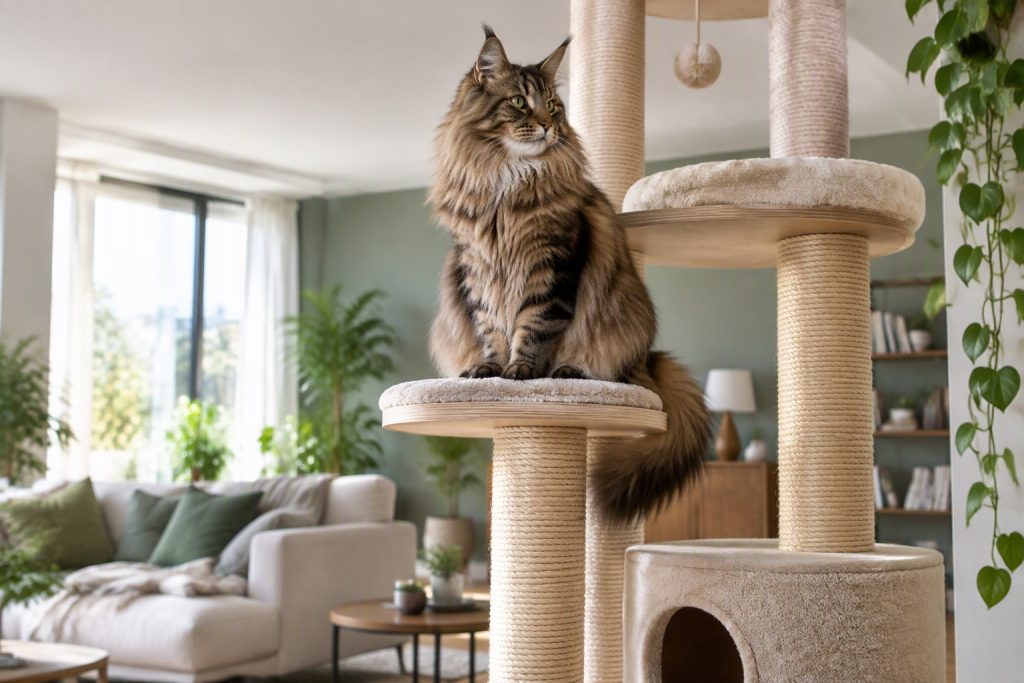
A good cat tree for a large cat is one built for weight, not looks: a wide, heavy base, thick sturdy posts, and platforms big enough for her to lie flat. Standard trees sized for average cats often wobble under a big cat, which is why she avoids them. Choose stability, size, and material over height alone.
- Look for a wide, heavy base that will not tip.
- Platforms must fit a fully stretched-out cat.
- Thick posts and strong hardware handle more weight.
- Stability matters more than maximum height.
What makes a cat tree suitable for a large cat?
The defining feature is that the tree is engineered for weight rather than merely scaled up in height. A large cat needs platforms wide enough to lie flat without her head or tail hanging off, and sturdy enough that they do not sag when she jumps onto them. The posts should be thick, ideally sisal-wrapped, and firmly anchored to the base and to each other with solid hardware. Look at the base dimensions first, because a narrow base on a tall tree is the classic tipping hazard. The bedding surfaces should be roomy and firm rather than thin and flimsy. When a tree is genuinely built for a big cat, she will use the top perch confidently, which is exactly what you want. A tree that is too small in any of these respects will simply be ignored, no matter how attractive it looks in a catalogue.
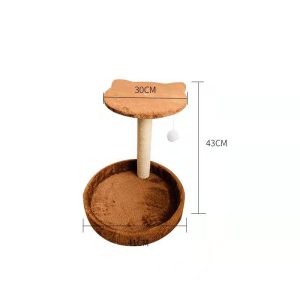
A cloth and wood climbing frame has levels spaced so a cat can step up, not scramble. Place…
How tall should a cat tree be for a big cat?
Height should follow stability, not lead it. Cats feel safest when they can perch high and survey the room, so a taller tree is generally better, provided the base is wide enough to keep it planted. For a large cat, a tree with a broad footprint and a height of roughly four to six feet is a reasonable target in most homes, with the top perch being the most-used spot. If the room is small, a slightly lower but very stable tree beats a tall, tippy one every time. The real test is whether the top platform stays rock-steady when your cat leaps onto it from the floor or an adjacent chair. A tree that shifts even slightly will be abandoned for the back of your sofa instead.
Why does stability matter so much for large cats?
Cats refuse to use anything that moves under them, and a large cat puts far more force into every jump and landing. A wobbling tree is not just an inconvenience; it can injure a cat who slips or falls from height, and it teaches her to avoid the structure entirely. Stability comes from a wide, heavy base, thick posts, and tight, well-designed joints rather than from weight alone. If your tree still rocks, anchoring it to a wall with a safety strap can make a big difference. Placing it against a wall or in a corner also limits how far it can travel. Once the tree is truly solid, a big cat will trust it enough to climb, stretch, and sleep at the top, which is the whole point. Checking a tree for wobble before you buy, by pressing firmly on the top platform and the base, is the quickest way to judge whether it is genuinely built for a large cat.
What materials hold up to a heavy cat?
Look for thick, solid posts rather than thin hollow ones, and for platforms made from sturdy board rather than flimsy particleboard that can snap or sag. Sisal-wrapped posts last well and satisfy scratching, while plush or fleece covers the resting areas for comfort. The hardware matters as much as the frame: bolts and screws should be substantial, and the joints should feel tight when you test them by hand. Check the weight rating if the manufacturer lists one, and be sceptical of very cheap, very tall trees, because something has to give to hit that price. A well-built tree costs more up front but lasts for years, while a flimsy one becomes a wobbly eyesore that your cat ignores.
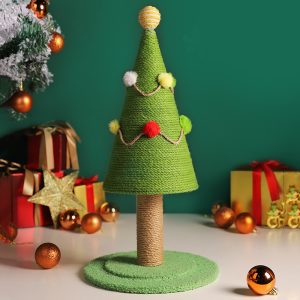
A holiday-shaped sisal climbing frame has levels spaced so a cat can step up, not scramble. Site it…
How much space does a large cat tree need?
Plan for the tree’s footprint plus clearance around it for jumping on and off, which is often more than owners expect. A large cat launches with real power, so she needs a clear landing zone and enough room to stretch to full height on the posts. In a tight room, a corner placement lets the walls add stability and keeps the tree out of walkways. If space is genuinely limited, our guide to the best cat tree for a small apartment covers compact options that still suit a bigger cat. Measure the spot before you buy, and check the ceiling height if the tree is tall. The right tree fits the room without dominating it, while still giving your cat a perch she can claim as her own.
How many cat trees does a big cat need?
One good tree can be enough for a single cat, but many large cats do better with more than one, especially if they share the home with other cats or spend long hours alone. A second, smaller tree or a wall-mounted perch in another room gives her a choice of vantage points and reduces competition for the best spot. The guideline is to provide enough vertical territory that no cat has to fight for it, and our article on how many cat trees one cat needs explains how to decide. Place them in different rooms so she always has a high, safe place nearby. Vertical space is one of the most valuable things you can give an indoor cat, and for a large cat, having more than one option keeps her active and settled. Rotate the trees’ positions occasionally so neither becomes stale, and check the fixings on any wall-mounted perch as your cat’s weight and enthusiasm test them.
Frequently asked questions
- What is the weight limit for a cat tree? It varies by product. Check the manufacturer’s rating and choose one that comfortably exceeds your cat’s weight with a margin.
- Can a large cat use a standard cat tree? Some can, but most standard trees wobble under a big cat, so look for a model with a wider base and sturdier posts.
- Should I anchor a cat tree to the wall? If it wobbles at all, yes. A safety strap reduces the risk of tipping and makes the tree far more appealing to your cat.
- Are wooden or carpeted cat trees better? It depends on your cat. Solid wood frames tend to be sturdier, while carpeted platforms are softer, so combine a strong frame with comfortable resting surfaces.
- How do I get my large cat to use a new tree? Place it near her favourite spot, rub it with catnip, and reward her the first few times she climbs it.





