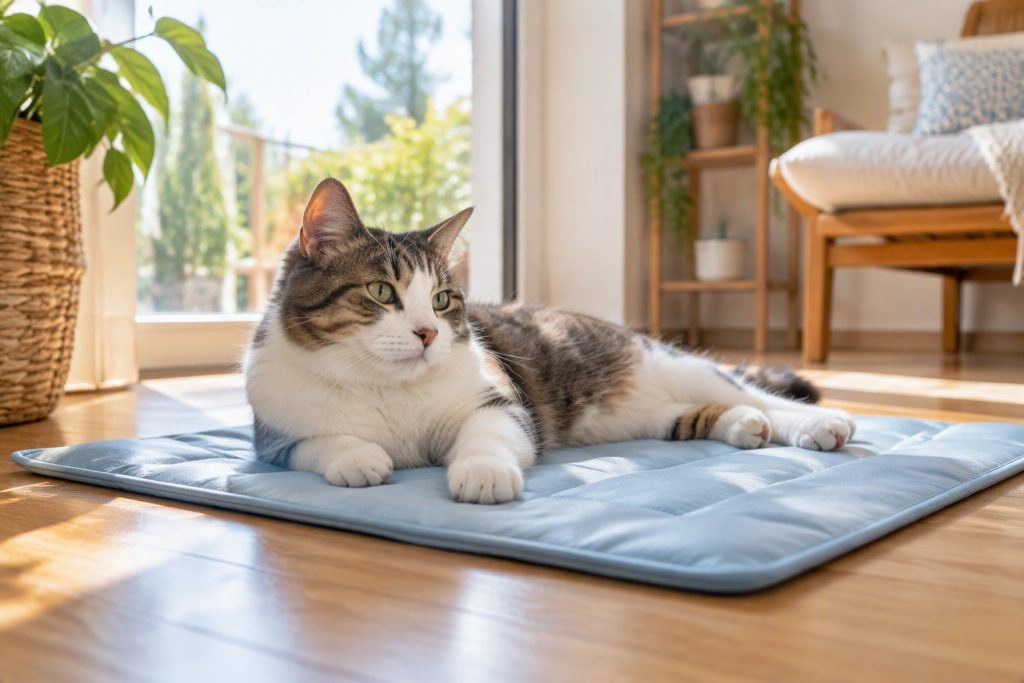
A good cooling mat for a cat is a pressure-activated gel mat or a water-filled mat that absorbs her body heat and stays a few degrees cooler than the air, giving her a spot to flop on when the room is warm. Cats cannot sweat through their skin, so they rely on shade, cool surfaces, and grooming to stay comfortable. A mat is not a substitute for air conditioning or ventilation, but it is a simple, cheap way to offer relief. The best mat is simply the one your cat will actually lie on.
- Gel and water mats absorb body heat passively.
- They help, but never replace shade and airflow.
- Pick a mat your cat can lie on fully.
- Never leave a cat alone with a chewable mat.
Do cooling mats actually help cats?
Yes, within limits. A pressure-activated gel mat draws heat away from the body through contact, so a cat lying on it feels cooler than she would on a warm cushion or a bare floor in a hot room. Water-filled mats work on the same principle, and some owners find they stay cool for longer because water holds temperature well. The effect is modest, not dramatic: a mat will not chill a cat the way a fan or air conditioning will, and it warms up under sustained body contact until she moves off it and it re-cools. Think of it as one tool among several. Cats seek out cool surfaces on their own, so a mat simply gives them a comfortable, designated option instead of the kitchen sink or a tiled bathroom floor. For a cat who tends to overheat, it is a worthwhile addition to a summer setup. If your home is air-conditioned and comfortable, a mat is optional rather than essential, but in a warm flat without cooling it can make a real difference to how relaxed she is.
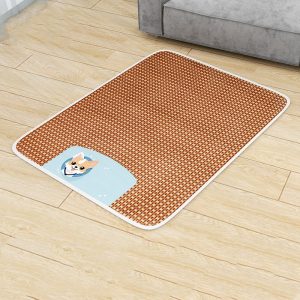
Seasonal Cooling Mat For Small And Large Pets. Part of the KiKi Meow Cat Beds collection for cats.
What types of cooling mat are there for cats?
The main types are pressure-activated gel mats, water-filled mats, and breathable mesh or raised cot-style beds. Gel mats are the most common: they contain a non-toxic gel that activates when the cat’s weight presses down on it, and they need no water, electricity, or refrigeration. Water-filled mats must be filled to a marked line and can be chilled in the fridge for extra effect, but they are heavier and can leak if punctured. Raised mesh cots lift a cat off the floor so air circulates underneath, which is especially effective in humid climates where contact cooling feels clammy. Some mats are designed to be frozen, but frozen mats can become uncomfortably hard and cold. For most cats, a gel mat is the simplest, safest starting point, with a mesh cot as a good alternative for humid summers.
What should I look for in a cooling mat?
Size matters most: the mat should be large enough for her to stretch out fully, because cats dissipate heat through their bellies and paws, and a mat she can only half-fit on helps less. Look for a durable, puncture-resistant outer layer and sealed seams, since claws and teeth are the main failure points. A non-toxic filling matters, in case she nibbles at a corner, and a wipe-clean surface makes daily use realistic. Check that the mat does not need to be refrigerated or plugged in if you want something you can leave out all day. Weight and portability are worth considering if you plan to move it between rooms or take it travelling. Finally, look for a mat that stays flat and does not bunch up, because a cat will avoid a lumpy, shifting surface. A removable, washable cover is a practical bonus, and a mat that folds or rolls makes storage easy when summer ends.
Are cooling mats safe for cats to lie on?
Generally yes, if you choose a pet-safe mat and use it sensibly. The most common risk is a cat chewing through the cover and ingesting gel or water, so never leave a chew-prone cat unsupervised with a mat, and replace one that has been punctured. Frozen mats can be too cold and stiff for comfort, and a very cold surface is not appropriate for a kitten, a senior, or a cat who is unwell, so keep those to room temperature. If your cat is older or has sore joints, a cooling mat alone may not be the most comfortable choice, and our look at the best bed for an older cat explains how to balance support with airflow. Always offer the mat as a choice, never as a forced resting place.
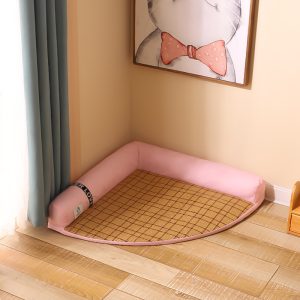
Summer Cooling Mats Cat Bed Sofa Pet Mats Cat House Ice Pad Sleeping Mats Cool Cold Bamboo Fiber…
How do I get my cat to use a cooling mat?
Cats are cautious about new objects, so introduce the mat gradually. Place it in a spot she already likes to rest, such as near a window or beside your chair, and let her investigate at her own pace. Do not pick her up and put her on it, which usually backfires. A light sprinkle of catnip or a favourite toy on the mat can encourage her to step on it, and putting it under a thin blanket she already uses can help it feel familiar. Some cats prefer the mat on the floor, others on a low platform or inside a box. If she ignores it, try a different type, such as a mesh cot, since individual cats have clear preferences about texture and temperature. Give it a week or two, and offer alternatives so she always has somewhere cool to go. Our guide to whether cats need beds explains how resting spots shape a cat’s daily comfort.
How do I clean and store a cooling mat?
Most gel and water mats can be wiped with a damp cloth and a little mild soap, then left to air dry fully before use. Check the care label first, because some covers are machine washable while others are not, and the filling should never go in a washing machine. Clean it whenever it looks soiled, and more often in summer when cats may drool or shed on it. Inspect the seams and surface for punctures or leaks each time you clean, and retire the mat immediately if the filling is exposed. Store it flat or loosely rolled in a dry place when the weather cools, away from direct sun and sharp objects. A well-kept mat should last several seasons, and keeping it clean means your cat is more likely to use it. If the mat develops a persistent smell or the surface starts to peel, replace it rather than trying to repair it.
Frequently asked questions
- Do cooling mats work without electricity? Yes. Gel and water mats cool through contact with the body and need no power, which makes them easy to use anywhere.
- Can I put a cooling mat in the freezer? Some are freezer-safe, but frozen mats can be too hard and cold. Room-temperature gel mats suit most cats better.
- Are cooling mats safe if my cat chews them? Only with supervision. A punctured mat can leak its filling, so remove it if your cat bites or claws at it.
- What if my cat refuses the mat? Try a different type, such as a raised mesh cot, and place it where she already rests. Never force her onto it.
- Is a cooling mat enough in a heatwave? No. Combine it with shade, airflow, cool water, and a cool room, and watch for signs of heat stress.