

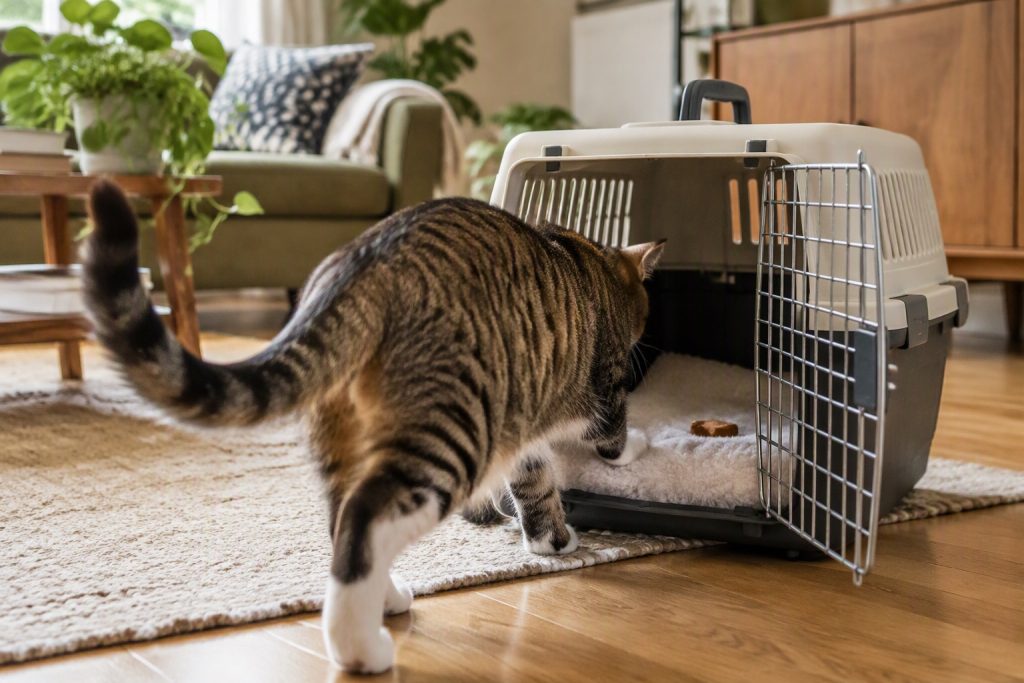
Most cats hate the carrier because they only ever see it on the way to the vet. The carrier is not inherently frightening; it becomes frightening because it reliably predicts a car journey, a strange place and often something unpleasant. That association can be rebuilt, and it is worth rebuilding, because a cat that walks into a carrier calmly can be taken to the vet without a struggle, which is better for the cat, the owner and the vet. The method is the same one used for most cat training: small steps, short sessions and food.
- Cats fear the carrier because it predicts the vet, not because the carrier itself is frightening.
- Leave the carrier out permanently so it becomes ordinary furniture rather than an event.
- Build up in steps: sniff, enter, eat inside, door closed briefly, then a short car trip.
- Never force a cat in; it undoes the work and makes every future trip harder.
Why does my cat hate the carrier?
Because of what it has come to predict. A cat that has only ever been put in the carrier immediately before a car ride and a vet visit has learned a very simple rule: the carrier means something bad is about to happen. That learning is fast and durable, and it explains why a cat will run and hide as soon as the carrier appears. Cats also dislike being placed in a confined space they cannot leave, and many carriers smell of previous stressful trips. There is nothing about the object itself that a cat finds frightening. If the carrier lived in the living room, held a familiar blanket and occasionally produced treats, the cat’s response would be completely different. The whole method is built on breaking the link between the carrier and the vet.

Deep red plush donut bed. Made from cloth. Supplied in light gray. Made for everyday resting. Gives a…
How do I get my cat used to the carrier?
Leave the carrier out where the cat can see it, with the door open or removed, and line it with something that smells familiar. Let the cat investigate on its own for several days without any attempt to close the door. Then start feeding the cat near it, and gradually move the food inside so the cat has to put its head in to eat. Once the cat is comfortable eating inside, feed it with the door open and then with the door briefly closed, always opening it again before the cat becomes anxious. Then add a short lift and put it down. Only after all of that should you take a very short car trip and return home. The whole sequence may take several weeks, and the pace should be set by the cat rather than by the calendar.
What kind of carrier is best?
A sturdy, hard-sided carrier with a door that opens from the front and, ideally, the top, because a top opening makes it much easier to lift a reluctant cat in and out. It should be large enough for the cat to stand, turn around and lie down, but not so large that the cat slides around in the car. A carrier that can be secured with a seatbelt is a practical advantage. Soft-sided carriers are lighter and easier to store, but less stable and harder to clean. Whatever you choose, check that the latch is secure, because a carrier that fails in a car park is a genuine safety problem and a cat loose in an unfamiliar place is in real danger.
What do I do on the day of the vet visit?
Keep the routine as normal as possible, and do not make the carrier an event. If the cat is already comfortable going in, put a familiar blanket inside, place the carrier on the floor and let the cat walk in, or lift it in calmly from the top. Cover the carrier with a light towel in the car, because many cats settle better when they cannot see the moving scenery. Drive smoothly, keep the car cool, and do not let the cat out of the carrier at any point. At the clinic, keep the carrier covered and on a level surface. After the visit, go back to normal immediately, without fuss, so the trip does not become a bigger event than it needs to be. A cat that is not fully trained can be lifted in gently, but never chased.

Teaser wand designed to turn a few minutes into a full hunt — a cat needs to finish…
Should I leave the carrier out all the time?
Yes, and it is the single change that makes the most difference. A carrier that lives permanently in a corner of a room, with the door open and a soft blanket inside, stops being a signal and becomes part of the furniture. Cats frequently choose to sleep in carriers left out this way, which is exactly the outcome you want, because it means the carrier is associated with rest rather than with the vet. Leaving it out is worth the slight loss of tidiness. You can also add a familiar-smelling item and occasionally place a treat inside so the association stays positive. Cats that only see the carrier twice a year never get the chance to build that association. The full approach is in getting a cat into a carrier without a fight.
What if my cat still refuses to go in?
If the cat is not ready on the day, do not turn it into a battle. Lifting a cat in gently from a top-opening carrier is acceptable when there is no alternative, and it is far better than chasing the cat around the house, which sets the training back weeks. If your cat is consistently unhandleable at vet time, ask the clinic whether they can help, because many practices have approaches for anxious cats. In some cases a vet may discuss short-term medication for travel, but that is a veterinary decision and not something to arrange yourself. For a frightened but not dangerous cat, the long-term answer is the same: keep training in short sessions, keep the carrier out, and pair it with food. The same gradual approach used for harness training applies here.
Frequently asked questions
- How long does carrier training take? Some cats accept it within a week or two; others need a couple of months. Short, frequent sessions work far better than long ones.
- Should I use a soft or hard carrier? Hard-sided carriers are generally safer and easier to clean, especially one with a top opening. Soft carriers are lighter but less stable.
- Can I use a pillowcase instead? For an emergency, some owners do. A proper carrier is safer and less stressful for routine trips, and it protects the cat in a car.
- Should I feed my cat before the trip? A light meal a few hours before is usually fine. Ask your vet if the visit involves sedation or a procedure.
- Why does my cat cry the whole way? Many cats vocalise in the car. Covering the carrier, driving smoothly and keeping the temperature cool often reduce it.


