

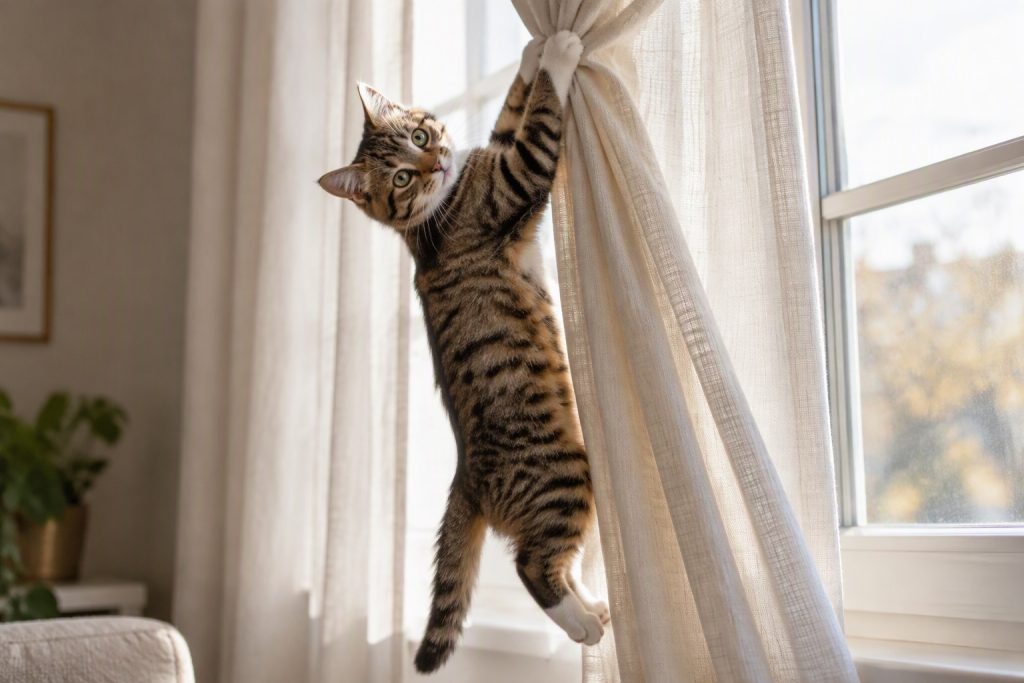
A cat that climbs the curtains is not being naughty, and it is not trying to annoy anyone. It is doing something cats are built to do — climb, stretch upward and get high — on the nearest structure that will take its weight. Curtains are ideal because they hang, they sway, and they are usually next to a window with something interesting on the other side. The fix is not to punish the cat but to give it a better climbing target and to reduce the reasons it feels the need to climb the curtains in the first place.
- Curtain climbing is normal climbing behaviour rather than defiance or spite.
- The usual drivers are boredom, a lack of vertical territory, and the window view behind the curtain.
- A stable, tall cat tree near the same window is the most effective redirection.
- Never punish or use a spray bottle; it adds stress and does not teach an alternative.
Why does my cat climb the curtains?
Three reasons usually combine. First, climbing is a natural behaviour that indoor cats have very few outlets for, and curtains are a large, textured surface that behaves a little like a tree trunk. Second, the curtain is next to a window, and windows are the best entertainment in most homes, so the curtain is on the route to something the cat wants. Third, and most often overlooked, the cat has nowhere better to go. A cat that climbs curtains usually has no tall, stable, interesting place to sit, so it makes one. Add a moment of high-energy play, such as a sudden dash across the room, and the curtain becomes the obvious thing to scale. Solving the behaviour means offering something that does the same job better.

A cat tree built to give a cat height to climb, perch and watch from — height is…
Is curtain climbing a sign of stress?
Sometimes, but it is more often a sign of boredom. Stress-related climbing tends to look different: it comes with other signs such as over-grooming, hiding, reduced appetite, spraying, or a cat that is unusually jumpy at sounds. It also often starts after a specific change, such as a move, a new pet or a new baby in the house. If the climbing is a solo behaviour that happens when the cat is full of energy and stops once it has been played with, boredom is the better explanation. If it comes with a cluster of other changes, treat it as a stress question and look at what has changed. In either case, punishment makes both versions worse, because it adds fear to a cat that is either under-stimulated or already anxious.
How do I stop a cat climbing curtains?
Give the cat somewhere better to climb, and put it in the same place. A tall, stable cat tree positioned by the window the cat is trying to reach does more than anything else, because it satisfies the same urge in a spot the cat already values. Add a shelf or a perch near the ceiling if the room allows it, and make sure the route up is easy to use. Keep the cat’s claws trimmed so any accidental contact does less damage, and if the curtains are still being used, consider gathering them during the day. It also helps to break the link between the curtain and the window: move a perch slightly to one side so the cat can watch the view without climbing the fabric. Consistency matters more than the specific product.
What kind of cat tree actually gets used?
The one that does not wobble, is tall enough to matter, and sits where the cat wants to be. Many cat trees are bought for size and placed in a corner the cat never visits, and then declared a failure. Height is the main thing: a tree should let the cat get its head above the room, and for many cats that means something taller than the average unit sold as a starter. Stability is the second, because a tree that sways when the cat lands on it will be avoided immediately. The third is position. Put it by the window, near where the family sits, or on the route the cat already patrols. A modest tree in the right place beats an elaborate one in the wrong one, and where to put the cat tree covers the detail.

A double wood cat tree puts the perch where the cat actually wants to be. Check that the…
Does playing more really help?
It often helps more than anything else, because a tired cat has much less reason to invent its own entertainment. The key is to play properly: a wand toy moved like prey, with stalking, chasing and a final catch, rather than a few half-hearted swipes. Two sessions a day, one in the morning and one in the evening, is a realistic target, and the evening session should end with a meal so the cat closes the natural hunt-eat-groom-sleep sequence. If the curtain climbing happens at a predictable time each day, move a play session to just before it. Most owners who complain about destructive climbing are surprised by how much changes when play becomes a fixed part of the routine rather than something that happens when the cat is already bored. Wider options are covered in indoor enrichment.
When is climbing a health concern?
Climbing is usually a healthy behaviour, so the concern runs the other way: a cat that stops climbing may be the one with a problem. If a cat that used to scale the furniture suddenly cannot or will not jump, that can indicate pain, particularly arthritis in the hips, knees or spine. Watch for a cat that climbs up but hesitates or cries on the way down, or that uses a series of intermediate steps it never needed before. A sudden burst of frantic climbing, especially at night, is more likely to be an energy or stress issue than a physical one. Either way, a change in a cat’s normal climbing or jumping is worth a vet conversation, because cats hide discomfort well and mobility is one of the first things to change.
Frequently asked questions
- Will my cat grow out of climbing the curtains? Usually not on its own. The behaviour continues as long as the need is unmet, though it often fades once a better climbing spot exists.
- Should I use a spray bottle to stop it? No. Spray bottles create fear, damage trust, and teach the cat only to climb when you are not watching. Redirect instead.
- Do curtains get damaged even if the cat is redirected? Sometimes. Keep claws trimmed and consider heavier curtain fabric or tie-backs while the new climbing spot becomes established.
- My cat climbs at night. Why? Night is when cats are naturally most active. A play session and a meal before bed usually reduces it substantially.
- Is it safe to let a cat climb high? Generally yes, provided the surfaces are stable and there is a sensible route down. Cats are competent climbers, and height is good enrichment.


