

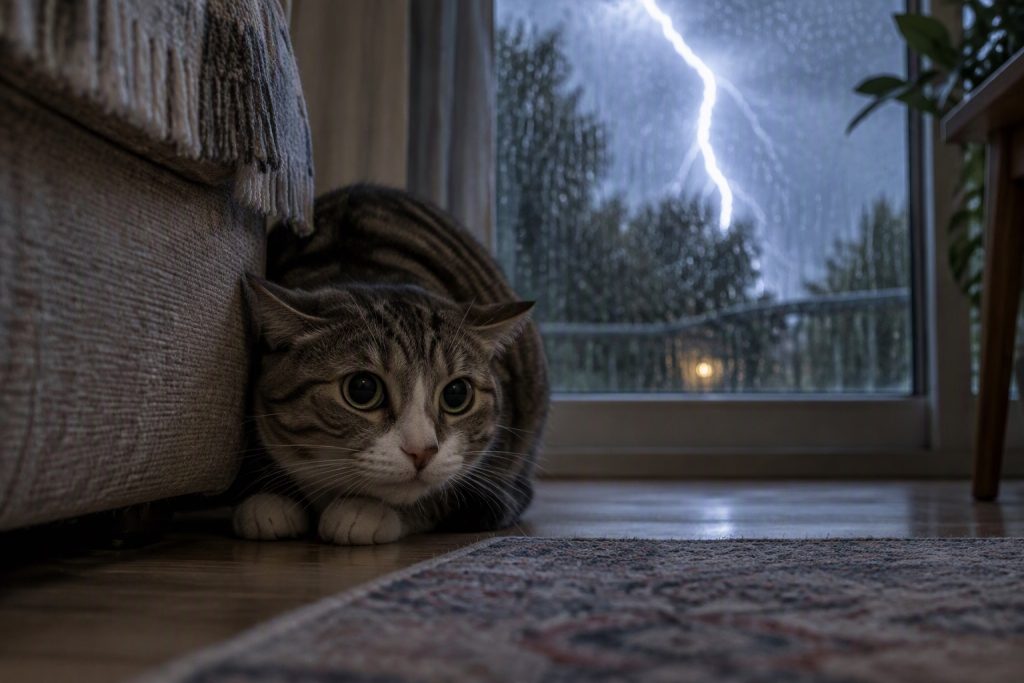
Fear of thunder and fireworks is common in cats, and it is often more subtle than the dog version. A frightened cat usually goes quiet and disappears rather than pacing and barking, which means owners sometimes miss it entirely. The signs are there if you know them: hiding in a new place, flattening to the floor, refusing food, dilated pupils, and sometimes eliminating outside the litter box. Because storm and firework fear tends to get worse with repeated exposure rather than better, it is worth preparing in advance rather than waiting for the next event and reacting to it.
- Cats usually show storm fear by hiding and going quiet rather than by making noise.
- Prepare before the event: a safe room, drawn curtains, and routine kept as normal as possible.
- Do not punish or force a frightened cat out of hiding; let it choose its safe spot.
- A vet can advise if the fear is severe, and some cats benefit from a plan made in advance.
How do I know if my cat is afraid of thunder?
Watch the behaviour that comes before the noise rather than during it. Many cats react to the drop in air pressure before the first clap, so a cat that disappears half an hour before a storm has already sensed it. The most common signs are hiding somewhere new and staying there, crouching low with the body flattened, tucking the tail, flattening the ears, and refusing food. Some become unusually clingy instead, following their owner around. A few will over-groom or eliminate outside the litter box. The one sign that is easy to miss is silence, because a cat that is frightened often stops making its usual sounds entirely. If you see this pattern repeating with storms, that is fear rather than coincidence. The same applies to other sudden changes, as covered in helping a cat through change.

Round furry plush bed with cat ears on the rim. Made from velvet. Made for everyday resting. Gives…
Why is my cat scared of fireworks?
For the same reasons as thunder, with a few additions. Fireworks are sudden, unpredictable and very loud, and a cat’s hearing is far more sensitive than a person’s, so what sounds loud to you is considerably louder to a cat. The unpredictability matters as much as the volume, because a cat cannot habituate to a noise it cannot anticipate. Cats also dislike the smell of smoke and the flashes of light, which arrive without warning. Some cats are more affected than others, and a cat that was calm as a kitten may become more reactive with age. Fear that is repeated without any relief tends to deepen, which is why preparing the environment before the event is more effective than trying to manage it in the moment.
What can I do to help a frightened cat during a storm?
Give the cat a safe place and let it use it. A covered bed, a box, or the space under a bed all work, and the cat should be left there without being coaxed out. Close the curtains, shut the windows and, if possible, choose the quietest room in the house. A radio or a fan at a low, steady volume often works better than silence, because it blunts the sudden peaks. Keep the routine normal: feed at the usual times and do not make a big event of the storm. If the cat comes to you, stay calm and let it settle nearby. Do not hold the cat against its will, and never punish it for hiding or for an accident. A familiar, dark, enclosed space is the most effective thing you can offer.
Should I comfort my cat during a storm?
Yes, if the cat wants comfort, but do not force it. The old idea that comfort rewards fear is not a good guide, because you cannot reward an emotion. What you can do is teach the cat that you are safe and predictable, which is genuinely helpful. If the cat comes to sit near you, stay calm and quiet and let it stay. If the cat wants to be alone under a bed, that is also a valid choice and forcing it out makes things worse. What does cause problems is a dramatic response from the owner: rushing around, speaking in a tense voice, or repeatedly checking on the cat. A calm, ordinary presence is what helps. If the cat is very distressed, contact a vet in advance to discuss options rather than waiting for the next event.
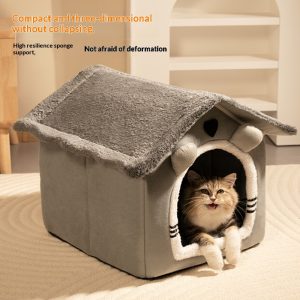
Grey house-shaped bed with a cat. Made from mixed materials. Made for everyday resting. Gives a cat a…
Can I prevent storm fear from getting worse?
Partly, by making the experience as uneventful as possible each time. Prepare the safe room in advance, so the cat has a familiar place to go that it has already chosen. Keep the routine stable and avoid adding any other stress around the same period, such as visitors or a vet trip. Do not let the storm become a big family event, because cats read the household’s mood closely. Some owners play a recording of thunder very quietly during calm periods to reduce reactivity, but this must be done gently and stopped at any sign of distress, because done badly it makes the fear worse. If the fear is severe or escalating, ask a vet about the options, which may include a behaviour plan or, in some cases, medication. Do not give any sedative or supplement without veterinary advice.
When should I ask a vet for help?
Ask for help if the fear is severe, if it is getting worse with each event, or if it is affecting the cat’s health. Book an appointment if the cat will not eat for a day around a storm, injures itself trying to escape, eliminates outside the litter box repeatedly, or stays hidden long afterwards. Also see a vet if the fear has started suddenly in an older cat, because a change in behaviour at that age can indicate pain or another medical problem rather than a new phobia. A vet can check for physical causes and discuss what support is appropriate. Preparing a plan before the next storm season is far more effective than trying to arrange help during one. Halloween night planning uses the same approach for a different kind of noise.
Frequently asked questions
- Do cats get scared of fireworks? Yes. Their hearing is much more sensitive than ours, and the unpredictability of fireworks makes them harder to ignore than a steady sound.
- Should I put my cat in a carrier during a storm? Only if it is genuinely safer there. For most cats, a familiar hiding spot in a quiet room works better than confinement.
- Does a thunder jacket work on cats? Some owners report benefit, but the evidence is limited and many cats dislike wearing anything. Introduce it calmly or not at all.
- Will my cat grow out of it? Fear usually deepens with repeated exposure rather than fading, so it is worth putting a plan in place rather than waiting.
- Can I leave my cat alone during a storm? If the cat is used to being alone and has a safe spot, yes. A very distressed cat is better off with a calm person nearby.


