

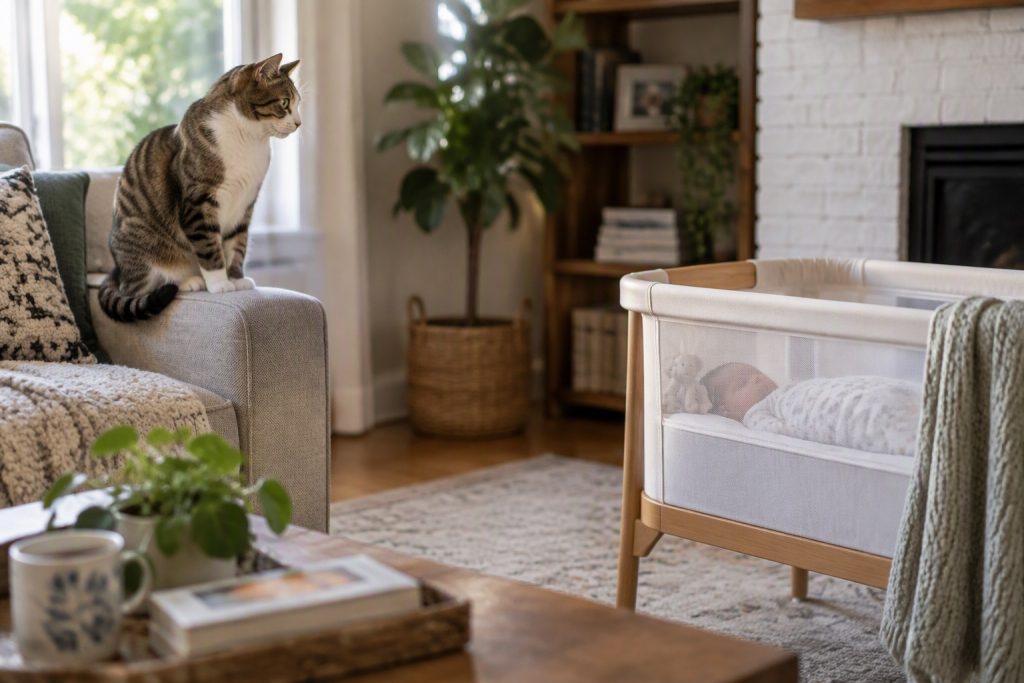
Bringing a baby home usually unsettles a cat far less than owners expect, provided the preparation starts early. Cats are not naturally hostile to infants, but they are sensitive to change, and a new baby brings a great deal of it: new sounds, new smells, new furniture, less attention, and a room that is suddenly off-limits. The cats that cope best are the ones whose routine and territory changed as little as possible. The aim is not a friendship between cat and baby but a calm, supervised coexistence, which is a realistic goal in almost every home.
- Prepare before the baby arrives by keeping the cat’s routine, space and resources unchanged.
- Introduce the baby gradually and always supervise; never leave a cat alone with a baby.
- Never punish a cat for approaching the baby; redirect calmly instead.
- A cat that stops eating, hides constantly or starts eliminating outside the box needs a vet check.
Will my cat be jealous of a new baby?
Jealousy is the wrong word, but a real shift in the cat’s life is the right idea. Cats do not resent a baby as a rival person; they respond to what actually changed, which is usually attention, routine and access. A cat that used to sleep on a lap every evening and now does not will notice, and it may respond by seeking attention more insistently, by withdrawing, or by claiming new spots. That is a reaction to a change in resources rather than to the baby itself. The most useful preparation is to alter the routine gently in the weeks before the birth, so the cat is already used to the new pattern rather than experiencing it as an overnight loss. Small, early changes are much easier for a cat to absorb than sudden ones.

Grey house-shaped bed with a cat. Made from mixed materials. Made for everyday resting. Gives a cat a…
How do I prepare my cat before the baby comes home?
Start a few weeks ahead and think about territory and routine. Set up the nursery early and let the cat explore it while it is still calm, rather than shutting it out for the first time on the day you come home. If the cat’s sleeping spot or feeding place is going to move, move it now, in small steps. Play recordings of baby sounds quietly now and then, so the noise is less novel. Bring home an item that smells of the baby before the birth, and let the cat investigate it. Keep the cat’s play sessions and mealtimes consistent, because routine is what makes a cat feel secure. If the cat’s daily play can continue after the birth, that continuity does a lot of work. For the wider picture, see helping a cat through change.
How do I introduce the cat to the baby?
Slowly, calmly and with the cat in control of the distance. When you come home, put the baby down and greet the cat first, so the cat does not learn that the baby means being ignored. Then let the cat approach the baby in its own time, and never hold the cat up to the baby or push them together. Keep the first encounters short and supervised, and reward the cat with a treat or a play session afterwards so the association is neutral or positive. Do not expect much from the first meeting; most cats sniff briefly and walk away, which is a perfectly good outcome. Over the following weeks, let the cat be present during calm moments such as feeding or nappy changes, so the baby becomes an ordinary part of the room rather than an event.
Should I keep the cat out of the nursery?
Not necessarily, and a blanket ban can create more problems than it solves. A cat suddenly shut out of a room it used to enter will often scratch at the door, and the nursery becomes a place it is desperate to reach. A better approach is supervised access, plus equally good alternatives elsewhere: a warm bed, a high perch and a quiet corner of its own. If you do decide to keep the cat out at night, install the barrier early, before the baby arrives, so the cat adjusts to it in advance. And whatever the arrangement, never leave a cat alone with a baby, even for a moment, because a cat seeking warmth or comfort may settle next to an infant’s face.

A cat tree built to give a cat height to climb, perch and watch from — height is…
What if my cat becomes aggressive or stressed?
Aggression towards a baby is rare, and the more common issues are stress behaviours: hiding more, over-grooming, spraying, or eliminating outside the litter box. Take those seriously, because they are signs the cat is struggling, and they usually respond to restoring routine and resources rather than to punishment. If the cat hisses or swipes at a person, that is a stress response and should be managed by giving the cat more space, more escape routes and more control, not by shouting. If the cat shows any aggression towards the baby, separate them immediately and keep them separated, and seek professional help rather than waiting to see whether it settles. A vet can rule out pain or illness, which is a common driver of sudden behaviour change, and a qualified feline behaviour professional can build a plan.
When should I get help?
Get help if the cat is showing aggression towards the baby or towards anyone in the household, if it has stopped eating or using the litter box, or if it is hiding continuously more than a week or two after the baby arrives. Those are welfare problems rather than adjustments, and they rarely resolve alone. Start with a vet, because pain and illness commonly present as behaviour change, and an unwell cat is more easily overwhelmed. If the cat is physically healthy, a feline behaviour professional can assess the household and suggest practical changes. Ask for help early rather than waiting, because behaviour problems rehearsed for months are harder to resolve. Do not use punishment or loud noises, and do not give any calming product without veterinary advice. Extra indoor enrichment helps here too.
Frequently asked questions
- Will my cat smother my baby? The old story about cats and babies is not supported. A cat may seek warmth nearby, which is why supervision matters, but deliberate harm is very rare.
- Should I rehome my cat when the baby arrives? Almost never necessary. With preparation, most cats adjust well, and rehoming should be a last resort after professional advice.
- How long does a cat take to adjust to a baby? Many settle within a few weeks. A cat that is still struggling after a month or two needs a proper assessment.
- Can my cat sleep in the nursery? Not unsupervised. Keep the cat out of the cot and cot room at night, and give it a good alternative sleeping spot nearby.
- Do pheromone diffusers help? Some owners report a calmer household with them. They are not a substitute for routine, space and a gradual introduction.


