

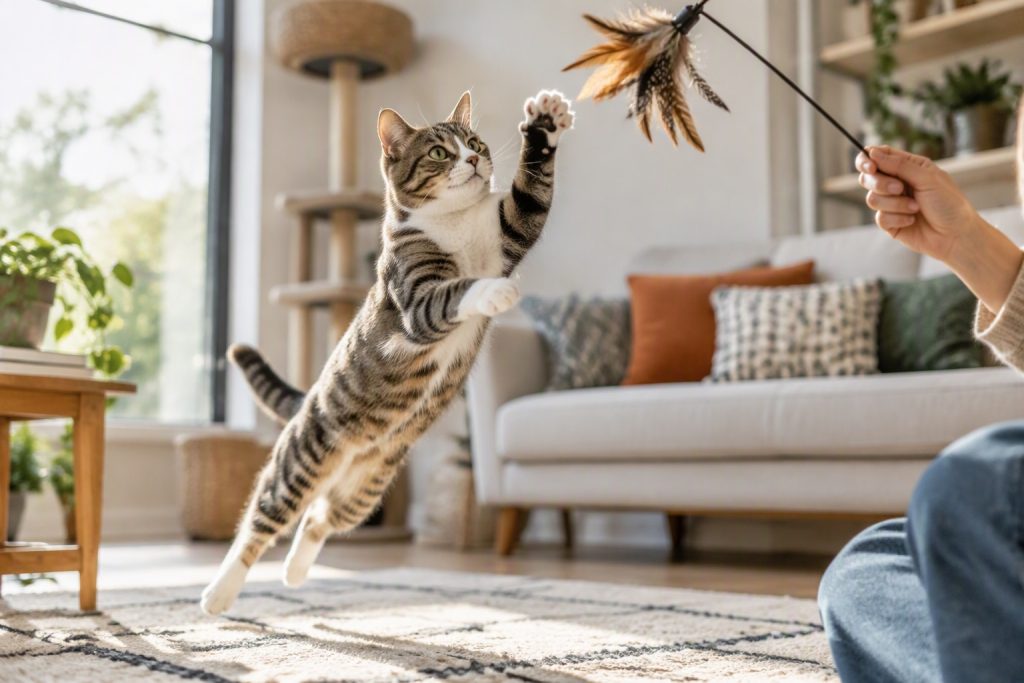
The best toys for a bored cat are the ones that let her hunt: wand toys she can chase, puzzle feeders that make her work for food, and a rotating mix of small toys to bat and pounce on. Boredom comes from a lack of challenge, not a lack of toys, so the way you play matters as much as what you buy.
- Wand toys that mimic prey beat most others.
- Puzzle feeders turn meals into activity.
- Rotate toys so they feel new again.
- Play with her, not just for her.
What are the best toys for a bored cat?
The most effective toys are those that trigger a cat’s hunting instincts rather than simply sit on the floor. Wand toys with feathers or small plush prey are the standout, because you control the movement and can make the toy dart, hide, and flee like real prey. Puzzle feeders and treat balls come a close second, since they turn eating into a problem to solve and engage her mind as well as her body. Small, lightweight toys she can bat, carry, and pounce on, such as crinkle balls and soft mice, are useful for solo play. A cat tunnel or a box adds ambush opportunities, and a laser pointer can be fun if you always finish by landing it on a real toy she can catch. The common thread is interaction and unpredictability. A basket of untouched toys is far less valuable than a few good ones used well.

A rotating ABS plastic and feather wand fits a cat that needs a target more than another thing…
Why do wand toys beat most other toys?
Wand toys win because they let a cat complete the full hunting sequence: stalk, chase, pounce, and catch. The movement is controlled by you, so the toy can behave like prey, speeding up, hiding behind furniture, and pausing before a burst, which keeps a cat’s attention far longer than a toy that just rolls. They also keep your hands at a safe distance, which prevents the hand biting that comes from wrestling with fingers. Because the play is interactive, it strengthens your bond and lets you tire a cat out properly in ten or fifteen minutes. Static toys, by contrast, lose their novelty quickly, especially once a cat has batted them under the sofa. Keep a few wand attachments, such as feathers and plush prey, and swap them to keep the game fresh. Ending each session by letting her catch the toy gives a satisfying finish and prevents frustration.
Do puzzle feeders help with boredom?
Puzzle feeders are one of the most underrated tools for a bored cat, because they turn a passive routine into an active one. Instead of eating from a bowl in seconds, a cat using a puzzle feeder has to nose, paw, and think to get her food, which mimics the effort of hunting and provides mental stimulation. This can reduce boredom, slow down fast eaters, and give an indoor cat a job to do. They are especially helpful for cats who are left alone during the day, because they provide something to work on while you are out. Start with an easy design and make it harder as she learns, so she stays challenged without getting frustrated. Our guide to puzzle feeders for cats explains how to introduce one and how to match the difficulty to your cat. For many bored cats, a puzzle feeder does more than a whole basket of toys.
How often should I rotate my cat’s toys?
Cats habituate quickly, and a toy that is exciting today may be ignored tomorrow simply because it has become familiar. Rotating her toys, keeping only a few out at a time and swapping them every few days, restores that novelty without spending a penny. Store the rest out of sight, and bring them back after a week or two so they feel new again. This works especially well with small solo toys, which tend to lose appeal fastest. Interactive play with a wand should happen daily regardless, because the value comes from the game, not the object. You can also refresh worn toys by attaching a new feather or a bell, or by hiding a favourite toy in a box for her to find. A simple rotation schedule keeps her environment interesting and prevents the boredom that leads to over-grooming, night-time chaos, and attention-seeking behaviour.
A plush toy that gives a cat a soft target to pounce on — a soft target takes…
What if my cat ignores every toy?
If your cat ignores every toy, the problem is usually the type of play rather than the cat. Some cats are not interested in chasing and prefer to stalk and pounce, so a wand toy that moves slowly and hides may work better than one that flies around. Others prefer to bat at things on the ground, or to hunt for food rather than toys. Try different styles and watch what she does when a real insect or a shadow catches her eye, then mimic that. Play at the times she is naturally active, usually dawn and dusk, and keep sessions short so she does not lose interest. If she has never played much and is also sleeping more, eating less, or seems unwell, a vet check is worth it, because illness can reduce a cat’s interest in everything. Our guide to how much play an indoor cat needs can help you build a routine she responds to.
How much play does a bored cat need each day?
Aim for at least two or three interactive play sessions a day, each lasting around ten to fifteen minutes, with at least one scheduled in the evening when cats are naturally most active. That amount is enough to satisfy most cats’ need to hunt and to prevent the restlessness that shows up as night-time chaos or constant pestering. If your cat is young, very active, or clearly under-stimulated, add a session or make them longer. Quality matters more than quantity: a focused session where she stalks and pounces tires her far more than a half-hearted wave of a toy. Finish each session by letting her catch the toy, then offer a small meal or treat to complete the hunt-eat-groom-sleep cycle. Consistency is what makes the difference, so build play into your daily routine rather than treating it as an occasional treat. A tired, fulfilled cat is a calmer, happier one.
Frequently asked questions
- What is the single best toy for a bored cat? A wand toy with interchangeable attachments, because it lets you imitate prey and keeps you involved in the play.
- Are laser pointers bad for cats? They can be frustrating if a cat never catches anything, so finish each session by landing the beam on a real toy she can pounce on.
- How many toys should I leave out? Keep only a few out at a time and rotate them, since too many at once makes each one less interesting.
- Can boredom make my cat destructive? Yes. Under-stimulated cats often redirect energy into scratching, over-grooming, or night-time activity, so play is a real fix.
- Do cats play alone? Some do with the right toys, but most need daily interactive play with you to be truly satisfied.





