

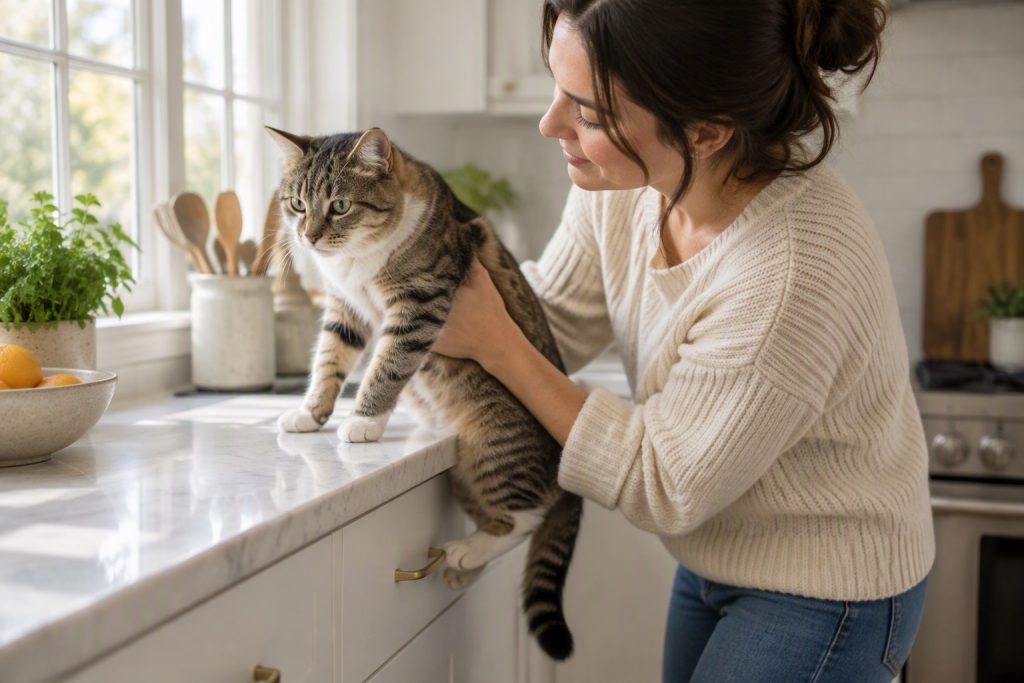
To keep a cat off the counter, make the surface unappealing, give her a better place to be, and remove the reward she gets from jumping up. Deterrents and punishment alone rarely work. Cats jump on counters to explore, to reach food, and to get high, so the lasting fix is to change what the counter offers and where else she can go.
- Remove food and rewards from the counter.
- Offer a higher, better perch nearby.
- Use motion deterrents, not punishment.
- Be consistent every single time.
How do I keep my cat off the counter?
The most reliable approach combines three things: removing the payoff, making the counter unpleasant, and providing a superior alternative. Start by never leaving food, dirty dishes, or scraps on the counter, because a cat who finds a reward there will keep coming back. Then make the surface less inviting with a motion-activated deterrent, a strip of double-sided tape, or a simple barrier while she learns. At the same time, give her a tall cat tree or a window perch nearby, ideally higher than the counter, so she has a better vantage point that is actually allowed. Consistency is essential, since letting her up once in a while undoes weeks of training. If the whole household follows the same rules and she has an appealing alternative, most cats will choose the perch over the counter. Punishment alone tends to fail, because it teaches her only to jump up when you are not there.

A teaser wand built to turn a few minutes into a full hunt — a cat needs to…
Why does my cat jump on the counter?
Cats jump on counters for reasons that make perfect sense to them. Counters are high, and height feels safe and gives a good view of the room, which appeals to a cat’s instinct to survey her territory. They are also where food is prepared, so a counter often smells of interesting things, and cats learn quickly if a snack is sometimes available. Some cats jump up for attention, having discovered that it reliably makes their person react, even negatively. Others are simply curious and want to investigate what you are doing. Boredom plays a role too, since a cat with little to do may explore forbidden places for entertainment. Understanding the motivation matters, because a cat jumping up for food, for height, or for attention each needs a slightly different solution. Address the underlying reason and the behaviour becomes much easier to redirect.
Do deterrents actually work to keep cats off counters?
Some deterrents help, but only as part of a broader plan. Motion-activated air canisters and mats that react when a cat steps on them can be effective, because they startle without you being involved, so the cat does not associate the unpleasantness with you. Double-sided tape, aluminium foil, or plastic mats can make the surface uncomfortable and are worth trying, though cats often learn to step around them. Scents that cats dislike, such as citrus, sometimes help, but results vary and some cats ignore them. The key point is that a deterrent only works if it is paired with an alternative the cat prefers and with removing any reward from the counter. A deterrent used alone just teaches the cat to jump up when the deterrent is not active. Combine deterrents with a better perch and no food on the counter for the best results.
Is punishment effective for counter jumping?
Punishment is generally ineffective and often counterproductive for counter jumping. Shouting, spraying water, or clapping may startle a cat off the counter in the moment, but cats do not connect the punishment to the act of jumping the way a person would. Instead, they learn to avoid the counter only when you are present, and they may become anxious or start avoiding you. Punishment can also damage trust and, in some cats, increase the behaviour by giving them the attention they were seeking. Physical punishment is never appropriate. A better approach is to make the counter unrewarding, provide an attractive alternative, and be consistent, so the cat’s own choice changes rather than her fear of you. If your cat is jumping up for attention, giving her plenty of positive interaction and play reduces the need to seek it in forbidden ways. Our guide to how to stop a cat from biting follows the same reward-based philosophy.

A rotating ABS plastic and feather wand fits a cat that needs a target more than another thing…
How do I make the counter less appealing?
Making the counter less appealing starts with removing everything a cat might want from it. Never leave food out, clean up crumbs and spills promptly, and put dirty dishes straight into the dishwasher or sink rather than leaving them on the surface. A cat who never finds a reward there has far less reason to keep jumping up. Add a temporary physical deterrent, such as double-sided tape, a plastic mat, or a motion-activated device, so the surface itself becomes uncomfortable or surprising. Keep the area near the counter clear of climbable furniture, so she cannot use a chair as a stepping stone. Consider a simple barrier during training, especially at night when you are not there to redirect her. The goal is to make the counter boring and slightly unpleasant, while making the allowed alternatives genuinely attractive. Consistency across the whole household is what makes this work.
When should I see a vet about counter jumping?
Counter jumping is usually a behaviour issue rather than a medical one, but a few situations warrant a vet visit. If your cat suddenly starts jumping on counters, climbing obsessively, or pacing when she never did before, especially if she is an older cat, it is worth a check, because restlessness and unusual activity can accompany pain, thyroid problems, or other conditions. If she is jumping up and then appearing distressed, unable to settle, or vocalising a lot, that change deserves attention. Also see your vet if the behaviour comes with weight loss, increased appetite, or changes in thirst or litter box habits, since these can point to a medical cause. And if your cat is elderly and you are worried that the jumping risks injury, your vet can assess her mobility. When a new behaviour appears suddenly in an adult cat, it is always reasonable to rule out a health cause before focusing on training. Our guide to cat-proofing your home for a new cat can help you set up the environment safely.
Frequently asked questions
- Will my cat eventually stop jumping on the counter? Most cats can be redirected with consistency, an appealing alternative perch, and no rewards on the counter, though some remain determined.
- Do cats hate the smell of citrus? Many cats dislike citrus, and it sometimes helps as a deterrent, but results vary, so combine it with other methods.
- Is spraying my cat with water cruel? It is generally not recommended, because it damages trust and teaches fear rather than the behaviour you want.
- Can I train my cat to stay off the counter? Yes, by removing the reward, making the surface unappealing, and rewarding her for using an allowed perch instead.
- Why does my cat jump on the counter only at night? She may be exploring when you are not there to stop her, so night-time deterrents and removing food rewards help most.





