

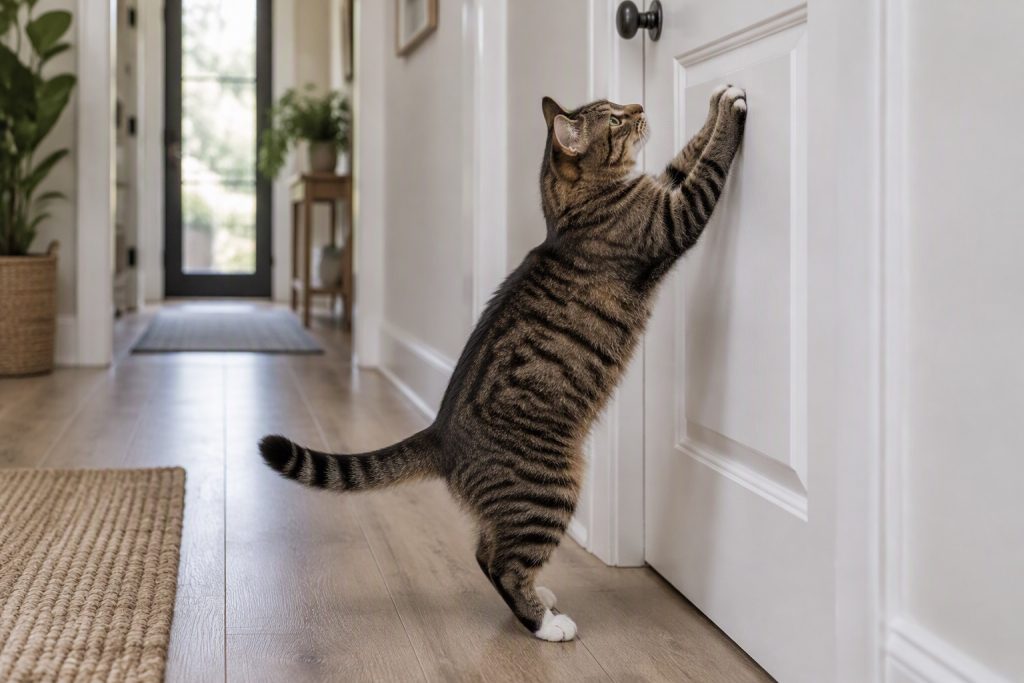
Door scratching is one of the most common cat complaints, and it is almost always about claw care, territory, or communication rather than spite. A cat scratches a closed door to shed the outer sheath of her claws, to mark the boundary of her space, and often simply to tell you she wants it opened. The lasting fix protects the door, offers a better legal outlet for scratching, and changes what the behaviour earns her.
- Scratching is normal claw and scent-marking behaviour.
- Protect the door and give her a proper post.
- Never punish; it tends to worsen the habit.
- Redirect every single time she starts.
Why does my cat scratch the door?
Scratching is a normal, hard-wired feline behaviour with three main jobs. It removes the dead outer sheath of the claw, keeping claws sharp. It stretches the muscles of the shoulders and back, which feels good. Most importantly, it leaves both a visual mark and a scent mark from glands in the paw pads, which is how a cat claims and re-claims territory. A door is an appealing target because it sits at the edge of her world: scratching there is a statement about where her space begins and ends. Doors are also often the barrier between her and something she wants, so the behaviour doubles as a request. Understanding this reframes the problem. She is not being naughty; she is doing exactly what a cat is built to do. Our guide on why cats scratch the sofa covers the same drives on furniture.
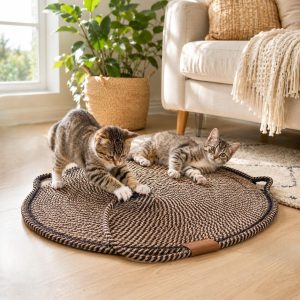
Woven cotton rope pad in an oval shape. Made from mixed materials. Made for scratching and stretching. Gives…
Why does my cat scratch the door at night?
Night scratching usually has a different fuel: boredom, hunger, and the fact that you are finally still. Cats are naturally most active around dawn and dusk, and many are wide awake when the house goes quiet. If scratching has ever worked, if you opened the door, called out, or got up, she has learned that the door is the lever that moves you. Even scolding is a response, and to a bored cat any attention beats none. Hunger can play a role if her last meal was early, and an unspent energy reserve from a dull day makes the night restless. The answer is not to give in, because that confirms the lesson. Instead, add a vigorous play session and a meal before bed, and make the door unrewarding so the behaviour stops paying.
What can I put on a door to protect it?
Physical protection buys you time while you retrain the habit. Clear adhesive films and plastic door guards are the simplest option: they are smooth, so claws slide rather than catch, and they peel off without damaging most finishes. Some owners find a peel-and-stick deterrent film discourages the behaviour because cats dislike the tacky feel, though you must check it is safe and remove it if it upsets her. A sturdy scratching post positioned right beside the door often works better than any barrier, because it offers a legal target at the exact spot she has chosen. Deterrent sprays vary in effectiveness and some cats ignore them entirely, so treat them as support, not a solution. Whatever you use, pair it with a proper scratching outlet rather than relying on the barrier alone. Remember too that a barrier only works while it is in place, so the scratching post must be doing the real work by the time you take the cover off. If you skip that step, the moment the protection comes down she will go straight back to the door.
How do I get my cat to use a scratching post instead?
The trick is to make the post more attractive than the door, and to put it where she already scratches. Place a tall, stable post directly beside the door she targets, so the same spot satisfies the same urge. Height matters: she needs to stretch fully upright, so a post should be at least as tall as she is when standing on her hind legs, and it must not wobble. Sisal rope and rough carpet are the textures most cats prefer. Then make it irresistible by rubbing it with catnip or silver vine, dangling a toy against it, and rewarding her with a treat and praise the moment she uses it. Never force her paws onto it, which creates a negative association. If she still prefers the door, try a different texture or a horizontal scratcher, since cats have personal preferences. Our guide on where to put a scratching post explains placement in more detail.
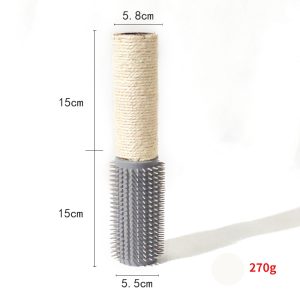
Sisal-wrapped post with a grooming brush base. Made from mixed materials. Made for scratching and stretching. Gives claws…
Do nail trims, caps, or deterrents help?
Trimming the tips of the claws reduces the damage a scratch can do, and it is a reasonable part of the plan, but it does not remove the urge to scratch. Trim only the clear tip and avoid the pink quick inside, and ask your vet or groomer for a demonstration if you are unsure. Soft nail caps are another option: they glue over the claw and blunt the damage, and many cats tolerate them, though they need replacing every few weeks and some cats find them stressful. Neither method addresses why she scratches, so use them alongside enrichment and a good post, not instead of it. Declawing is a major, painful amputation and is not recommended by veterinary bodies for behaviour problems. Deterrent sprays and motion-activated air canisters can help break a habit at a specific spot, but they work best as a short-term support while the real solution takes hold.
When should I ask for professional help?
Most door scratching settles with consistent management over a few weeks. Seek help if the behaviour is intense, if your cat is injuring herself, if she is also scratching walls, furniture, or herself, or if she seems anxious in other ways. Sudden new scratching in an older cat can sometimes reflect stress, pain, or a change in the household, so a vet check is sensible when the behaviour appears out of nowhere. A veterinary behaviourist can help if the scratching is tied to anxiety, conflict with another cat, or a compulsive pattern. Keep a simple diary of when it happens, what precedes it, and what you do, since patterns are easier to break once you can see them. And if you rent, protect the door early: prevention is far cheaper than a repair bill. Landlords tend to be far more forgiving of a cat than of a scratched door, so mention the scratching behaviour when you ask about pets and put protection in place from day one.
Frequently asked questions
- Does punishing my cat stop door scratching? No. Punishment adds stress and often increases scratching, because it still gives attention.
- Should I open the door when she scratches? No. Opening it teaches her that scratching works, which makes the habit stronger.
- How long does it take to stop? With a good post, consistent redirection, and no reward for scratching, most cats improve within a few weeks.
- Are scratch deterrent sprays safe? Many are, but cats often ignore them. Test in a small area and follow the label.
- Will trimming claws stop the behaviour? It reduces damage but not the urge, so it works best alongside a proper scratching post.





