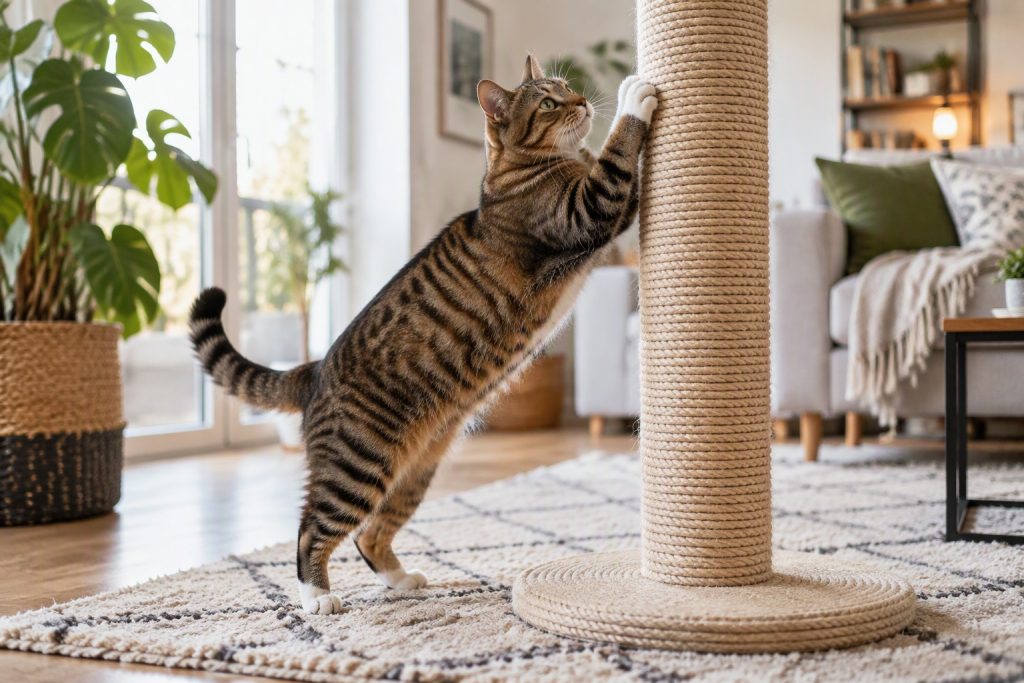
Sisal is one of the best scratching surfaces for cats because it is rough enough to catch and shed the claw sheath, durable enough to last, and satisfying to grip. The best sisal scratching post is tall enough for your cat to stretch fully upright, heavy or braced enough that it will not wobble, and wrapped in tightly wound rope rather than loosely glued twine. Placement beside the furniture she already scratches matters as much as the post itself.
- Sisal grips and sheds claws well and lasts.
- Choose a post taller than your cat on hind legs.
- A wobbling post gets ignored; stability is key.
- Place it where she already scratches.
Why is sisal good for a scratching post?
Sisal is a natural fibre made from the agave plant, and its coarse texture is close to the bark and tree trunks cats evolved to scratch. That roughness gives claws something to catch, which is what allows a cat to pull off the loose outer sheath and sharpen the claw underneath. A smooth surface cannot do this, which is why cats often reject carpet or fabric posts. Sisal is also hard-wearing: a well-wrapped post can withstand months of daily use, far longer than soft alternatives. Tightly wound rope holds its shape better than loosely glued twine, which frays and pulls away. Sisal is also easy to keep clean, since you can vacuum it or wipe it down, and it does not hold odour the way fabric can. The result is a surface that feels right to a cat and stands up to the job.
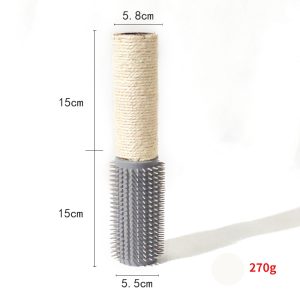
Sisal-wrapped post with a grooming brush base. Made from mixed materials. Made for scratching and stretching. Gives claws…
What height and stability should a sisal post have?
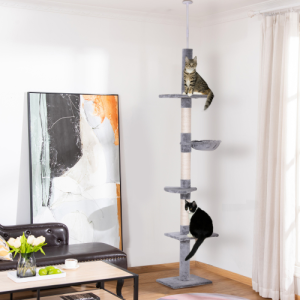
Height is not a detail; it is the whole point. A cat scratches to stretch, so she needs a post she can reach up and pull against at full extension. Measure her from nose to tail tip while standing on her hind legs, and choose a post at least that tall, ideally taller. A short post forces her to scratch low, which she will find unsatisfying and may abandon. Stability matters just as much, because a post that rocks or slides is frightening and useless. Look for a wide, heavy base, or a post that can be braced against a wall or fixed to a stud. A floor-to-ceiling tension post solves both problems and suits small flats. If the post wobbles when you push it, your cat will notice, and she will go back to the sofa. Our article on sisal versus cardboard scratchers compares the alternatives.
How does sisal compare with cardboard?
Both work, and many cats have a clear preference. Cardboard scratchers are inexpensive, come in horizontal and angled shapes, and cats love shredding them, but they shed bits of cardboard, wear out relatively quickly, and need replacing every few months. They are also often too low for a full vertical stretch unless you choose a tall or wall-mounted version. Sisal posts last longer, look tidier in a living room, and support the full stretch that most cats need, but they cost more upfront and some cats prefer the softer give of cardboard. A good compromise is to offer both: a tall sisal post for the main stretch and a flat cardboard pad for horizontal scratching, which many cats do alongside vertical scratching. Watch which one she uses and invest more in that style. Cats who scratch horizontally will often ignore a vertical post entirely, and vice versa.
Where should I put a sisal post?
Put it where she already scratches, because you are trying to redirect an existing habit rather than create a new one. If she targets the sofa arm, place the post directly beside it, and if she scratches a door frame, put it there. Once she is reliably using the post, you can move it a little at a time towards a spot you prefer, but do not start by hiding it in a back room. Cats scratch in places that matter to them, often near where they rest or where the household passes, so a post in the corner of a spare bedroom will likely be ignored. Some cats want a post near their sleeping area, and others want one by a window. Offering more than one post in a home with multiple cats is wise, since sharing a single resource can cause friction. Our guide on getting a cat to use a scratching post has more on placement.
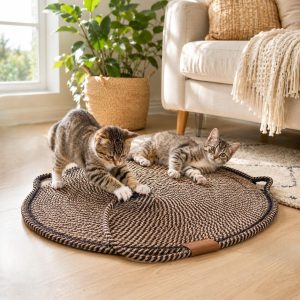
Woven cotton rope pad in an oval shape. Made from mixed materials. Made for scratching and stretching. Gives…
How do I get my cat to use it?
Make the post more appealing than the furniture. Rub it with catnip or silver vine, and dangle a toy against the sisal so she attacks it and her claws make contact naturally. Praise and treat her the moment she scratches it, so the behaviour is rewarded. If she scratches elsewhere, place the post there rather than moving her. Never force her paws onto the post or hold her against it, because that builds a negative association. You can also make the furniture less attractive in the short term with a smooth cover or a deterrent film while the post becomes the better option. Some cats need a slightly angled post rather than a vertical one, so experiment. Most cats take to a well-placed, stable sisal post within a week or two, but patience and consistency are essential.
How do I maintain a sisal post?
Sisal is durable but not indestructible, and a fraying post loses its appeal. Vacuum the post regularly to remove shed claw sheaths and dust, and check the rope for loose ends. If the sisal begins to unravel, you can rewrap it with new sisal rope, which is far cheaper than replacing the whole post. Glue the rope tightly in place and let it cure fully before your cat uses it again, and check the glue is dry and odourless. Rotate or reposition the post occasionally, since a change of location can renew interest. If the base becomes loose, tighten it, because stability is what keeps the post in use. When a post is worn through in a favourite spot, that is a sign it has done its job; rewrap or replace it promptly rather than letting her drift back to the sofa. It is also worth keeping a spare post in the house, because a cat who loses access to her favourite scratching surface while it is being repaired will happily rediscover the furniture in the meantime.
Frequently asked questions
- Is sisal better than carpet for cats? Usually yes. Sisal grips and sheds claws better, and it does not fray into strings like carpet.
- How tall should a sisal post be? At least as tall as your cat when she stands on her hind legs, and taller is better.
- Will my cat use a sisal post? Most do if it is tall, stable, and placed where she already scratches.
- How long does a sisal post last? With daily use, expect months rather than years, though the rope can be rewrapped.
- Should I get a horizontal sisal scratcher too? It is worth offering both, since cats have individual preferences for direction.