

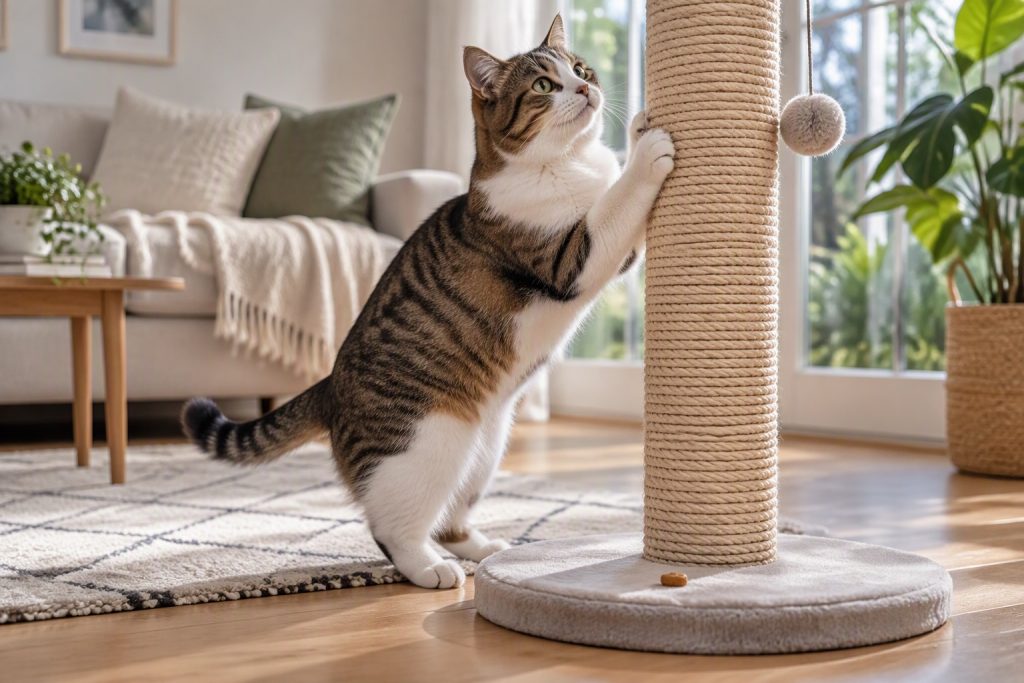
To get a cat to use a scratching post, put it where she already scratches, make it tall and rock-steady, and reward her the moment she touches it. Most cats ignore new posts that are short, wobbly, or hidden in a corner. The trick is to make the post the obvious, appealing choice rather than an alternative she has to discover.
- Place the post where she already scratches.
- Make sure it is tall and completely stable.
- Reward and redirect the moment she uses it.
- Never punish scratching; it backfires.
How do I get my cat to use a scratching post?
Start by matching the post to how your cat already scratches, because she has already told you her preferences. If she stretches up the sofa arm, she wants a tall vertical post; if she claws the rug, she may prefer a flat horizontal pad. Place the new post right beside her current favourite target so it is the obvious alternative, and steady it so it does not shift when she leans into it. Then make it inviting: rub it with catnip, dangle a toy along it, or play with her near the base so she associates it with good things. The instant she uses it, reward her with praise or a treat. Consistency is key, so repeat this every time you catch her scratching, and give her several appealing surfaces rather than expecting one post to do everything.
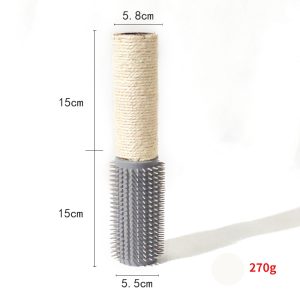
Sisal-wrapped post with a grooming brush base. Made from mixed materials. Made for scratching and stretching. Gives claws…
Why is my cat ignoring the scratching post?
Cats usually ignore a post for one of a few practical reasons, and each has a fix. It may be too short, so she cannot stretch fully, which is the most common complaint. It may be unstable, and a post that rocks under her weight feels unsafe, so she avoids it. It may be made of a material she does not like, such as a smooth surface that offers no resistance, or it may sit in a spot she never passes. Sometimes the post is simply in the wrong room, far from where she actually spends time and scratches. Another possibility is that she has already formed a strong habit elsewhere, and habits take time and patience to redirect. Work through these causes one at a time, and you will usually find the specific reason your cat is turning up her nose.
Where should I put the post to get her to use it?
Location does more to determine success than almost anything else, so place the post where your cat already scratches rather than where it looks tidy. If she claws the corner of the sofa, put the post right there, even if it is not where you would choose to display it. Once she is reliably using it, you can move it a few inches at a time toward a spot you prefer. Cats also like to scratch after waking and near where they sleep, so a post beside her bed often gets used. Our guide to where to put a scratching post explains how to place multiple posts around the home so she always has one within reach. A post in the right place will be used within days; a beautiful post in the wrong place may never be touched. Watch her for a day and note exactly where she scratches, then site the post there rather than where it suits your room layout.
How do I make the post more appealing?
Make the post irresistible by appealing to her senses and her instincts. Rub dried catnip or spray a catnip solution on the surface to draw her in, and attach a dangling toy or a piece of string at the top so she reaches up and makes contact naturally. Scratching the post yourself with your fingernails can also spark curiosity, because cats often investigate sounds of scratching. If she likes treats, place a few at the base so she approaches it happily. Choose a surface with real texture, such as sisal rope, rather than something slippery, and make sure the post is tall enough for a full stretch. Our comparison of why cats scratch the sofa explains the instinct behind the behaviour, which helps you channel it rather than fight it.
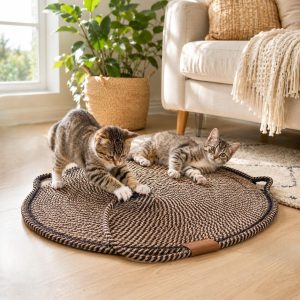
Woven cotton rope pad in an oval shape. Made from mixed materials. Made for scratching and stretching. Gives…
How do I stop her scratching the sofa instead?
Redirect rather than punish, because scolding a scratching cat teaches her only to do it when you are not watching. Put a post beside the sofa, then make the sofa temporarily less appealing with a throw, a deterrent strip, or double-sided tape while she learns the new habit. Cover the exact spot she targets, because cats often scratch one specific corner rather than the whole piece. Cover the target area completely while she learns, since a partial cover often just moves the scratching a few inches along. When you catch her mid-scratch, calmly move her to the post and reward her there. Keep her claws trimmed, which reduces damage while she is still learning, and never declaw, as it is painful and can cause lasting behavioural problems. With the right post in the right place and consistent redirection, most cats switch within a few weeks, and the sofa stops being the battleground.
How long does it take for a cat to accept a scratching post?
Some cats take to a new post within a day, while others need several weeks of patient encouragement, and a few never warm to a particular post and need a different type instead. The timeline depends on how well the post matches her preferences and how firmly her old habit is established. A cat who has scratched the same sofa corner for years will take longer to change than a young cat forming her habits for the first time. Speed things up by placing the post correctly, keeping it stable, rewarding every use, and never punishing the unwanted behaviour. If a month passes with no interest at all, the post is probably wrong in material, height, or location, so try a different style. Patience and experimentation almost always win, and the payoff is intact furniture and a happier cat. If one style fails, try a different height or material rather than giving up, because the right combination usually works.
Frequently asked questions
- Why won’t my cat use the scratching post I bought? It is often too short, unstable, the wrong material, or in the wrong place. Fix those before assuming she will never use one.
- Should I put catnip on a scratching post? Yes. Catnip draws many cats to a new post so they investigate and discover it on their own.
- Can I train my cat to use a post? Yes, by placing it correctly and rewarding every use. It takes patience, but most cats learn within a few weeks.
- Does trimming claws stop scratching? No. Scratching is instinctive and not only about sharpness, but trimming does reduce the damage while you redirect the behaviour.
- How many scratching posts should I have? At least one per cat plus one extra, spread around the home so a post is always within easy reach.





