

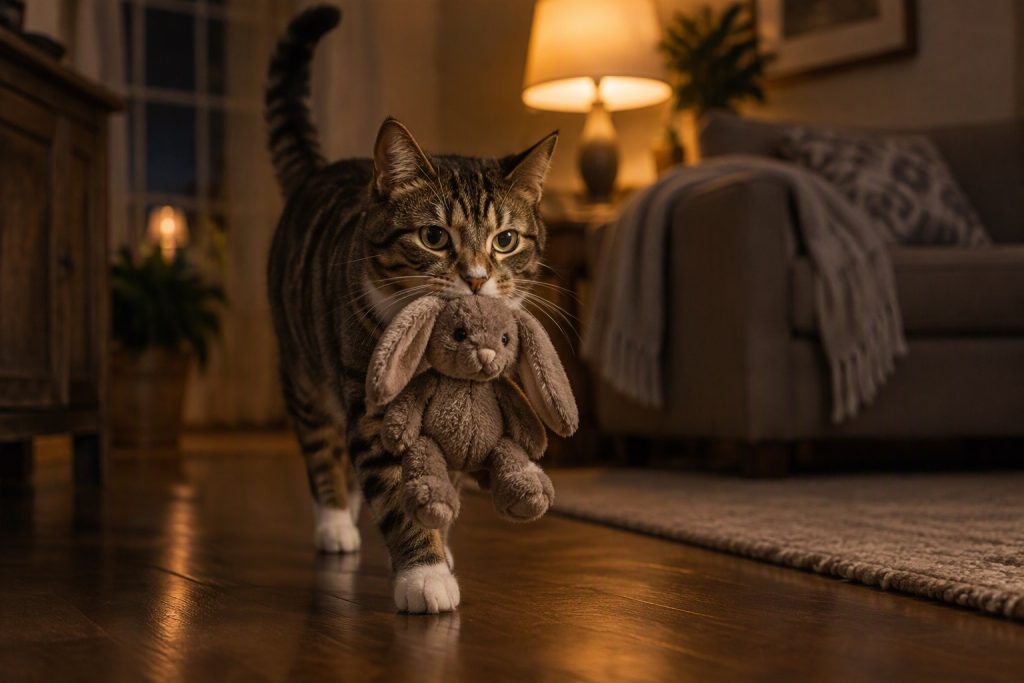
Cats bring toys at night because dusk and dawn are when cats are naturally most active, and carrying prey to a safe place is part of the hunting sequence. Your cat is not bored of the toy; she is following an instinct to move a caught item to a secure spot, often near where you sleep, which is the safest place in her territory. She may also be inviting you to play, since night is when her energy peaks and you are finally still.
- Cats are naturally most active at dawn and dusk.
- Carrying toys mimics moving caught prey.
- Your bed is the safest spot she knows.
- An evening play and feed routine reduces it.
Why does my cat bring toys to me at night?
Two instincts overlap here. The first is prey transport: after a successful hunt, a cat carries the catch to a place where she can eat it without competition, and in a home that place is often the bedroom or your bed, because it smells of you and feels secure. The second is social. Cats who have learned that you engage with toys will bring one to you as an invitation, and at night you are finally still, quiet, and available. Some cats also announce the arrival of a toy with a distinctive yowl, which owners often describe as sounding proud. This is not a gift in the human sense and it is not a sign that she thinks you cannot hunt. Our article on why cats bring toys explains the daytime version of the same behaviour, which is identical in motivation and usually easier to redirect.

A rotating ABS plastic and feather wand fits a cat that needs a target more than another thing…
Why is night specifically the trigger?
Cats are crepuscular, meaning their natural activity peaks at dawn and dusk rather than in the middle of the day. That rhythm evolved because prey is most active at those times and because low light gives a hunter an advantage. In a home, this means your cat’s energy rises in the evening and again in the early morning, and she has no way of knowing that your schedule is different. Compounding it, most indoor cats sleep through long stretches of the day while you are out, which leaves them with a full tank of energy when you go to bed. Add the fact that night is quiet, the house is calm, and small sounds and movements are more noticeable, and you have ideal conditions for a hunt. Our guide to why cats run at night covers the related behaviour of night-time racing, which often accompanies the toy carrying.
Is bringing toys at night a sign my cat is bored?
Often, yes, at least partly. A cat whose hunting needs are met during the day is usually calmer at night, while a cat who has had no real stalking and pouncing will find her own entertainment. Boredom in indoor cats is common, and it shows up as night-time activity, attention-seeking, over-grooming, and destructive behaviour. The good news is that boredom responds well to relatively small changes: a proper wand play session, a puzzle feeder, some vertical space, and a rotating set of toys. The behaviour at night is the symptom, and the underlying cause is usually unspent energy plus a lack of a hunting outlet. That said, some cats simply carry toys around at night regardless of how much play they get, because the behaviour itself is self-rewarding. In that case, management matters more than prevention.
Does bringing toys at night mean my cat is trying to wake me?
Sometimes, and it is worth being honest about that. Cats learn fast, and if carrying a toy to the bed at three in the morning once resulted in you getting up, stroking her, or feeding her, she will do it again. The behaviour that gets a reaction gets repeated. That does not mean she is being spiteful or manipulative in a human sense; it is straightforward learning. If you want to reduce the night-time visits, the most effective single change is to make sure they produce no reward. Do not get up, do not talk to her, do not turn on a light, and do not feed her. That is harder than it sounds in the middle of the night, but it works within a week or two for most cats, because a behaviour that stops paying stops happening.

A plush toy that gives a cat a soft target to pounce on — a soft target takes…
How do I reduce night-time toy bringing?
Shift her activity earlier. Play a proper wand session in the late evening, for ten to fifteen minutes, and let her catch the toy at the end so the hunt feels complete. Then feed her a meal, because the natural sequence after a hunt is eat, groom, sleep, and a full stomach genuinely does make cats sleepy. Keep the house dim and quiet in the hour before bed, and avoid rough play right at bedtime, which winds a cat up rather than settling her. Put a few toys away at night so there is less to carry, and leave one or two low-key options out. If she still brings toys, do not react. Over a couple of weeks, combined with the play and feed routine, most cats settle. If she is genuinely hungry at night, check that her daily calories are adequate, and ask your vet before changing her diet.
When should night-time behaviour worry me?
Night-time activity is normal, but a sudden change in an older cat is worth investigating. If a cat who has always slept through the night starts pacing, yowling, and carrying things around at all hours, that can be a sign of an underlying medical problem. Hyperthyroidism commonly causes increased night-time activity and vocalisation in middle-aged and older cats. Cognitive dysfunction, the feline equivalent of dementia, causes night-time restlessness and disorientation. Pain from arthritis can make a cat unable to settle, and hunger from diabetes or another condition can drive night-time seeking. If the behaviour is new, if it comes with weight change, appetite change, increased drinking or urination, or if your cat seems confused, see your vet. Otherwise, treat it as a scheduling problem and adjust her day, because in most cases the behaviour is harmless and simply needs an earlier outlet.
Frequently asked questions
- Why does my cat carry her toy around and yowl at night? She is announcing a catch, which is a normal hunting behaviour, not distress.
- Is my cat bringing me a gift? Not in the human sense. She is moving a catch to a safe place, which happens to be near you.
- Should I play with my cat when she brings a toy at night? No, if you want the behaviour to reduce. Play earlier in the evening instead.
- Do cats grow out of night-time activity? Most calm down once play needs are met, but the crepuscular rhythm never disappears.
- My older cat has started this suddenly. Should I worry? Yes. New night-time restlessness in an older cat is worth a vet check.





