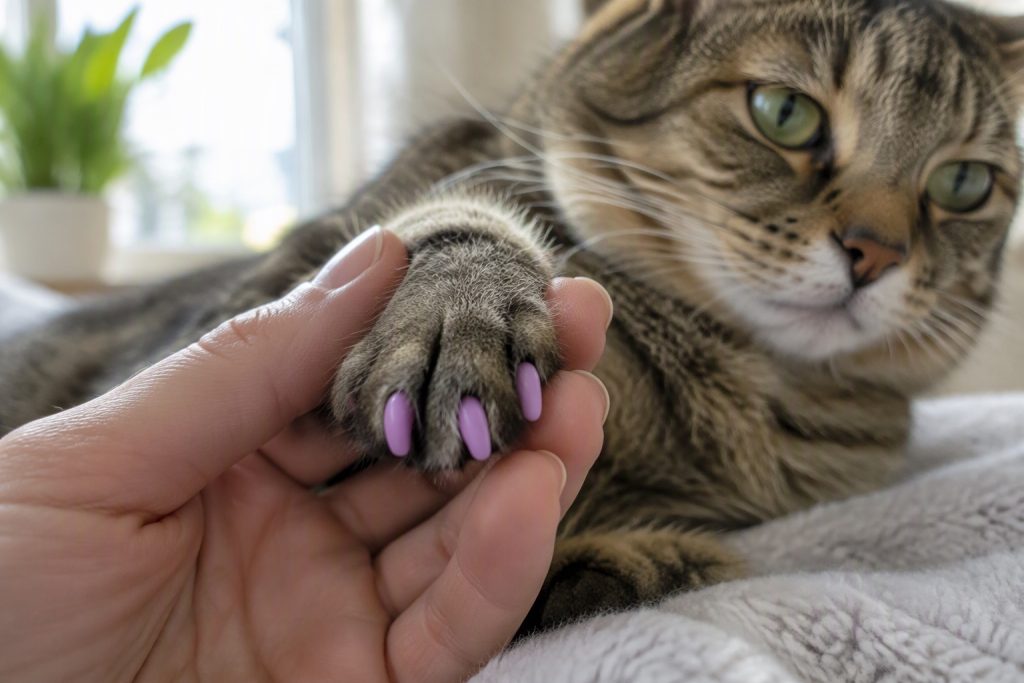
Cat nail caps do work for what they are designed to do: they cover the claw tip so scratching causes far less damage to furniture and skin. They do not stop a cat from scratching, they do not remove the need to scratch, and they need to be reapplied every four to six weeks as the claw grows. They are a management tool, not a solution, and they should only be used with correct sizing and safe adhesive.
- They blunt damage, not the scratching urge.
- They need replacing every four to six weeks.
- Correct sizing and safe glue are essential.
- They are not a substitute for a scratching post.
What are cat nail caps and how do they work?
Nail caps, sometimes called soft claws or nail tips, are small vinyl or rubber covers that are glued over the tip of each claw. They blunt the sharp point, so when a cat scratches a sofa arm or your leg, the damage is dramatically reduced, though the pressure of the scratch is still there. They do not prevent the claw from extending and they do not stop the underlying behaviour, which is why a cat wearing caps will still scratch, still stretch, and still mark her territory. Application involves trimming the claw tip, filling each cap partway with a pet-safe adhesive, and sliding it onto the claw, holding it for a few seconds. A full set takes ten to twenty minutes for a cooperative cat and considerably longer for a cat who objects. The caps fall off naturally as the claw grows and sheds its outer sheath, which is why they need replacing roughly monthly.
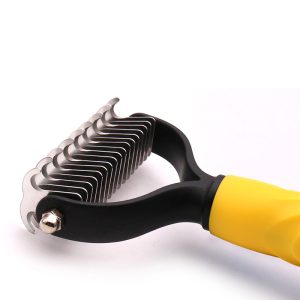
A plastic dematting comb clears the loose hair before it lands on the furniture. Use it before the…
Do nail caps actually stop cats scratching furniture?
They reduce the damage, not the behaviour. If the problem is shredded sofa corners, caps can be genuinely effective, because a blunt tip does far less harm than a sharp one. If the problem is that your cat scratches the sofa instead of her post, caps do nothing to change that preference, and you will still need to address placement, surface, and stability. There is also a welfare consideration: scratching is a normal, necessary behaviour for claw health, stretching, and scent marking, so blocking the damage without providing an outlet leaves the need unmet. The best results come from using caps alongside proper scratching provision, not instead of it. Our article on why cats scratch the sofa explains what is actually driving the behaviour and how to redirect it, which is the part that solves the problem in the long term.
Are nail caps safe for cats?
When applied correctly, they are generally considered safe. The main risks come from poor technique: using a cap that is too small, which pinches the toe; applying too much glue, which can bond the cap to the surrounding fur or skin; or using a non-pet-safe adhesive, which can irritate or burn. Caps that are too tight can restrict the claw and cause discomfort or infection, so correct sizing matters more than any other single factor. Some cats chew at the caps, and swallowing a cap is a possible hazard, though most pass through harmlessly. Watch for signs of trouble: limping, licking at a paw persistently, swelling, redness, or a bad smell. If you see any of these, remove the caps and contact your vet. Cats with certain medical conditions or injuries to the claws should not wear caps without veterinary advice.
How long do nail caps last and how do I apply them?
Expect four to six weeks, with some caps shedding earlier and a few lasting longer. The front claws wear and grow faster than the back, so you may need to replace the front set more often. To apply them, trim only the very tip of the claw, being careful to stay well clear of the quick, which is the pink area containing blood vessels and nerves. Fill each cap about a third to half full with the adhesive supplied, slide it over the claw, and hold it in place for the time the product specifies. Work on one paw at a time, in a calm room, with treats, and take breaks rather than forcing it. If your cat will not tolerate the process, a vet or groomer can apply them. Our guide to cat nail clippers covers choosing a clipper that makes the trim quick and safe.
Nail scissors, bath brush, de-shedding glove and a drying towel — the full groom in one box. Cuts…
What are the alternatives to nail caps?
Several, and most cats do better with a combination. Proper scratching provision is the foundation: at least one sturdy vertical scratcher per cat, tall enough for a full stretch, placed where your cat already scratches. Soft furnishings, carpet, and sisal suit different cats, so offer variety. Regular nail trimming blunts the tips without covering them, and it is the simplest ongoing solution if your cat tolerates it. Double-sided tape or a temporary cover on the furniture helps break the habit while the scratcher becomes established. Pheromone sprays can reduce stress-related scratching. If the scratching is really about attention or play, more interactive play sessions reduce it. Declawing is not an acceptable option, as it is a major amputation that causes lasting pain and behavioural problems, and it is banned in many countries. Nail caps sit alongside these tools rather than replacing them.
When should I not use nail caps?
Avoid them if your cat has any injury, infection, or swelling in a claw or paw, since covering the area will hide the problem and may make it worse. Avoid them if your cat has a medical condition that affects the claws or the skin, without asking your vet first. Avoid them on kittens, whose claws are small and whose feet are still developing, and on cats who are very stressed by handling, because the application itself becomes a welfare problem. Do not use them as a substitute for veterinary treatment of a behavioural problem, and do not use them to avoid providing scratching outlets. If your cat repeatedly removes and eats the caps, stop using them. And if you are using caps because a household member is at risk from scratches, talk to your vet about the best combined approach, since no single tool solves a complex behaviour. If the caps cause your cat any distress at application, it is usually better to trim claws and improve her scratchers instead.
Frequently asked questions
- Do cat nail caps hurt? Correctly sized and applied caps should not hurt. Poorly fitted ones can pinch the toe.
- How often do nail caps need replacing? Usually every four to six weeks, as claws grow and shed their outer sheath.
- Can nail caps stop my cat scratching? No. They reduce the damage. Your cat will still scratch, so provide proper scratchers.
- Are nail caps better than declawing? Yes. Declawing is an amputation, whereas caps are a removable cover.
- What if my cat chews her nail caps off? Remove any loose caps and stop using them if she keeps eating them, since swallowing is a risk.