

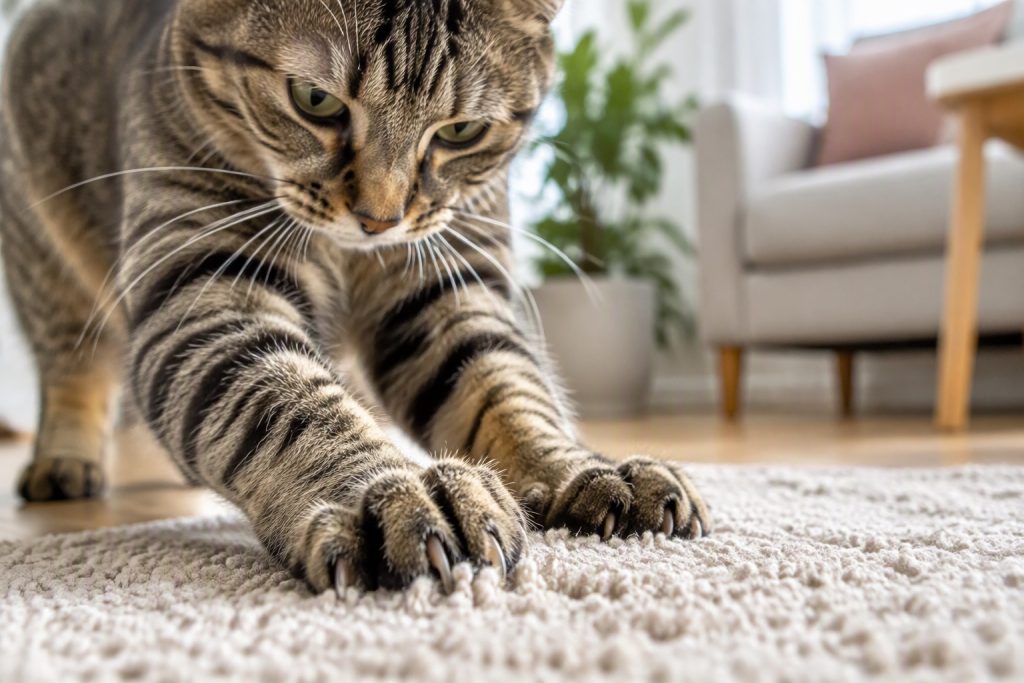
Cats scratch carpet for two main reasons: to shed the worn outer layer of their claws, and to mark territory with scent from glands in their paws. Carpet is a favourite target because its looped pile catches the claw and gives a satisfying grip, and because a long horizontal stretch of it lets a cat scratch while stretching. It is normal behaviour, not spite or naughtiness. You stop it by providing a better scratching surface, placed where she already scratches, and by making the carpet less rewarding to use.
- Scratching sharpens claws and marks territory.
- Carpet gives a satisfying grip for the claws.
- It is normal, not bad behaviour or revenge.
- Add a good post nearby and redirect her to it.
Why does my cat scratch the carpet specifically?
Carpet suits a cat’s scratching needs unusually well. The tight looped fibres grab the claw so it catches and peels, which is exactly what a cat wants when she is shedding the dull outer sheath of each claw. Carpet is also usually horizontal and long, which lets a cat sink her claws in and stretch her whole body forward, working her shoulders and back at the same time. Many cats prefer horizontal scratching to vertical scratching, and carpet is the most available horizontal surface in most homes. There is also a marking element: cats have scent glands between their paw pads, so scratching leaves both a visual scratch and a chemical signature that tells other cats she was here. That is why a cat often returns to the same patch of carpet, and why the spot tends to be in a socially important place, such as a doorway or the middle of the living room. Our article on why cats scratch the sofa explains the same instincts applied to furniture.
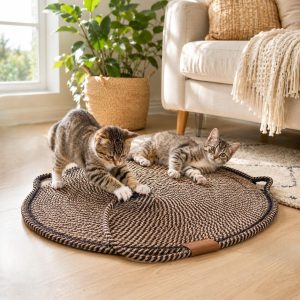
Woven cotton rope pad in an oval shape. Made from mixed materials. Made for scratching and stretching. Gives…
Is carpet scratching bad for my cat or my home?
For your cat it is entirely healthy, because scratching maintains her claws and stretches her muscles, and preventing it can cause stress and redirected behaviour. For your home, the damage depends on the carpet. Looped carpets such as berber can snag and pull into long runs, which is the most destructive outcome, while cut-pile carpets tend to show surface damage that is easier to live with. The real problem is usually the location, because a cat who scratches the same doorway eventually frays it badly. Rather than trying to stop scratching altogether, the goal is to move it to an appropriate surface. Keep your cat’s claws trimmed, which reduces the damage each scratch causes, and place a suitable scratcher right where she is already working, because a cat is far more likely to use a post that is already in her chosen spot than one hidden in another room.
How do I get my cat to scratch a post instead of the carpet?
Match her preferences and her location. Since she is choosing carpet, she likely likes a horizontal surface, so offer a horizontal scratcher, such as a flat cardboard pad or a carpet-covered board, and place it exactly where she scratches, overlapping the spot if possible. If she scratches vertically on the stairs or the side of furniture, choose a tall, stable vertical post that lets her stretch to full height, because a short post that wobbles will be rejected. Material matters too: sisal and cardboard are the most popular, and a carpet-covered post can work for a carpet-scratching cat, though some owners avoid it for fear of teaching her that carpet is fair game. Rub the new scratcher with a little catnip or silvervine to attract her, and reward her with praise and a treat when she uses it. Our guide on where to put a scratching post covers placement in detail.
What can I do to protect the carpet meanwhile?
While she is learning to use the new scratcher, you can make the carpet less appealing without frightening her. Cover the damaged spot with a plastic mat, a sheet, or double-sided tape, all of which feel unpleasant under her claws, and place the scratcher directly on top or beside it so the better option is the easy one. Keep her claws trimmed every couple of weeks, which reduces how much damage a scratch does, and give her more scratching outlets so she is not dependent on one patch. Never shout at her or use a spray bottle, because punishment creates stress and often makes scratching worse, since anxious cats scratch more to mark territory. If she has several carpet spots, put a scratcher at each one rather than expecting her to travel to a single post. Over a few weeks, most cats transfer their habit if the alternative is well placed and rewarding.
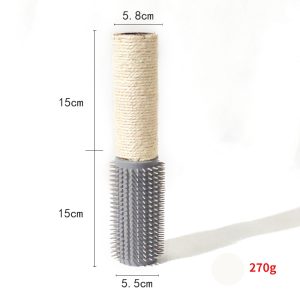
Sisal-wrapped post with a grooming brush base. Made from mixed materials. Made for scratching and stretching. Gives claws…
Does stress make carpet scratching worse?
It can. Scratching is partly a marking behaviour, and a cat who feels insecure marks more, so a new cat in the home, a move, a new baby, or conflict over resources can all increase scratching. Watch for scratching that appears suddenly or intensifies, especially near doors and windows, which are boundary areas a cat wants to claim. In a multi-cat home, make sure there are enough resources to go round, including scratchers, litter boxes, food stations, and resting spots, so no cat feels the need to over-mark. Give her vertical space and quiet hiding places, and keep routines predictable. If the scratching is clearly tied to tension, the behaviour usually settles once the underlying stress is reduced. If it appears out of nowhere with other changes, such as increased grooming or hiding, it is worth a vet check, since discomfort can also increase restlessness and marking.
Are there carpets or surfaces that resist scratching?
No carpet is cat-proof, but some are more resilient. Tight, low-pile and hard-wearing synthetic carpets show less damage than deep, soft piles, and berber, with its looped construction, is the worst choice because a single pull can unravel a long run. If you are choosing flooring and share your home with a cat, a low-pile or woven carpet is more forgiving, and hard flooring with a rug she can scratch is easier to manage because the rug can be replaced. Whatever you have, the most effective protection is not the material but the alternative you provide: a cat with a satisfying scratcher in the right place scratches the carpet far less. Combine that with regular claw trimming and you will keep damage to a minimum. If your cat has destroyed one spot and you must repair it, do the repair after you have established the new scratching habit, so the fresh carpet does not immediately become the next target.
Frequently asked questions
- Why does my cat only scratch carpet, not her post? She may prefer a horizontal surface. Try a flat cardboard or carpet scratcher in the same spot.
- Is carpet scratching a sign of stress? Sometimes. Scratching is marking behaviour, so stress and insecurity can increase it.
- Will trimming her claws stop the scratching? No, but it reduces the damage. She will still need a proper scratching outlet.
- Should I punish my cat for scratching the carpet? No. Punishment raises stress and often makes scratching worse. Redirect her instead.
- Do carpet-covered posts encourage carpet scratching? They can. Some owners prefer sisal or cardboard for a carpet-scratching cat.





