

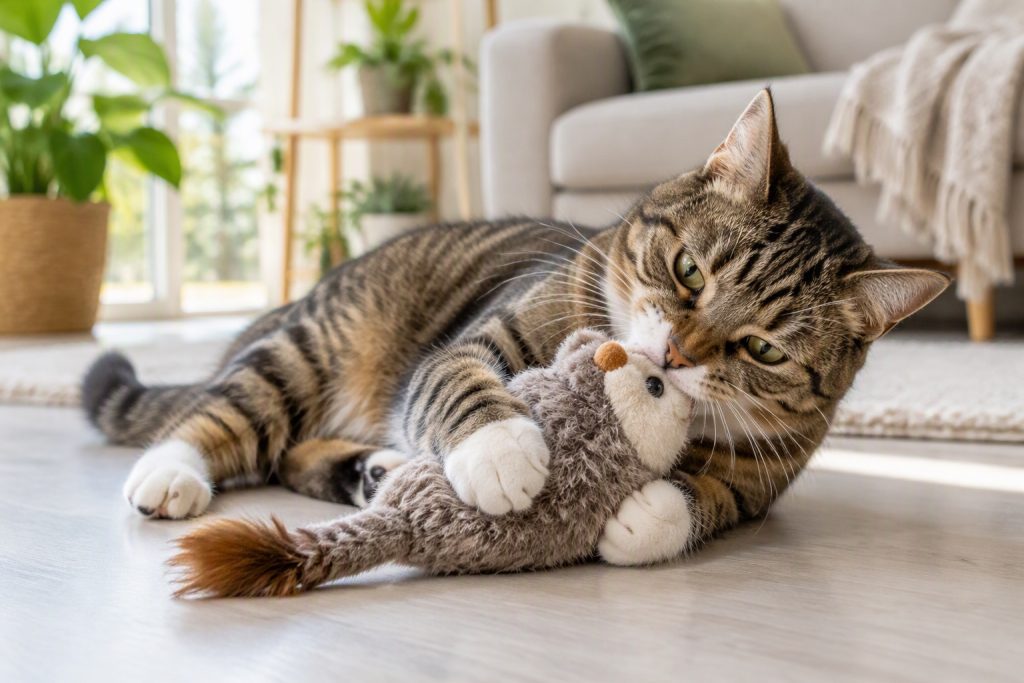
A cat bites its toys as part of normal hunting play. Biting, grabbing, and kicking a toy lets her rehearse the final part of a hunt, and it is one of the healthiest outlets for predatory energy. Soft toys, kickers, and wand attachments are all fair game, and the biting usually means the toy is working exactly as intended. The only times to intervene are when she bites hands or feet instead of toys, when she swallows parts of a toy, or when biting becomes a sign of overstimulation or stress.
- Biting toys is normal hunting play.
- It rehearses the kill bite from a real hunt.
- Offer kicker and wand toys to redirect it.
- Never let her bite hands or feet instead.
Why does my cat bite and kick her toys?
This is the classic “bunny kick” sequence, and it comes straight from hunting. When a cat catches prey, she grips it with her front paws, bites to subdue it, and kicks with her powerful back legs to disembowel and disable it. When she does the same to a toy, she is running a complete and satisfying hunt from start to finish, which is why the behaviour often looks so intense. The biting also provides feedback: the resistance of a stuffed toy against her teeth and jaws is rewarding, and it lets her use her jaws the way they are designed to be used. For an indoor cat who never hunts for real, toys are the only place this instinct can go, so biting and kicking toys is a sign of a well-adjusted cat with a healthy outlet. It is not aggression toward you, and it is not a behavioural problem.

A rotating ABS plastic and feather wand fits a cat that needs a target more than another thing…
Is biting toys ever a warning sign?
Usually not, but there are a few situations worth noticing. If she bites a toy and then redirects onto your hand or ankle, she may be overstimulated or frustrated, which is a cue to end the session calmly rather than continue. If the biting is accompanied by flattened ears, a lashing tail, hissing, or a tense body, she is not playing; she is stressed or defensive, and the toy is incidental. If she bites toys obsessively to the point of ignoring food or rest, or if the behaviour is new and intense, it can accompany stress or discomfort. And if she is chewing and swallowing parts of toys, that is a genuine safety concern, because swallowed fabric or foam can cause a blockage. Watch the whole picture: relaxed, playful biting with a soft body is fine, while tense or frantic biting deserves a closer look.
Which toys are best for a cat who loves to bite?
Offer toys that are designed to be grabbed and kicked. A kicker toy, which is a long, plush shape the size of a small prey animal, is ideal, because it lets her wrap her front paws around it and rake it with her back legs while biting the end. Wand toys with a soft or feathered attachment let her bite at the end of a chase, and plush toys with a crinkle or catnip filling add appeal. Rotate them so the novelty does not wear off, and keep a dedicated set that is only for biting so she learns what is fair game. Avoid toys with small detachable parts, long strings, or loose bells that can be swallowed. Our guide on the best kicker toy for cats covers what to look for in more detail.
How do I stop her biting my hands instead?
The key is never to teach her that hands are toys. If you roughhouse with your hands, she learns that biting skin is part of play, and that habit is hard to undo. Instead, always redirect her to a toy: when she goes for your hand, freeze, say nothing, and offer a kicker or wand toy instead. If she bites during play, end the session immediately and walk away for a minute, so she learns that biting ends the fun. Do not yank your hand away quickly, which triggers a chase reflex, and do not punish her, which creates fear and can make biting worse. Give her plenty of legitimate biting outlets, because a cat with enough play rarely needs to use hands. If the biting is happening outside play, such as when you walk past, it may be play-soliciting behaviour that needs more structured play sessions. For related behaviour, see our article on why cats bring toys.
A plush toy that gives a cat a soft target to pounce on — a soft target takes…
Could biting toys mean my cat is bored or stressed?
It can, and the clue is intensity and timing. A cat who bites toys enthusiastically during play is simply enjoying herself. A cat who seeks out toys to bite when she is alone, or who bites them frantically, may be under-stimulated and trying to burn off energy. Stress can also show up as increased oral behaviour, so if the biting started after a change at home, or comes with over-grooming, hiding, or a change in appetite, look at her environment. The basics help: two play sessions a day, a puzzle feeder for meals, vertical space, and a predictable routine. If the behaviour appears suddenly and is accompanied by other changes, a vet visit is sensible, because dental pain or discomfort can make a cat chew more than usual.
How do I keep play safe and satisfying?
Structure sessions to mimic a real hunt: let her stalk, chase, pounce, and finally catch and bite the toy, then let her win by leaving the toy with her for a moment before putting it away. Ending on a catch is far more satisfying than ending on a miss, and it reduces frustration. Supervise chewing closely, and inspect toys regularly for tears, loose stitching, or exposed stuffing, retiring anything damaged. Avoid toys with strings long enough to swallow or elastic that can snap, and never use human hair ties or rubber bands, which are commonly swallowed. Store wand toys out of reach so she cannot chew the string unsupervised. Finally, keep nails trimmed so play does not injure you accidentally, and wash plush toys periodically, since they collect saliva and fur. Safe, well-timed play is the single best way to keep the biting behaviour happy and harmless.
Frequently asked questions
- Why does my cat bite and kick her toy? It is the natural hunting sequence of gripping, biting, and kicking prey, played out safely on a toy.
- Is it bad if my cat bites her toys? No. It is healthy play, as long as she does not swallow parts or bite hands instead.
- How do I stop her biting my hands? Never play with hands. Redirect to a kicker or wand toy, and end play if she bites skin.
- What is the best toy for a biting cat? A long kicker toy she can grab and rake, plus a wand toy with a soft attachment.
- Can biting toys mean my cat is stressed? Sometimes. Frantic or new biting with other changes can signal stress or discomfort, so check with your vet.





