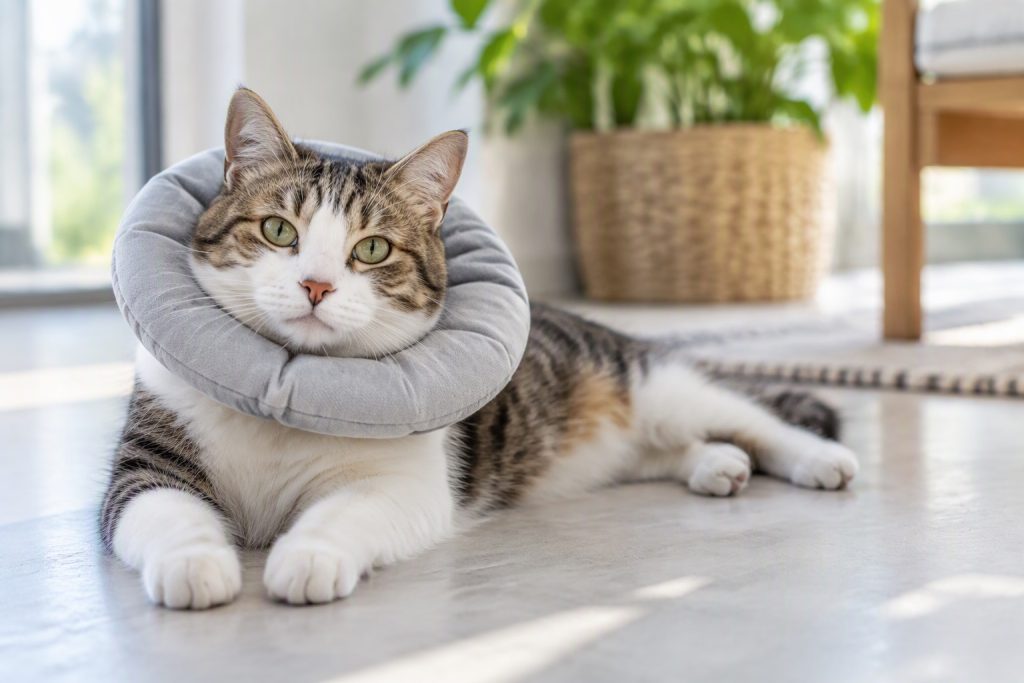
The best cone alternative for cats is a soft recovery suit or a padded collar that keeps her away from the incision without blocking her vision, eating, or movement. Soft suits cover the wound directly, padded collars ring the neck to stop licking, and both are usually tolerated far better than a hard plastic cone. Whichever you choose, it must stay on whenever you cannot supervise her.
- Soft recovery suits cover the wound without a cone.
- Padded collars stop licking and stay comfortable.
- She must still eat, drink, and see clearly.
- Keep it on whenever you cannot watch her.
Why do cats hate the plastic cone?
The classic Elizabethan collar is effective, but it is also uncomfortable and disorienting. It is rigid and bulky, so it bangs into furniture, catches on carpets, and blocks her peripheral vision, which makes a nervous cat feel exposed. Many cats refuse to eat, drink, or use the litter box while wearing one, and some become so stressed that they try to scrape it off, which can injure the wound or their neck. The noise of the plastic near her ears is unpleasant, and the loss of whisker contact with the world adds to the distress. Because stress slows healing and raises the risk of complications, a calmer alternative is often the better choice. That is not to say cones are useless — they remain the most reliable option for a cat who will not tolerate anything else, and for some surgical sites they are the safest. Our guide to neutering recovery covers the full aftercare routine. For a cat who is already anxious, a calmer barrier can mean the difference between rest and constant struggling.
A breathable plastic grooming tool takes the undercoat first, which is where matting starts. Try it after a…
What types of cone alternative exist?
The main options are recovery suits, soft padded collars, and inflatable or donut-style collars. A recovery suit is a close-fitting bodysuit that covers the incision and prevents licking, and it is generally the most comfortable for the cat because it leaves the head and legs free. A soft padded collar is a fabric ring that sits around the neck and physically blocks her from reaching the wound, with a much softer feel than plastic. Inflatable collars work the same way but can be bulkier. There are also flexible fabric cones that are softer than rigid plastic while still creating a barrier. Each has trade-offs: suits are ideal for body incisions but not for the head or legs, while collars suit head and neck wounds. Your vet can recommend the best fit for the specific surgery. If the suit leaves red marks or she cannot walk normally, it is too tight and should be swapped for a larger size.
Which is best after spaying or neutering?
For a spay or neuter, a recovery suit is usually the best first choice, because the incision is on the belly and a suit covers it directly while allowing full movement. She can eat, drink, jump gently, and use the litter box without the frustration of a rigid collar. Many owners find suits far easier than cones, and most cats accept them within a day. That said, a suit only works if it fits snugly and stays in place, and you must check the wound through or around it regularly. If your cat is determined to lick through the fabric, or if the incision needs more protection, a soft collar combined with a suit can be the answer. Some cats simply will not wear a suit, in which case a padded collar is the fallback. Our guide to what to expect after spaying explains the healing timeline. A suit that opens flat is far easier to manage alone, especially if you have to dress her several times a day.
How do I get her to accept a suit?
Introduce it calmly, when she is relaxed rather than mid-play or agitated. Let her sniff the suit first, then put it on in one smooth motion without a struggle, and give her a treat and praise immediately afterwards. Do not chase her around the room, which turns it into a game or a threat. Most cats fuss for a few minutes, walk oddly, then settle. If she freezes or refuses to move, sit quietly nearby and let her adjust, offering gentle encouragement. Never leave a suit on a cat who is genuinely panicking, because she could hurt herself trying to escape it. Check the fit: it should be snug but allow full leg movement, and it must not restrict breathing, the neck, or the tail. With a little patience, most cats adapt within a day or two. If she panics badly, try a different style or ask your vet to show you how they fit it.
Nail scissors, bath brush, de-shedding glove and a drying towel — the full groom in one box. Cuts…
How do I keep it clean?
Cleanliness matters, because a soiled suit can irritate the incision and cause infection. Check it daily for urine, faeces, or discharge, and change it as soon as it is dirty. Most suits are machine washable, so have at least two so one can be worn while the other is washed. Use a gentle, unscented detergent and skip fabric softener, which can leave residue that irritates skin. Let the suit dry fully before putting it back on. While she is out of the suit for a change, supervise her closely so she cannot lick the wound. If the suit is hard to remove and replace, ask your vet or a nurse to show you the technique, because a smooth method keeps both of you calm and avoids stressing her several times a day. Keeping the suit clean also keeps the wound clean, so a spare is worth having from day one.
When is a cone still the right choice?
There are times when a cone or rigid collar is genuinely the best option. If your cat is determined and flexible enough to reach the wound even through a suit, or if she has an eye, ear, or facial wound that a suit cannot cover, a cone may be necessary. Very anxious cats who panic in a suit may also do better with a soft collar they cannot remove. If the wound is at risk of opening and the vet has stressed the importance of no contact, follow their advice rather than substituting your own preference. Never remove the cone early because she seems fine, since cats often leave wounds alone until the moment you are not looking. Ask your vet which option suits your cat’s surgery, temperament, and home, and be honest if one approach is not working. Whatever you choose, the goal is the same: keep her away from the wound without adding stress.
Frequently asked questions
- What can I use instead of a cone for my cat? A recovery suit or a soft padded collar are the most common alternatives and are usually better tolerated.
- Are recovery suits better than cones? For body incisions such as a spay or neuter, many owners and vets prefer suits, as long as the fit is snug and the wound stays covered.
- Can my cat still eat and use the litter box in a suit? Yes, if the suit fits well. She should be able to move, eat, drink, and toilet normally.
- How long does my cat need to wear a suit or collar? Usually until the incision has healed, typically about a week to ten days, or as your vet advises.
- What if my cat licks through the suit? Check the fit and consider adding a soft collar. If she still reaches the wound, ask your vet.