

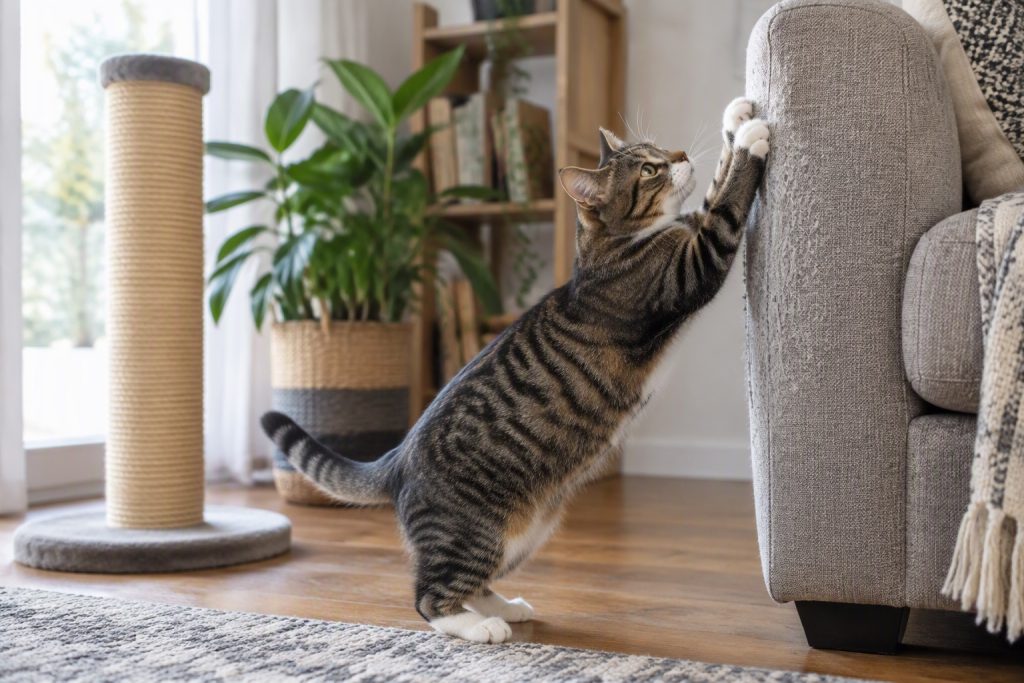
Scratching is not naughtiness and it is not a phase. Cats scratch to shed the outer layers of the claw, to stretch the muscles of the back and shoulders, and to leave both a visual and a scent mark on their territory. A cat that shreds the sofa arm is doing all three of those things on the most convenient object available. The answer is not to stop the behaviour, which is not possible, but to make the object you prefer more attractive than the object you do not, and to place it exactly where the cat already wants to scratch.
- Scratching is a normal need, so the goal is redirection rather than prevention.
- Put the scratcher next to the thing being damaged, not in a different room.
- Vertical scratchers suit cats that stretch tall; horizontal ones suit cats that scratch on the floor.
- Never punish the cat or consider declawing, which is a serious welfare harm.
Why does my cat scratch the sofa and not the post?
Because the sofa is better. It is often longer, more stable, and in a more socially important place in the house. Cats choose a scratching surface on three criteria: it does not wobble, it is tall or long enough for a full stretch, and it is in a prominent spot. A cheap post that sways under a paw, or a small scratcher tucked in a corner behind a door, fails on all three. The sofa passes on all three, which is why it keeps winning. There is also a marking element: cats scratch in places that matter socially, often near where the family gathers or near a doorway. Note where the cat scratches over a day. That is why moving the scratcher to the sofa’s side works far better than buying a more expensive one for the hallway.

Multi-shape corrugated sheets let one board serve two postures, a flat section for forward stretching and an angled…
Where should I put the scratcher?
Next to whatever the cat is currently destroying. This is the single most effective change most owners can make, and it is the one they most often resist for aesthetic reasons. A scratcher in the spare room will be ignored; a scratcher beside the sofa arm will be used. Once the cat is reliably using it there, you can very gradually move it a few centimetres a week towards wherever you would rather it lived. Cats also scratch on waking, so a scratcher next to the main sleeping spot gets used. If the cat scratches near a doorway or a window, add one there too. Think of scratching stations as furniture for the cat, and place them where the cat already spends time rather than where they are least visible.
Should I choose a vertical or horizontal scratcher?
Match the cat’s habit, not your preference. Watch how the cat scratches the sofa: if it stands up and reaches high, it wants a tall vertical post with a stable base. If it crouches and rakes the carpet or the floor, it wants a horizontal pad. Many cats want both, and a house with one of each placed in different spots usually solves more problems than two of the same. Vertical scratchers need to be tall enough for a full stretch, which for an adult cat is often around the length of the cat with its front legs extended. Stability matters more than size: a post that moves when the cat leans on it will be abandoned immediately, and it will teach the cat to go back to the furniture.
What materials do cats actually prefer?
Sisal rope and corrugated cardboard are the two reliable options, for slightly different reasons. Sisal has a rough, fibrous texture that shreds satisfyingly and holds up well on a vertical post. Cardboard is softer and works well flat on the floor or in a slanted bed-style scratcher, and many cats prefer its give under the claws. Carpet is a poor choice, because it teaches the cat that carpet is a legitimate scratching surface, and that is exactly the lesson you are trying to avoid. Do not use a material that resembles the sofa fabric. Some cats also like bare wood, which is why the corner of a wooden doorframe sometimes loses. Rotate or replace worn scratchers rather than letting them become smooth, because a scratcher with no resistance stops being interesting.
Bowl designed to give a cat a stable dish that does not slide — a dish that moves…
Do nail trims stop scratching?
They reduce the damage but they do not change the behaviour. A cat with trimmed claws still scratches, because the behaviour is about stretching and marking rather than about claw length. Trimming does mean the claws are blunter and tear less fabric, which is genuinely useful, and it is worth doing regularly if the cat tolerates it. The right way to trim is a little at a time, with a proper cat clipper, avoiding the quick inside the claw. If the cat will not tolerate it, a vet or a groomer can do it. Trimming is a supporting measure, not a solution: the solution is still a stable, well-placed scratcher that the cat prefers. A cat new to trimming needs short sessions just to accept paw handling. For the practical side, see redirecting scratching away from the sofa arm.
How long does redirection take?
Often a few days, sometimes a few weeks, and it depends on how consistently you place and reward. Put the new scratcher right against the damaged spot, and when the cat uses it, offer a treat or a piece of play nearby so the association is positive. Never punish scratching: a cat that is shouted at while scratching learns to scratch when you are not there, which is worse. Keep the cat’s claws trimmed in the meantime to limit damage, and cover the sofa arm temporarily if you need to. If the cat still prefers the furniture after several weeks, the scratcher is probably the wrong height, material or place, so change one of those rather than repeating the attempt. Cat tree placement follows the same principles of stability and position.
Frequently asked questions
- Is declawing ever a reasonable option? It is a serious operation that removes part of the toe, and it can cause lasting pain and behaviour problems. Scratching is normal, and redirection is the humane route.
- Why does my cat scratch the carpet? Carpet is a horizontal surface with give, which some cats prefer. Offer a flat cardboard scratcher in the same spot.
- Will a scratching post stop my cat scratching the sofa completely? Often it reduces it a great deal rather than eliminating it. A stable post in the right place is the strongest lever you have.
- Should I use a spray to keep the cat off the sofa? Repellent sprays are unreliable and can stress the cat. Redirecting to a better surface works far more consistently.
- My cat scratches one chair only. Why? That chair probably has the right height, stability and position. Put a scratcher of matching height right beside it.


