

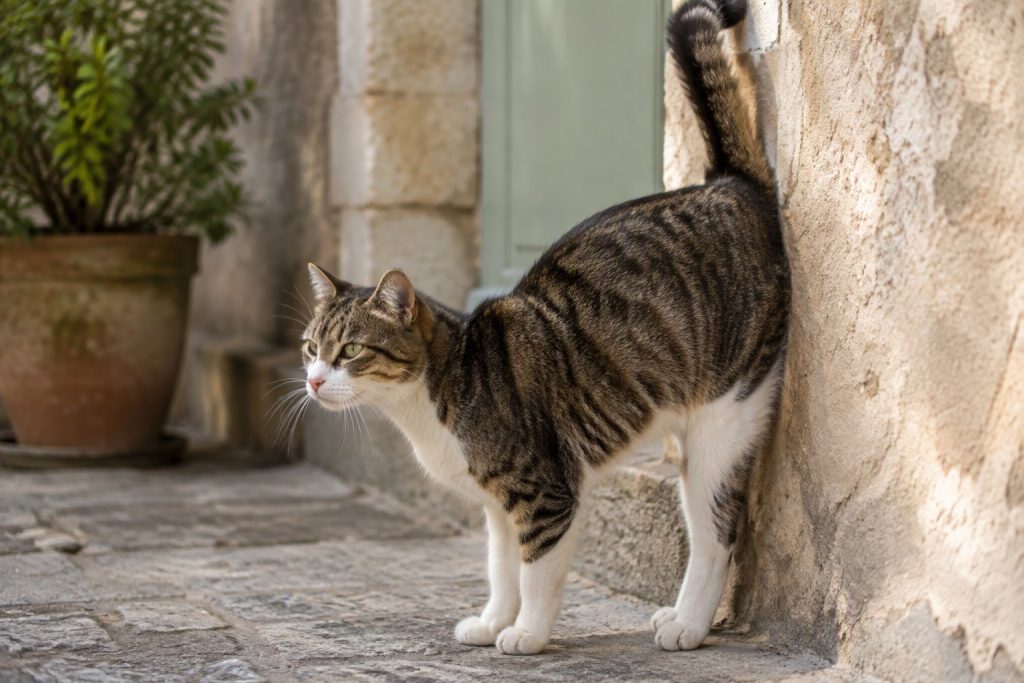
Spraying is different from ordinary urinating, and the difference matters: a spraying cat stands, holds its tail up and quivering, and directs a small amount of urine backwards onto a vertical surface. A cat that squats and produces a normal volume on a flat surface is doing something else. Spraying is a marking behaviour, and it is driven by territory, stress or, in a meaningful share of cases, a medical problem. Because the causes range so widely, and because urinary disease in cats can escalate quickly, a vet check comes before any behaviour plan rather than after it.
- Spraying is marking on vertical surfaces; squatting to urinate is a different behaviour.
- Common triggers are other cats, a new animal in the house, stress and changes in territory.
- Urinary and hormonal problems can cause or worsen it, so a vet should be involved.
- Never punish a spraying cat; it raises stress and tends to make the marking worse.
How do I know if my cat is spraying or just urinating?
The posture is the clearest difference. A spraying cat stands upright, often on tiptoe, with the tail raised and usually quivering, and the urine is directed backwards onto a vertical surface such as a wall, a doorframe, a curtain or the side of furniture. The volume is often small, and the surface will show a line or a patch rather than a puddle. A cat that squats and leaves a normal puddle on the floor, a bed or a rug is urinating rather than spraying, even if it is doing it outside the box. The two overlap in cause sometimes, but they are different behaviours and they need different handling. Photograph or note the posture and the surface, because that detail is genuinely useful to a vet.

A cat tree built to give a cat height to climb, perch and watch from — height is…
Why is my cat spraying in the house?
Most commonly because of other cats. A new cat in the house, a neighbourhood cat visible through a window, or a change in the status between existing cats can all trigger marking, because spraying is how cats advertise presence and claim space. Stress from any source can do it too: a move, building work, a new baby, a rearranged room, or a change in routine. Intact cats spray far more often than neutered ones, and both males and females do it. Some cats spray on new objects brought into the house, particularly ones that smell strongly of somewhere else, such as a bag or a piece of second-hand furniture. In multi-cat homes, it is often a sign that the cats need more space and more resources, which is covered in fixing resource conflict.
Is spraying always a medical problem?
No, but medical causes are common enough that they should be ruled out first, particularly in a cat that has never sprayed before. Urinary tract disease, cystitis, bladder stones and kidney problems can all cause a cat to urinate in unusual places, and the posture can sometimes look like spraying. Hormonal conditions and, in intact cats, reproductive drives are also relevant. In older cats, arthritis can make getting into a litter box painful, which produces accidents that owners describe as spraying. Reviewing litter box placement is useful alongside that. None of these can be distinguished at home, and some become serious quickly. That is why a vet examination, and usually a urine sample, is the first step for any new marking behaviour, rather than assuming it is territorial.
What can I do about a cat spraying to mark territory?
Reduce the pressure the cat is responding to. If a cat outside is the trigger, block the view with frosted film, a blind or a curtain, and keep the cat away from the window at the times the visitor appears. If the household has multiple cats, add litter boxes, feeding stations, water bowls and resting places so no cat has to compete, and add vertical space so cats can avoid each other without conflict. Clean marked spots with an enzymatic cleaner, because ordinary detergent leaves scent cues behind. Scratching posts near the marked area can help, since scratching is also a marking behaviour and cats often choose it over spraying when the option is available. Calming measures and pheromone products may help some cats as a background support, but they are not a substitute for fixing the underlying pressure.

Multi-shape corrugated sheets let one board serve two postures, a flat section for forward stretching and an angled…
Does neutering stop spraying?
It often reduces it substantially, and it is the single most effective measure in intact cats, but it is not a guarantee. Neutering before the behaviour becomes established works best, which is one reason it is commonly recommended early. In a cat that has been spraying for a long time, the habit can persist after neutering because it has become learned as well as hormonal. Neutering also does not address spraying driven by other cats or by stress, which is a large share of cases in multi-cat homes. If the cat is already neutered and starts spraying, the cause is almost certainly environmental or medical rather than hormonal, and a vet visit is the sensible next step. Do not assume the behaviour is untreatable, because most cases improve once the cause is identified.
When does spraying need a vet visit?
See a vet for any new spraying, and promptly if it comes with straining, frequent trips to the litter box, blood in the urine, crying out, or licking at the rear. Those signs can indicate urinary disease, and in male cats a blockage is a life-threatening emergency that needs treatment the same day. Book an appointment also for a cat that is drinking more, losing weight, or behaving differently in other ways, because those point to a systemic cause. Bring a description of the posture, the surfaces involved, and when it started. If the cat is medically clear, that is when an environmental plan makes sense, and a vet can advise on whether a behaviour referral or a calming product is appropriate. Never give any medication or supplement for spraying without veterinary advice.
Frequently asked questions
- Will my cat spray if it is neutered? Neutered cats spray far less often, but it can still happen, usually because of other cats or stress in the home rather than hormones.
- Does spraying mean my cat is angry with me? No. Spraying is a marking behaviour driven by territory, stress or a medical problem. It is not a reaction to a person.
- Can a female cat spray? Yes. Females spray, particularly when intact or when stressed by other cats in the household.
- What is the best way to clean a sprayed wall? Use an enzymatic pet cleaner and let it work for the full time on the label. Avoid ammonia-based products, which smell like urine to a cat.
- Will a pheromone diffuser fix it? It may reduce stress for some cats, but it does not replace a vet check or environmental changes. Treat it as support, not a cure.


