

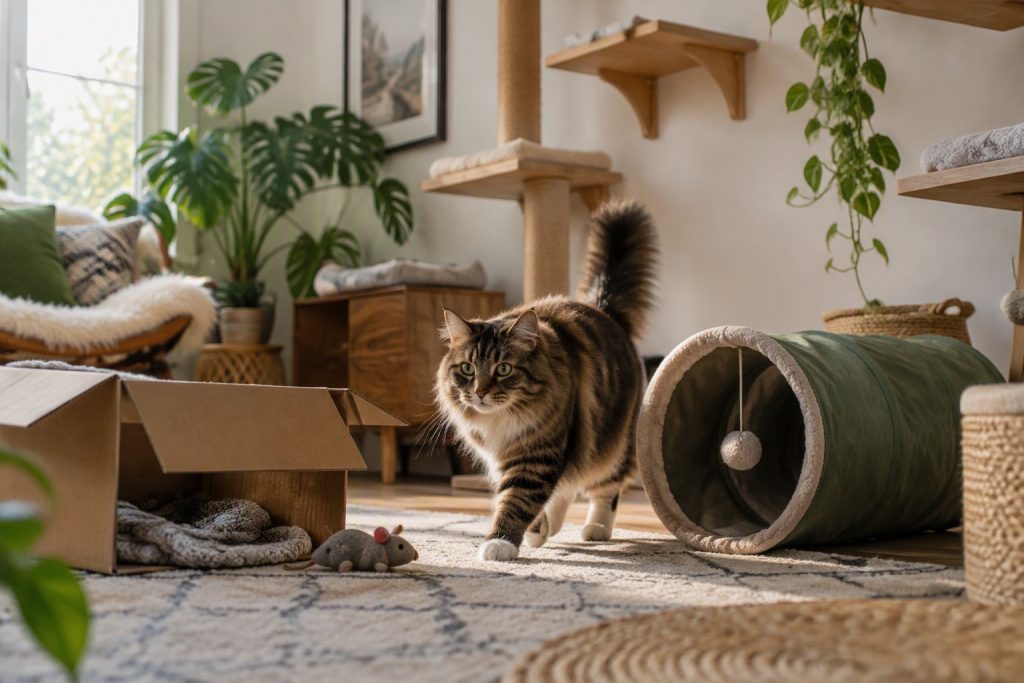
Indoor enrichment is not about buying more cat toys; it is about making sure a cat can do the things cats are built to do — climb, scratch, hide, hunt, watch and rest somewhere warm — without going outside. A cat that can do all six in its own home is generally a settled cat. A cat that can do none of them is a cat that will find its own outlets, usually on the curtains, the sofa or your ankles. The good news is that most of these are cheap, and several are changes to the layout of a room rather than purchases at all.
- Enrichment means giving a cat outlets for climbing, scratching, hiding, hunting, watching and resting.
- The highest-value changes are usually vertical space, a good scratching surface and a daily play routine.
- Rotating toys keeps them interesting, which matters more than owning many of them.
- Enrichment does not fix pain, illness or anxiety; those need a vet.
What does enrichment actually mean for an indoor cat?
It means giving the cat a home where its natural behaviours have somewhere to go. Cats are predators with a strong drive to stalk and catch, and they are also prey-sized animals with a strong drive to observe and hide. Both sides need an outlet. In practice, enrichment covers vertical space for climbing and perching, surfaces for scratching, places to hide, something to hunt in play, something to watch through a window, and warm, secure places to sleep. It is not a single product and it is not a one-off purchase. Think of it as the difference between a room a cat lives in and a room that is built around how a cat actually behaves. Most homes are somewhere in between, and moving them a few steps towards the second is what makes the difference.
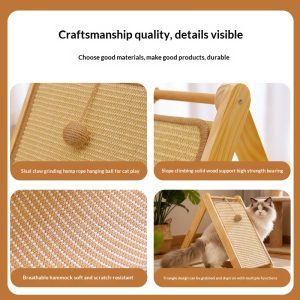
A cat tree built to give a cat height to climb, perch and watch from — height is…
What are the highest-value changes I can make?
Three changes deliver most of the benefit. First, vertical space: a tall, stable cat tree or a couple of shelves that let the cat get up and look down, which meets the climbing and perching need and reduces tension in multi-cat homes. Second, a scratching surface the cat actually wants to use, placed next to whatever it is currently scratching. Third, a daily interactive play routine, because hunting is the behaviour most indoor cats have no outlet for at all. If you only do three things, do those. After that, add a window perch, a couple of hiding spots, and something to think about such as a puzzle feeder. Together those cover the six needs, and none of them requires remodelling a room.
Do I need to buy a lot of equipment?
No, and buying a lot is often counterproductive. A cupboard full of toys does nothing, because a toy on the floor stops being interesting within minutes and a toy moved by a person stays interesting for years. What you need is a small set of good tools used well: a wand toy for interactive sessions, a sturdy scratcher, a tall climbing structure, and a puzzle feeder. Boxes, paper bags with the handles removed, and a cardboard tube are free and cats use them enthusiastically. The principle is novelty and interaction, not volume. Rotating a handful of toys weekly, so each disappears for a while and comes back, does more for a cat than owning twenty always available and therefore ignored. A single good wand toy used for ten minutes is worth more than a basket of untouched ones.
How do I make play sessions work?
Play properly, briefly and often. Move the toy like prey: let it hide behind furniture, dart across the floor, pause, then run. Let the cat stalk, chase and finally catch it, and end the session with that catch rather than with the toy vanishing, because a hunt that never concludes is frustrating rather than satisfying. Two sessions a day of five to ten minutes each is a realistic target, and the evening session should end with a meal so the cat completes the natural hunt-eat-groom-sleep sequence. Stop while the cat is still interested, because that keeps the game worth coming back to. If your cat will not engage at all, try a different toy and time of day, and consider whether the cat is unwell. A cat that used to play and has stopped may be in pain.
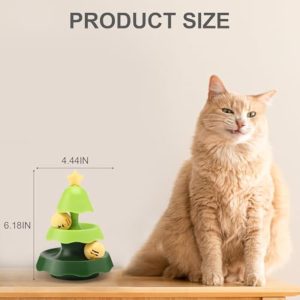
This rolling toy rolls and moves the way a cat's prey does — movement is the whole point.…
How does enrichment help with behaviour problems?
A large share of indoor cat behaviour problems are really under-stimulation problems. Curtain climbing, furniture scratching, ankle ambushing, evening vocalising, knocking objects off surfaces and night zoomies all become less frequent when the cat has more to do. It is not a magic fix for everything: anxiety, pain, over-grooming and house-soiling need a vet, and enrichment will not resolve a medical problem. But for the general restlessness that owners describe as the cat being difficult, enrichment is usually the answer. The way to tell the difference is to add enrichment consistently for two weeks and see what changes. If the behaviour improves, it was under-stimulation. If it does not, or if the cat also has other signs, that is a reason to involve a vet rather than to buy more toys.
How do I know if my cat has enough?
Look at the cat rather than the equipment. Signs of a well-enriched cat include settling after play, sleeping in a variety of places, using its scratcher, spending time watching from height, and not being destructive at predictable times of day. Signs that more is needed include repetitive behaviour at the same hour each day, pacing, over-grooming, meowing at you in the evening, and a cat that follows you constantly with nothing to do. It also helps to test the cat’s day: if the house is empty for eight hours, what is actually available to the cat during that time? A window, a perch and a puzzle feeder cover a lot of that gap. For the wider set of options, see the value of a window perch and puzzle feeders for beginners.
Frequently asked questions
- Can a cat be happy indoors only? Yes. Indoor cats live longer on average, and what they need is enrichment that replaces what the outdoors would have provided.
- How much play does an indoor cat need daily? Two short interactive sessions a day is a reasonable baseline, with more for young cats and less for seniors.
- Do I need a catio or can I use a harness? Neither is essential. Both can help, but a well-enriched indoor home meets the same needs. Harness training suits some cats and not others.
- What is the cheapest enrichment? Boxes, a window, a paper bag, and time spent moving a wand toy. The last one is the most valuable and costs nothing.
- My cat has lots of toys and is still destructive. Why? Because toys alone are not enrichment. Interaction, height and a scratching surface usually matter more than the number of toys.


