

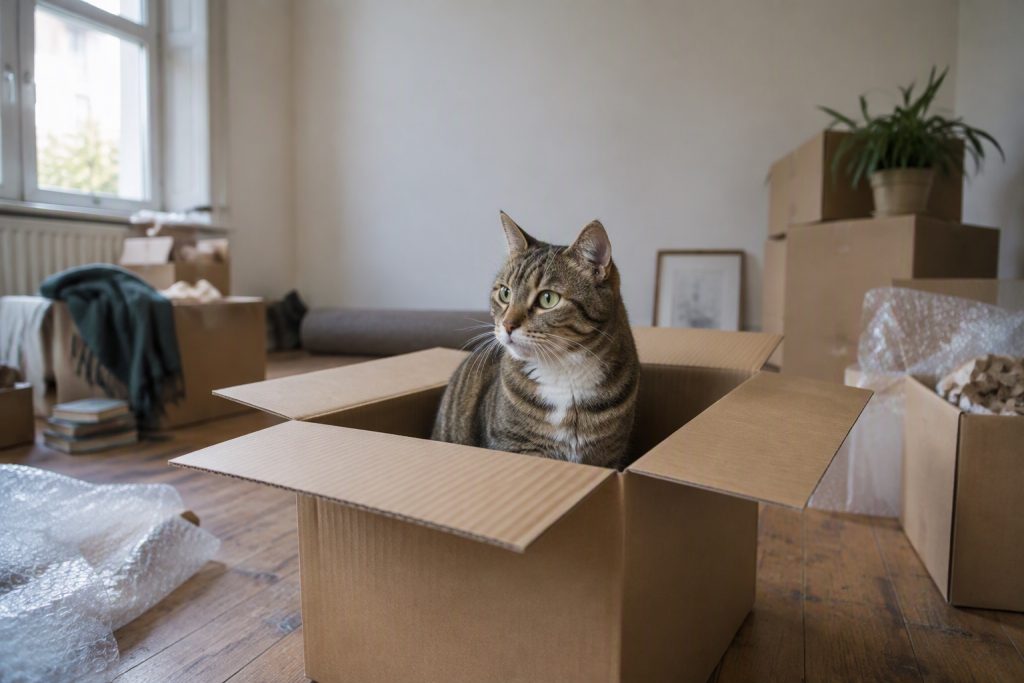
Moving house is one of the most stressful things that happens to an indoor cat, and the stress is not only about the new place. It is about the loss of familiar scent, the disruption of routine, the noise and the boxes, and the fact that a cat’s sense of safety depends heavily on knowing its territory. Cats cope with this far better when the move is planned around them rather than fitted in around the furniture. The main principles are simple: keep the cat out of the chaos, move its familiar things first, and reintroduce the cat to the new home one room at a time.
- Cats cope better when they are kept out of the moving process entirely.
- Move familiar items — bedding, bowls, litter box, scratcher — before or with the cat.
- Set up one room first and keep the cat there while the rest of the house is unpacked.
- A cat that stops eating or hides continuously after a move should be checked by a vet.
How do I prepare my cat for a move?
Start a week or two before, and start with scent. Cats rely on familiar smell to feel secure, so do not wash the bedding, blankets or cat beds in the run-up to the move. If you are using a new carrier, introduce it early and leave it out. Pack gradually rather than in one frantic day, because a house that empties slowly is less alarming than one that changes overnight. Keep the cat’s routine as normal as possible: same feeding times, same play sessions, same litter box position, even when the room around it is full of boxes. If you know the new home, take something that smells of the cat there in advance, or bring back an item that smells of the new place for the cat to investigate. Familiar objects in both directions help the transition.

Round furry plush bed with cat ears on the rim. Made from velvet. Made for everyday resting. Gives…
What should I do on moving day?
Keep the cat out of it entirely. The best arrangement is a single closed room with the door shut, containing food, water, a litter box, a bed and something familiar, so the cat is away from the doorways, the lifting and the noise. If the move takes more than a day, consider a friend’s spare room for the cat rather than a house in upheaval. Put the cat in its carrier only when the route to the car is clear, and move it last rather than first, so the new home has a settled room waiting. Label the cat’s box and keep it with you rather than in the van, because a cat in a hot vehicle is a serious risk. On arrival, take the cat straight to its prepared room.
How do I settle a cat into a new home?
Give the cat one room first, with everything it needs, and keep it there for a few days. This is not a punishment; it is a way of letting the cat build a secure base in manageable stages. Put the litter box, food, water and bed in the same room, spaced out, and spend quiet time there without forcing interaction. Once the cat is eating, using the litter box and coming out to explore that room confidently, open the door and let it explore further at its own pace. Keep the rest of the house quiet for the first few days and avoid having visitors. Do not carry the cat around the new house to show it the rooms, because that removes its control. Let it map the space on its own, and keep the layout consistent once it does.
How long does it take a cat to adjust?
It varies a great deal. Some cats are exploring confidently within a few days, while others take several weeks to settle, and a few need longer than that. Kittens and confident, sociable cats usually adapt fastest, and cats that have moved several times before tend to cope better. Older cats, nervous cats and cats that have lived in one home for years often need the most time, and they benefit from the slowest introduction. The signs of settling are practical: eating normally, using the litter box reliably, grooming, sleeping in the open rather than under furniture, and showing interest in play. Progress is rarely a straight line, and a cat that seems fine for a few days and then hides again is having a normal wobble rather than going backwards.

Grey house-shaped bed with a cat. Made from mixed materials. Made for everyday resting. Gives a cat a…
What if my cat hides for days?
Give it time and space, and keep the basics close. A cat that hides for a few days after a move is doing something normal, and dragging it out makes it worse. Put food, water and a litter box within reach of the hiding place so the cat does not have to choose between safety and basic needs, and sit quietly nearby without reaching for it. Keep the room dim and quiet, and avoid loud noises, new people and other animals for the first week. You can encourage the cat with a treat trail or a wand toy used gently at a distance. If the cat is eating and using the litter box, the hiding is usually temporary. If it is not eating at all, that is a different situation and needs veterinary advice.
When should I worry after a move?
Worry when the cat stops eating for more than a day, stops using the litter box, or shows signs of illness such as vomiting, diarrhoea, or laboured breathing. Those are reasons to contact a vet rather than wait. Also take seriously a cat still hiding continuously after a week or two, or one losing weight or over-grooming. Stress can trigger real physical problems in cats, including urinary issues, and a cat that has just moved is at higher risk for a period. If the cat seems physically well but is struggling to adapt, a vet can also advise on calming options, and a behaviour professional can help with a plan. Do not give any calming supplement or remedy without asking a vet first. Litter box placement and carrier training both help make the next transition easier.
Frequently asked questions
- Should I move the cat or leave it with someone? For a long or chaotic move, leaving the cat in a quiet familiar place and moving it afterwards is often kinder than having it in the middle of everything.
- Should I wash the cat’s bedding before the move? No. Familiar scent is what helps the cat feel secure. Wash it after the cat has settled, not before.
- Can I let my cat outside after a move? Keep an indoor cat indoors. If your cat normally goes out, wait at least a few weeks before letting it out, and only in a controlled way.
- Will my cat forget me after a move? No. Cats recognise familiar people, and the bond usually strengthens during a stressful transition rather than weakening.
- Do pheromone diffusers help after a move? Some owners find them useful as background support. They are not a substitute for a quiet room and a steady routine.


