

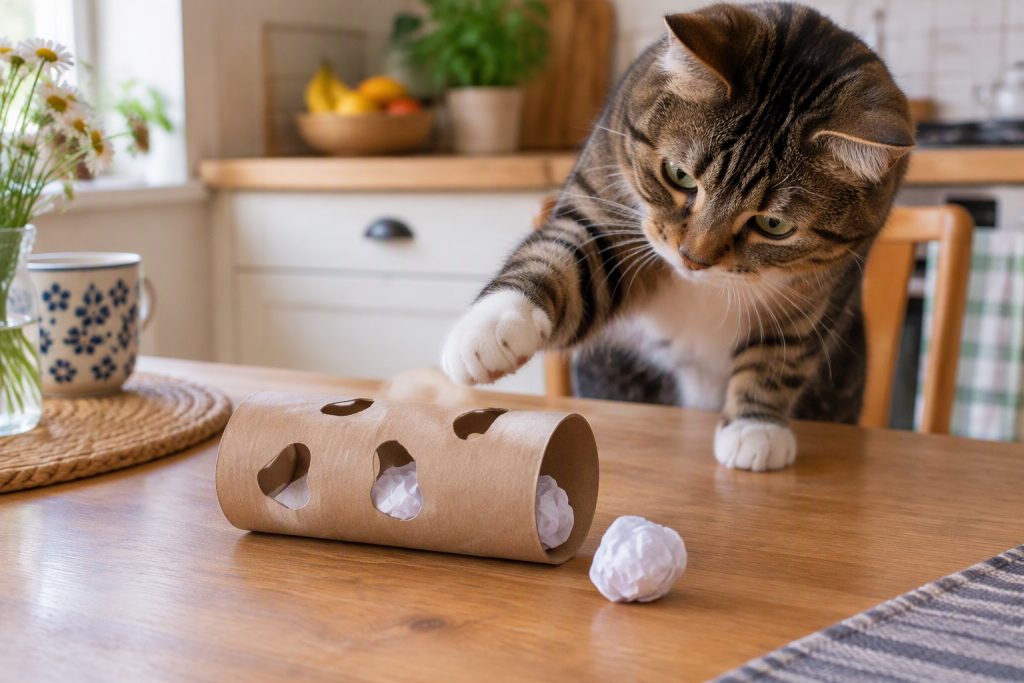
Good enrichment does not require spending money, and some of the most effective things you can give a cat are already in the house. A cardboard box, a paper bag with the handles cut off, a screwed-up ball of foil and a length of string on a stick cover most of what a cat needs. The principle is not the object but the behaviour it allows: something to hide in, something to chase, something to solve. Homemade enrichment also has an advantage over bought toys, because you can adapt it to what your particular cat actually responds to, and replace it for nothing when it wears out.
- The best DIY enrichment lets a cat hide, chase, climb or solve something.
- Cardboard boxes, paper bags and homemade puzzle feeders cost nothing and work well.
- Cut handles off bags and remove staples, tape and string before giving anything to a cat.
- DIY enrichment does not replace interactive play or a vet visit when something is wrong.
What can I make for my cat tonight?
Start with a box. A plain cardboard box on its side is a hiding place, a launch pad and a bed, and most cats will use one within minutes. Cut a second hole in it and it becomes a tunnel and an ambush point. A paper bag laid flat on the floor with the handles cut off is a free hiding spot and makes a satisfying rustling noise. A crumpled ball of foil rolled across the floor triggers the same chasing response as a bought ball. A length of string on a stick dragged across the floor becomes a wand toy. None of these takes more than a couple of minutes to prepare, and all of them use the same instincts a bought toy does. See whether the cat is bored if the destruction is timed.
Bowl designed to give a cat a stable dish that does not slide — a dish that moves…
How do I make a simple puzzle feeder?
A muffin tin with a few tennis balls on top, or a shallow cardboard tray with cardboard dividers taped in, both work as entry-level puzzle feeders. Put a few pieces of dry food in the compartments and let the cat work out how to reach them. A plastic bottle with a few small holes cut in the side, filled with kibble and rolled along the floor, is another easy option, though it needs supervision because plastic can crack and splinter. A toilet roll tube with the ends folded over and a hole cut in the side works for a small handful of treats. The rule with all of them is that the food must be reachable with a bit of effort, not locked away. If your cat gives up, make the next version easier rather than trying to encourage it.
Are cardboard boxes and paper bags safe?
They are safe with a few sensible precautions. Remove all handles from bags, because a cat can get its head through a loop and panic. Remove staples, tape, plastic windows and any string, because those can be swallowed. Do not use bags that have held anything toxic, and avoid bags with strong ink smells. With boxes, remove any staples or packing tape and check for sharp edges. Do not use plastic bags at all, because they are a suffocation risk. A cardboard box will eventually be chewed and flattened, which is fine, and it should be replaced when it starts to fall apart. Supervise new items for the first few minutes, especially with a kitten, and take anything away that the cat starts eating rather than playing with.
How do I make a homemade wand toy?
A sturdy stick, a length of string and a small soft object tied to the end is all it takes. A feather, a strip of fabric, a crumpled paper ball or a soft toy all work as the lure. The attachment should be soft and light enough for the cat to catch and hold, and tied securely so it cannot come off and be swallowed. Avoid anything with small parts that can detach, and avoid elastic, which can snap back and injure a cat’s eye. Keep the string long enough to move the lure across the floor and behind furniture, because that is what makes the game feel like hunting. Store it out of reach when not in use, so the toy stays novel and the string does not become a chew toy. Replace frayed string promptly.
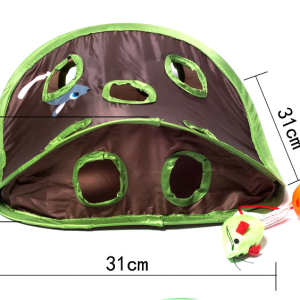
This rolling toy rolls and moves the way a cat's prey does — movement is the whole point.…
How do I build a cheap climbing or hiding spot?
You do not need a cat tree to give a cat height. Stacked sturdy boxes taped together make a serviceable climbing structure, as long as the base is wide and the stack cannot topple. A shelf cleared of breakables gives a cat a high perch, and a chair pulled up to a window achieves the same thing. For hiding, a box on its side in a corner, or a paper bag, is enough. If you want something that lasts, a second-hand piece of furniture with a blanket on top often becomes the cat’s favourite spot. The two rules are stability and position: a wobbly structure will be avoided, and a spot in a room the cat never uses will be ignored. Put the new structure where the cat already spends time, and it will be used.
How often should I change the enrichment?
Often enough to keep it interesting, but not so often that the cat never settles. A useful pattern is to rotate a small set of items weekly: put some away and bring others out, so that each one is novel when it reappears. Boxes can stay until they fall apart, because a familiar box in a familiar place is genuinely useful. Puzzle feeders should be swapped or made harder as the cat gets good at them, because a puzzle that has been solved stops being interesting. Wand toys should be stored away between sessions so they retain their value. If you notice the cat has stopped using something entirely, change it or move it rather than buying a replacement. Cats respond more to novelty and position than to price. See indoor enrichment for the wider set.
Frequently asked questions
- Do cats prefer bought toys or homemade ones? Many cats are just as happy with a box or a paper bag. What matters is movement, novelty and interaction, not the price.
- Is string safe for cats to play with? Only under supervision, and never left down. Swallowed string can cause serious internal damage, so put it away after each session.
- Can I use a laser pointer as DIY play? It provides chasing but never a catch, which frustrates some cats. End the game by resting the beam on a toy the cat can actually pounce on.
- My cat ignores everything I make. Why? Try a different type of play, a different time of day, and check that the item moves like prey. A static object rarely holds interest.
- How much enrichment does an indoor cat need? Enough to cover climbing, scratching, hiding, hunting and watching. Daily play is the part owners most often skip.


