The best interactive toys for indoor cats are the ones that mimic a hunt and need you, or the toy itself, to move unpredictably. The seven types worth owning are a wand teaser, a laser pointer, a treat puzzle, a treat-dispensing ball, a motion-activated toy, a kicker or catnip toy, and a track or crinkle toy. Variety matters more than any single purchase.
- Wand toys are the gold standard for hands-on play.
- Puzzle feeders turn meals into a hunt.
- Motion toys cover the hours you are away.
- Rotate toys weekly so they stay novel.
What makes a toy genuinely interactive for a cat?
A toy is interactive when it responds to your cat — or when it moves in a way that triggers her hunting sequence of stalk, chase, pounce, and catch. That means unpredictability, not constant motion. A toy that zips around on a fixed pattern becomes predictable within minutes, and a predictable toy is a boring toy. The best options let you control the pace, so you can make the “prey” hide, dart, and pause, which is what keeps a cat engaged. Materials matter too: feathers, crinkle, and soft plush appeal to different cats, so offering a mix is smart. The seven categories below cover the main ways to deliver that experience. You do not need all seven at once, but owning two or three types gives you options when interest fades. Start with a wand and a puzzle, then add a self-moving toy if your cat spends long hours alone.
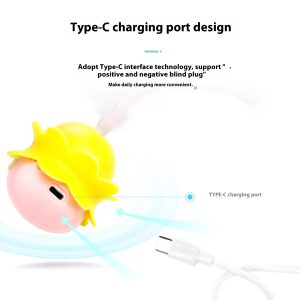
Rotating Self-Hi Relieving Stuffy Cat Teaser Feather Pet Toy. Part of the KiKi Meow Cat Toys collection for…
Why is a wand toy the best starting point?
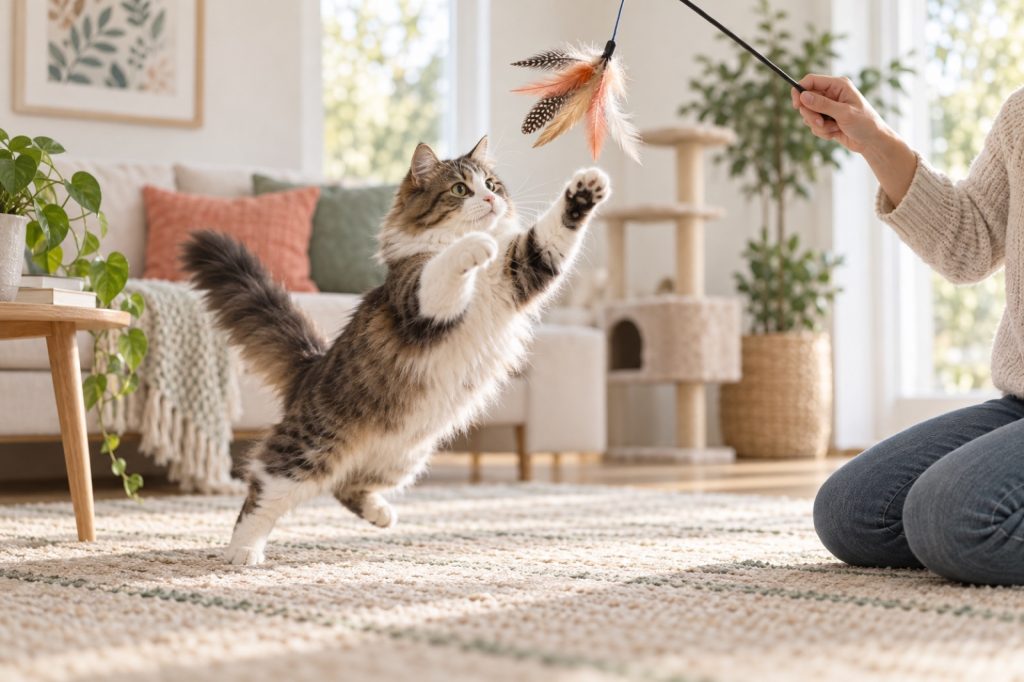
A wand with a feather, ribbon, or fabric attachment is the closest thing to real prey and the most reliable way to tire a cat out. You control it, so you can make it move like a bird or a mouse — fast dashes, sudden freezes, and slow, tantalising crawls. That control is what lets you run a full hunt that ends in a catch, which is the part that satisfies your cat. Wands also keep your hands at a safe distance, so play stays off your skin. Use one for ten to fifteen minutes, let her win a few times, then put it away rather than leaving it out. For a full picture of daily play, see our guide to how much play an indoor cat needs. Keep the wand stored out of reach between sessions so it stays special rather than becoming furniture.
How do puzzle feeders fit in?
Puzzle feeders are interactive in a different way: they make your cat work for food, which uses her brain and her paws. A ball that releases kibble as it rolls, or a tray with sliding compartments, turns a two-minute meal into ten minutes of problem-solving. That mental effort tires a cat in a way pure running does not, and it is perfect for the hours when you cannot play. Start easy so she learns the reward is there, then choose a harder design as she gets faster. Watch for frustration, though — if she gives up, make it simpler again. Puzzles work best alongside active play, not instead of it, and our guide to puzzle feeders explains how to introduce one smoothly. Start with a shallow tray and only a few treats so the win comes quickly and keeps her motivated.
Are self-moving toys worth it for cats left alone?
Yes, for many cats, provided you choose one that starts and stops rather than running continuously. A motion-activated toy that springs to life when your cat approaches, or one on a timed cycle, gives her something to chase while you are out and keeps the house from feeling dead. The trap is the fixed pattern: if the toy repeats the same path every time, your cat will lose interest within days, so pick one with some randomness or swap it out regularly. These toys are also useful overnight, when a restless cat might otherwise target your ankles. Pair one with a puzzle feeder for a full day of engagement. A self-moving toy is not a replacement for your hands-on play, but it fills the gaps. Choose one with a timer or motion sensor so it is not running all day and wearing out its welcome.
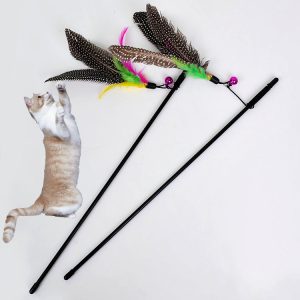
Pearl Bird Cat Teaser Feather Pet Toy Bell Cat Playing Rod. Part of the KiKi Meow Cat Toys…
How do I rotate toys so my cat stays interested?
Novelty is the whole game. Keep out only three or four toys at a time, and store the rest out of sight. Every week or so, swap the out-of-sight ones back in and retire the current set. Because cats lose interest in what is always available and regain it for what has been gone, rotation makes a small collection feel endless. Wash soft toys and refresh catnip every few weeks, since scent fades and a flat-smelling toy is dull. For wands, change the attachment rather than buying a whole new wand. If you have a catnip or silvervine kicker, store it in a sealed bag between turns so the scent stays strong. A simple labelled box makes the rotation easy to maintain. Rotate on the same day each week so it becomes a habit you do not have to remember, and your cat gets a fresh set without you buying anything new.
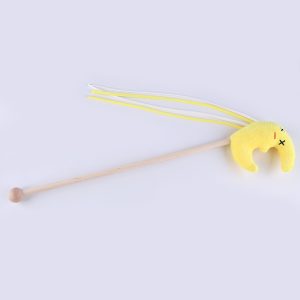
Cat Feather Bell Mouse Toy Cat Feather Bell Mouse Toy Cat Feather Bell Mouse Toy. Part of the…
How much play should an indoor cat get each day?
Aim for two or three interactive sessions a day, each ten to fifteen minutes, with at least one in the evening. Indoor cats have no hunting to do, so play is how they burn physical and mental energy, and a shortfall shows up as night-time ankle attacks, furniture scratching, or low-level stress. Build the sessions around her natural peaks, which are early morning and dusk. End each one with a catch and a small reward, then feed her, so the sequence feels complete. A tired, satisfied cat is a calmer cat. If your cat is ambushing your feet after dark, our guide to ankle biting at night shows how play and feeding fix it. The evening session is the one that most changes a cat’s night-time behaviour, so do not skip it.
Frequently asked questions
- What is the single best interactive toy? A wand teaser with a feather or ribbon attachment, because you control it and it mimics prey.
- Are laser pointers good for cats? They start a chase well, but always finish with a physical toy she can catch so she is not left frustrated. Never shine it in her eyes, and avoid ending the game with the dot simply vanishing.
- Do cats get bored of the same toy? Yes. Rotate toys weekly and refresh catnip to keep them feeling new.
- Can toys replace playtime with me? No. Self-moving toys fill gaps, but hands-on wand play is what truly satisfies a cat. Plan at least one session a day where you are the one moving the toy.
- How many toys should I keep out? Three or four at a time, with the rest stored away for rotation. Swap the set weekly, and store the spares somewhere she cannot raid.