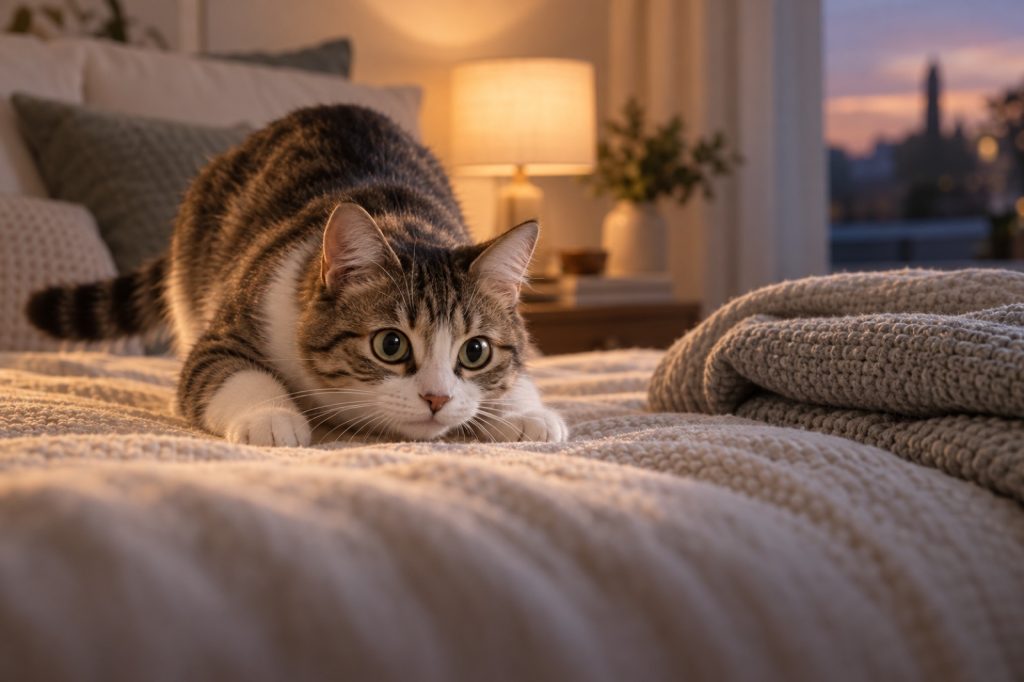
Ankle-biting at night usually means your cat is bored, under-stimulated, and full of energy with no outlet. Indoor cats often sleep through the day and hit a hunting peak in the evening, so they stalk the most exciting moving thing available — you, under the duvet. The fix is a real play session before bed, plus food or puzzle work that closes the hunt.
- It is usually pent-up energy, not aggression.
- Cats have natural dawn-and-dusk hunting peaks.
- A long wand-toy session before bed drains it.
- Feed or puzzle-feed after play to close the hunt.
Why does my cat attack my ankles at night?
Cats are crepuscular, which means their natural hunting drive peaks around dawn and dusk. An indoor cat with a full food bowl and a quiet day often sleeps for most of it, banking energy that has nowhere to go. When the house settles and you get into bed, movement under the covers looks exactly like prey. Your feet twitch, the duvet shifts, and her hunting sequence switches on. This is why the behaviour often starts the moment the lights go out and you are still. It is not that she is suddenly aggressive; it is that her body expects a hunt at this hour and you are the only game in town. Understanding the timing is half the solution. The other half is giving her a hunt that ends properly, so the drive is satisfied rather than just interrupted. A cat who naps from ten in the morning until eight at night has banked a full day’s energy for exactly this moment.

Rotating Self-Hi Relieving Stuffy Cat Teaser Feather Pet Toy. Part of the KiKi Meow Cat Toys collection for…
Is this aggression or just play?
It is almost always play, but the two look similar and can blur. Play biting comes with a loose body, flattened ears that flick, a tail that lashes in excitement, and repeated pouncing rather than a single strike. Real aggression is stiff, silent, and often comes with hissing, a puffed tail, or a direct stare. The distinction matters because the responses differ. Play behaviour needs an outlet and redirection; genuine aggression needs a vet check and a careful look at stress, pain, or territory. If your cat ambushes your ankles, then bounces away and waits for you to react, that is a hunting game she wants you to play. The trick is to move that game onto a toy and away from your skin. A wand toy gives her the same stalk-and-pounce thrill while keeping your feet out of the equation entirely.
How much play does she actually need?
Most indoor cats need two or three proper play sessions a day, each lasting ten to fifteen minutes, and the evening session is the one that changes night behaviour. A good session mimics a hunt: move a wand toy like prey, let her stalk, pounce, catch, and finally win. That win matters, because a hunt that never ends leaves a cat frustrated and more likely to target your ankles later. Rotate your toys so the same wand does not become boring. Our guide to how much play an indoor cat needs breaks down the daily total. A cat who is genuinely tired out at bedtime is far less interested in your feet. If ten minutes is not enough, extend the session until she walks away or lies down, which is her signal that the hunt is over.
How do I build a bedtime routine that works?
Copy the natural sequence: hunt, catch, eat, groom, sleep. About thirty to forty minutes before you go to bed, run a vigorous wand-toy session until she is panting or losing interest. Then serve a meal or a substantial snack, because eating after a hunt signals that the day’s work is done. A puzzle feeder that makes her work for the food extends the sequence and buys you more quiet time. After that, most cats groom and settle. Keep the routine at the same time every night, because predictability is what teaches her that night means sleep. If you skip the play but still feed her, you have the meal without the hunt, and the energy stays bottled up. The order matters as much as the routine itself, so keep the sequence the same every night.
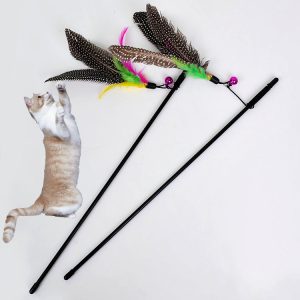
Pearl Bird Cat Teaser Feather Pet Toy Bell Cat Playing Rod. Part of the KiKi Meow Cat Toys…
Do puzzle feeders help with night energy?
They help in two ways. First, they turn a fast meal into a slow, engaging task, which uses mental energy as well as physical. Second, they give your cat something to do in the early hours that is not your ankles. A puzzle feeder left out overnight can absorb the dawn energy peak that would otherwise land on your feet. Start with an easy design and let her learn, then increase the difficulty as she gets quicker. Combine it with the pre-bed play session for the best effect. If you are new to them, our guide to puzzle feeders for cats covers how to introduce one without frustrating her into giving up. A feeder she can solve in ten minutes is better than one she abandons after two.
What should I NOT do when she bites?
Do not play with your hands or feet, ever, not even as a kitten. It teaches her that skin is a toy, and that lesson is hard to unlearn. Do not yank your foot away quickly, because that triggers the chase instinct and makes the game more exciting. Do not shout or punish, because that adds stress without teaching an alternative. Instead, go completely still and boring until she loses interest, then redirect her to a wand toy. If she bites during a play session, end the session calmly for a minute, then resume with the toy. If the biting is sudden and intense, or comes with other behaviour changes, have your vet check for pain or illness, since discomfort can lower a cat’s tolerance. A cat who was never a biter and suddenly is deserves a closer look.
Frequently asked questions
- Why does my cat bite my feet only at night? Her hunting drive peaks at dusk, and feet under a duvet look like prey. An evening play session and a late meal usually shift it within a week.
- Is it a sign she is angry with me? No. It is play behaviour driven by energy and boredom, not spite. Look at her body language: a loose, bouncy cat is playing, while a stiff, silent one is not.
- Will a laser pointer help? It can start the chase, but always finish with a physical toy she can catch, or she stays frustrated.
- How long before the routine works? Most cats settle within one to two weeks of consistent evening play and a post-play meal. Keep the timing steady, because cats learn the pattern quickly when it repeats.
- Should I lock her out of the bedroom? That is a last resort. Try play and feeding first, since it addresses the cause. If you do close the door, leave her a warm bed, water, and a puzzle feeder outside it.