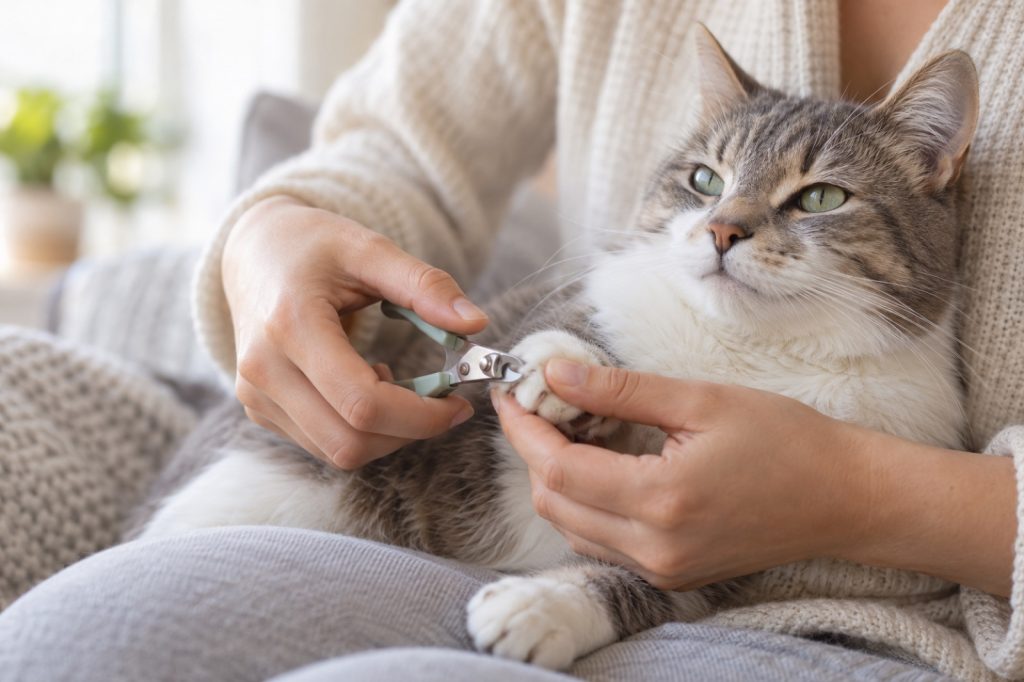
Most indoor cats need their claws trimmed every two to four weeks. Indoor cats do not wear their claws down the way outdoor cats do, so the outer sheath builds up and the nails grow long, snaggy, and uncomfortable for both of you. Start slowly, trim only the clear tip, and reward generously so the routine stays calm.
- Trim every two to four weeks for most indoor cats.
- Trim only the clear tip — never the pink quick.
- Start with one paw and build up over several days.
- Get help or see a groomer if she panics.
How often do indoor cats really need a trim?
Every two to four weeks is the practical range for most indoor cats, though it varies with the individual. A cat who scratches a lot on a good post may wear her claws down more slowly and need trimming less often. A cat who barely scratches, or an older cat who moves less, may need it closer to every two weeks. The best way to decide is to check the claws themselves rather than the calendar. Look for tips that curve sharply or catch on fabric, and press gently on a toe pad to extend a claw. If the tip feels sharp and hooks on a towel, it is time. If the nails are already snagging on carpets or your clothes, you have waited a little too long. A two-week check takes seconds and saves you from a much harder job later.
Nail scissors, bath brush, de-shedding glove and a drying towel — the full groom in one box.
Why do indoor cats need it more than outdoor cats?
Claws grow continuously, and in the wild a cat wears them down by climbing, walking on rough ground, and scratching trees. An indoor cat walks on soft carpet and flooring, which does very little to blunt a claw. She also sheds the outer sheath when she scratches, and if she has no suitable surface, that sheath stays on and the nail thickens and curls. Over time, a long claw can curve back into the paw pad, which is painful and can cause infection. Long claws also snag on upholstery and rugs, which is both a hazard for the cat and a source of damage at home. Regular trimming is not cosmetic; it is basic foot care that keeps her comfortable and your furniture intact. It also makes the nail easier to see and cut next time, because the quick recedes as the nail is shortened.
How do I find the quick and avoid cutting it?
The quick is the pink core that contains blood vessels and nerves, and cutting into it hurts and bleeds. On a cat with light-coloured nails, hold the paw up to a light and the quick is usually visible as a pink line running into the clear tip. On dark nails you cannot see it, so trim in small slices and stop when you see a grey or pink oval appear in the cut surface — that is the edge of the quick. Never cut in one big snip. Have styptic powder or cornflour ready in case you nick it. If you are unsure, take off only the sharpest point and leave the rest for next time. Our guide to scissor versus guillotine clippers explains which tool gives you the most control. If you are nervous, trim just the very tip the first few times until you build confidence.
What clippers should I use?
Use a sharp pair made for cats, not human nail clippers, which can split the nail. Scissor-style clippers give you a clear view of the tip, which helps on dark nails, while guillotine-style clippers are quick and simple on light nails. Whichever you choose, the blade must be sharp; a dull blade crushes the nail instead of cutting it, which is uncomfortable and makes the nail more likely to split. Keep the tool clean and replace it when it starts to drag. Trim a little at a time and check the cut surface before continuing. A calm, unhurried approach matters more than the exact model, so buy something comfortable in your hand and keep it in a predictable place. Replace it as soon as it starts to drag, because a blunt blade makes the job harder for both of you.

Cat Spray Comb Stainless Steel Pet One-click Hair Removal Brush. Part of the KiKi Meow Cat Grooming collection…
What about older cats and long-haired cats?
Older cats often need more frequent trimming, not less. Arthritis can make scratching uncomfortable, so they stop maintaining their claws, and the nails thicken and curl. A senior cat may also have reduced mobility, so a claw can grow into the pad without anyone noticing until it causes pain. Check her claws every two weeks. Long-haired cats have an extra issue: their claws can snag in their own coat, especially around the paws and belly, causing tangles and mats. Keeping the claws smooth reduces snagging, and pairing that with regular grooming keeps the coat healthy. Our guide to stopping matting in a long-haired cat covers the grooming side. If a claw has grown into the pad, see your vet rather than cutting it yourself. It is painful and may need treatment, and a vet can also show you how to prevent it happening again.
How do I trim a cat who hates being handled?
Go slowly and split the job. Start by handling her paws for a few seconds a day, without clipping anything, and reward her each time. Once she tolerates that, trim one claw, then stop and reward. Build up over several days rather than forcing all eighteen claws in one sitting. Choose a quiet moment when she is relaxed or drowsy, and wrap her gently in a towel if she wriggles, leaving one paw out at a time. Never hold her down or shout, because that teaches her to fear the clippers. If she panics, stop and try again later. For a cat who truly will not tolerate it, a vet or groomer can trim them safely, and it is not worth a battle that damages trust. A short appointment every few weeks is far better than a daily struggle at home.
Frequently asked questions
- How often should I trim my cat’s claws? Every two to four weeks for most indoor cats, checked by looking at the claws rather than the calendar. Check weekly by extending a claw, and trim when the tip feels sharp.
- What happens if I never trim them? They thicken, curl, and can grow into the paw pad, causing pain and infection.
- Can I use human nail clippers? No. Use sharp cat clippers, which cut cleanly instead of splitting the nail.
- I cut the quick — what now? Press styptic powder or cornflour onto it and keep pressure on until it stops bleeding. It looks alarming but usually settles within a minute or two.
- My cat hates it. Can I skip trimming? A vet or groomer can do it. Untrimmed claws risk snagging and growing into the pad, so do not let it slide.