

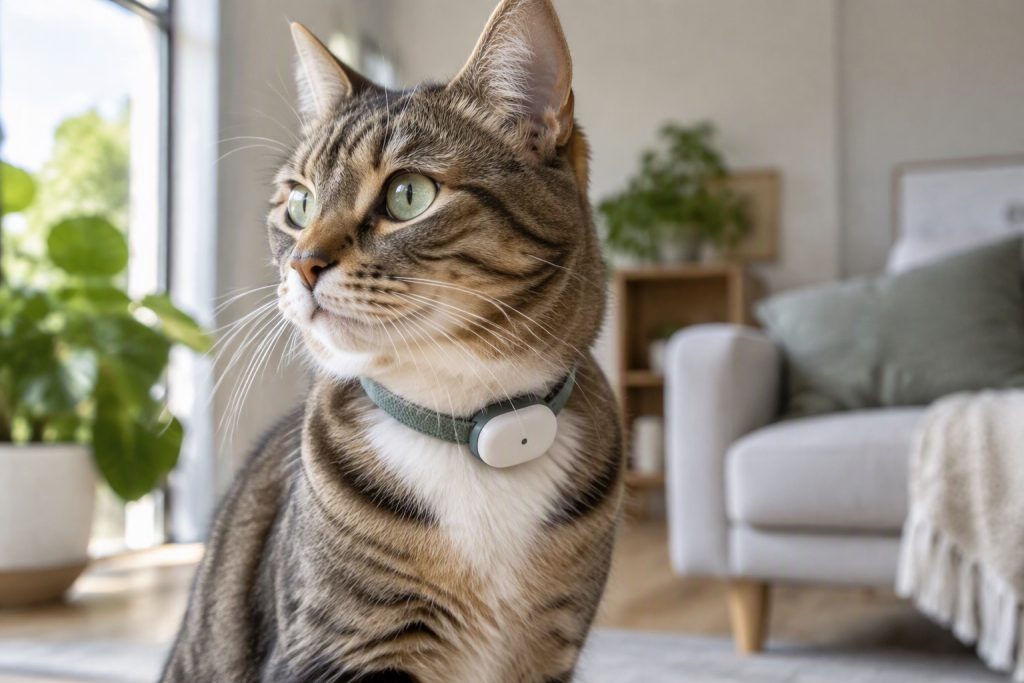
The best cat activity tracker is one your cat will actually wear and that gives you data you will use: daily steps or activity minutes, rest patterns, and a trend over time. Cats are harder to fit than dogs, so collar comfort, weight, and battery life matter more than a long feature list. For most indoor cats, a light collar-mounted tracker with a good app and a week or more of battery life is the sweet spot. If your cat refuses a collar, a motion-triggered camera is a better fit than a tracker she will not wear.
- Pick light, comfortable, and secure over feature-heavy.
- Look for activity minutes, rest, and trend history.
- Battery life of a week or more saves daily hassle.
- A camera suits cats who refuse collars.
What should a cat activity tracker actually measure?
Useful trackers measure three things well: activity, rest, and time. Activity is usually counted as steps or active minutes, and the number itself matters less than the pattern, because every cat has her own baseline. A cat who normally logs three hundred active minutes a day and drops to one hundred is a real signal; a cat who has always been a napper is not suddenly ill because her number looks low next to someone else’s cat. Rest and sleep tracking is where trackers earn their keep, because changes in sleep are often the first sign of pain, stress, or illness in cats. Time stamps matter too, since a cat who is restless at 3 a.m. but calm by day is showing a specific pattern. Look for an app that shows trends over weeks, not just today’s number, so you can compare against her own normal.

Rainbow-striped plush cylinder. Keeps a bored indoor cat busy and burns off restless energy. Made from fleece and…
What makes a tracker comfortable for a cat?
Weight is the first consideration. Cats are small and their necks are delicate, so a tracker that feels heavy or bulky will be rejected or, worse, become a hazard. Look for something light, with a low profile that sits flat against the collar rather than dangling. The attachment matters too: it should clip or slide on securely so it cannot be pawed off, but it must not catch on furniture or branches. Because cats climb and squeeze through tight spaces, a breakaway collar is essential, and the tracker should be compatible with one. Introduce it gradually, putting it on for short periods with treats and play so she associates it with good things, and check the fit often, since a collar that is right in winter can be tight once a cat grows a thicker coat. If she scratches at it constantly, it is too heavy or too loose.
Do indoor cats really need a tracker?
They can benefit more than outdoor cats, in a way, because indoor cats are the ones whose activity is hardest for us to judge. An indoor cat’s whole world is your home, and it is easy to miss a slow decline in movement that happens over months. A tracker turns that into a visible line on a graph, which is genuinely useful if your cat is a healthy weight one year and creeping upward the next. It is also helpful for older cats, because a drop in activity can be an early hint of arthritis, and for cats on a weight-loss plan, where you want evidence that the extra play is working. For the target of how much movement a house cat should get, see our guide on how much play an indoor cat needs. If your cat will not wear a collar, a camera that records motion clips is the practical alternative.
How do I choose between a tracker and a camera?
Choose based on what your cat will tolerate and what question you are asking. A collar tracker answers “how much did she move today, and how did she sleep?” and gives you numbers over time, which is ideal for weight management, senior monitoring, and spotting trends. A camera answers “what is she doing when I am not home?” and is better for cats who will not wear a collar, for multi-cat homes where you want to see who is eating, and for behaviour questions like night-time restlessness or conflict between cats. Many owners end up with both, but if you must pick one, start with tolerance: a tracker she wears every day beats a camera you forget to check. Whichever you choose, the point is consistency, because a single day of data tells you very little and a month of data tells you a great deal.
Made from cloth Key features 【Name】 : cat simulation animal sound shell toy[Fill]: No fill, 2 built-in BB…
How do I use the data without overreacting?
Treat the numbers as a personal baseline, not a score. Record two to three weeks of normal behaviour first, then watch for meaningful deviations from that baseline rather than day-to-day wobbles, which are usually just weather, mood, or a quiet afternoon. A sustained drop in activity of a week or more, a sudden change in sleep, or a pattern of restlessness at night are the kinds of trends worth acting on. Pair the data with simple at-home checks, such as weighing your cat regularly and running your hands over her body, because numbers and hands together give a much clearer picture than either alone. Our article on checking your cat’s weight at home shows how to track weight simply. If the data suggests something is wrong, it is a prompt to see your vet, not a diagnosis in itself.
What are common mistakes with cat trackers?
The biggest mistake is buying for features rather than fit, then finding the tracker in a drawer because the cat would not wear it. The second is comparing your cat to someone else’s; step counts vary enormously with breed, age, and temperament, so only her own history is meaningful. The third is trusting a single reading. A day of low activity during a heatwave or after a vaccination is normal, so look at the trend. The fourth is ignoring the collar itself: check the fit weekly, look for rubbing or hair loss under the tracker, and make sure the breakaway mechanism still releases properly. Finally, remember that a tracker cannot tell you why something changed, only that it did. Use it as an early-warning tool that sends you to your vet with a clear, factual story rather than a vague worry, and you will get the most from it.
Frequently asked questions
- Are activity trackers safe for cats? Yes, if they are light, low-profile, and fitted to a breakaway collar that releases under pressure.
- How many steps should a cat take a day? There is no universal number. Compare her to her own baseline rather than to other cats.
- Can a tracker tell if my cat is in pain? Not directly, but a sustained drop in activity or a change in sleep can be an early hint worth checking.
- What if my cat refuses to wear a collar? Use a motion-triggered camera instead, or build up collar tolerance slowly with treats.
- How long should the battery last? A week or more is ideal, so charging does not become a daily chore you abandon.





