

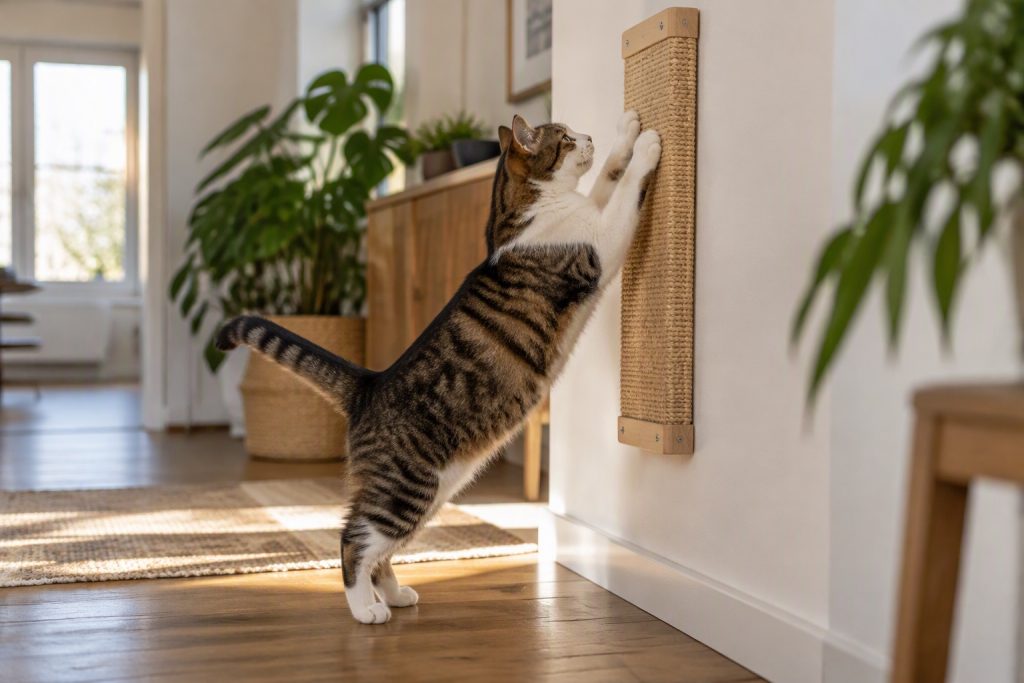
The best wall-mounted cat scratcher is one tall enough for your cat to stretch fully upright, stable enough not to wobble when she pulls, and fixed at a height where she naturally reaches. Look for a wall anchor that goes into a stud or uses proper masonry fixings, a sisal or cardboard surface she actually likes, and a mounting height that puts the scratching zone roughly level with her stretched shoulder. Stability matters more than appearance: a wobbly scratcher gets abandoned within days.
- Mount it tall enough for a full vertical stretch.
- Fix it into a stud or use proper wall anchors.
- Sisal rope and corrugated cardboard are the top surfaces.
- Any wobble means your cat will ignore it.
Why choose a wall-mounted scratcher over a post?
A wall-mounted scratcher solves the problem that defeats most freestanding posts: movement. A post on a small base rocks when a cat leans into it, and cats abandon anything that shifts under their claws. Fixed to a wall, the same surface becomes rock solid, which is exactly what a scratching cat wants. Wall mounting also frees up floor space, which matters in a small flat, and it lets you place scratching exactly where your cat already scratches, rather than where a piece of furniture happens to fit. Height is easier to get right too, since you choose the mounting point instead of accepting whatever a manufacturer built. If your cat has been working on a wall or a door frame, a wall-mounted scratcher placed directly over that spot is one of the most effective redirections available, as we explain in why cats scratch walls.
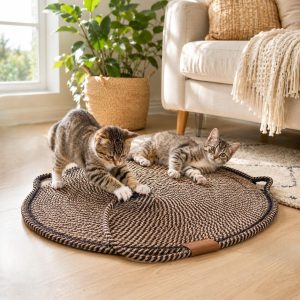
Woven cotton rope pad in an oval shape. Made from mixed materials. Made for scratching and stretching. Gives…
How tall should a wall-mounted scratcher be?
Tall enough for a full stretch. When a cat scratches, she typically stands on her hind legs, extends her forelegs overhead, and pulls downward, and the surface has to cover that whole reach. For an average adult cat that means a scratching surface of at least 50 to 60 centimetres, mounted so the top is above her fully stretched height. Cats also scratch horizontally while lying down, and some prefer a low, flat pad, so it is worth observing which posture yours uses before you buy. A short pad mounted at shoulder height will only ever catch part of the movement, and a cat who cannot complete the stretch may go back to the sofa. If you have a large breed, measure rather than estimate. Many wall scratchers can be mounted at any height, which is an advantage over fixed-height posts, so use that flexibility.
Which scratching surface is best?
Two surfaces dominate, and the right one depends on your cat. Sisal rope wrapped tightly around a core gives a rough, resistant texture that suits cats who like to dig in and pull hard, and it lasts well. Corrugated cardboard gives a softer, more crumbly surface that many cats prefer for horizontal scratching, and it is cheap to replace, though it sheds debris and wears out faster. Some cats prefer carpet, but carpet is a poor choice if you are trying to protect carpeted floors, because it teaches the wrong lesson. Wood and rope-wrapped timber appeal to a minority. If you are unsure, offer two surfaces side by side for a week and see which one collects the most claw marks. Our comparison of where to put a scratching post is worth reading next, because placement will decide whether the surface you choose gets used at all.
How do I mount a wall scratcher so it never moves?
Fixings decide everything. Find a stud with a stud finder and screw into it wherever possible, since a fixing into timber will hold far better than one into plasterboard alone. If no stud lines up with the position you want, use proper hollow-wall anchors rated for well above the weight of the scratcher plus the pull of a cat, and use two or more rather than one. For masonry or brick, use a masonry bit and wall plugs. Never rely on adhesive strips alone for a scratcher a cat will pull on. Check the mount again after the first week, because a cat’s repeated pull can loosen a fixing that felt tight at installation. If the scratcher still flexes, add a bracket or move it to a stud. A quick wobble test with your hand, pushing and pulling firmly, tells you whether it will survive a real scratching session.
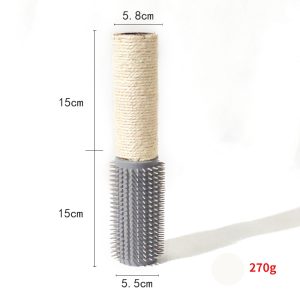
Sisal-wrapped post with a grooming brush base. Made from mixed materials. Made for scratching and stretching. Gives claws…
Where should I mount it?
Put it where your cat already scratches, not where it looks best. That usually means beside the sofa arm, near a door frame, at the end of a hallway she uses as a scratching route, or next to wherever she stretches when she wakes up. Cats scratch to mark territory, to shed old claw sheaths, and to stretch, and they tend to do it in socially important spots rather than hidden corners. Mount the scratcher at the same height as the damage it is meant to replace, so the cat’s existing habit carries over. If she scratches a wall corner, mount it on that corner. If you have multiple cats, mount more than one, because a single scratcher in a multi-cat home becomes a resource to guard. Avoid mounting above a radiator, beside a litter box, or anywhere she has to pass another cat to reach.
What if my cat ignores the wall scratcher?
First check stability, because a wobble is the most common reason for rejection. Then check height and surface: a pad mounted too low or in the wrong material will be ignored even if it is rock solid. Next, make it more appealing by playing with a wand toy around it and by rubbing a little catnip or silvervine onto the surface. You can also gently guide her paws onto it during a stretch, but never hold her there or force the movement, which teaches avoidance. Keep the scratcher in a spot she already uses rather than somewhere convenient for you. Finally, protect the original target in the meantime: cover the sofa corner or the wall she was using so the old habit has nowhere to land. Most cats adopt a well-placed, stable wall scratcher within a week or two once the alternatives are less rewarding.
Frequently asked questions
- Do wall-mounted scratchers work better than posts? They can, because they do not wobble, which is the main reason cats reject freestanding posts.
- How high should I mount a cat scratcher? Tall enough that your cat can stretch fully upright, usually with the top above her stretched height.
- Can I mount a scratcher on plasterboard? Yes, but use proper hollow-wall anchors and ideally fix into a stud.
- Is sisal or cardboard better? Sisal lasts longer and suits vertical pulling. Cardboard suits horizontal scratching and is cheap to replace.
- My cat still scratches the wall beside it. Why? The mount may be too low or unstable, or the surface may be the wrong type for her.





